Start to Finish
Every report on this site took the same route. A scanner found something malicious sitting on adversary infrastructure, I decided it was worth the time, I took it apart, and it came out the other end as a report with detection rules and machine-readable indicators that a defender can pick up and use the same day.
This page walks that route end to end at a high level. Each step links to the page that covers it properly, so you can read the whole shape first and then go deep on whatever you actually came for.
Two things are worth knowing before the walkthrough. I do this alone, so every design decision below is shaped by that constraint rather than by what a team would build. And the parts that need judgment stay with me: what is worth investigating, what the evidence actually shows, and whether a finished report is good enough to publish.
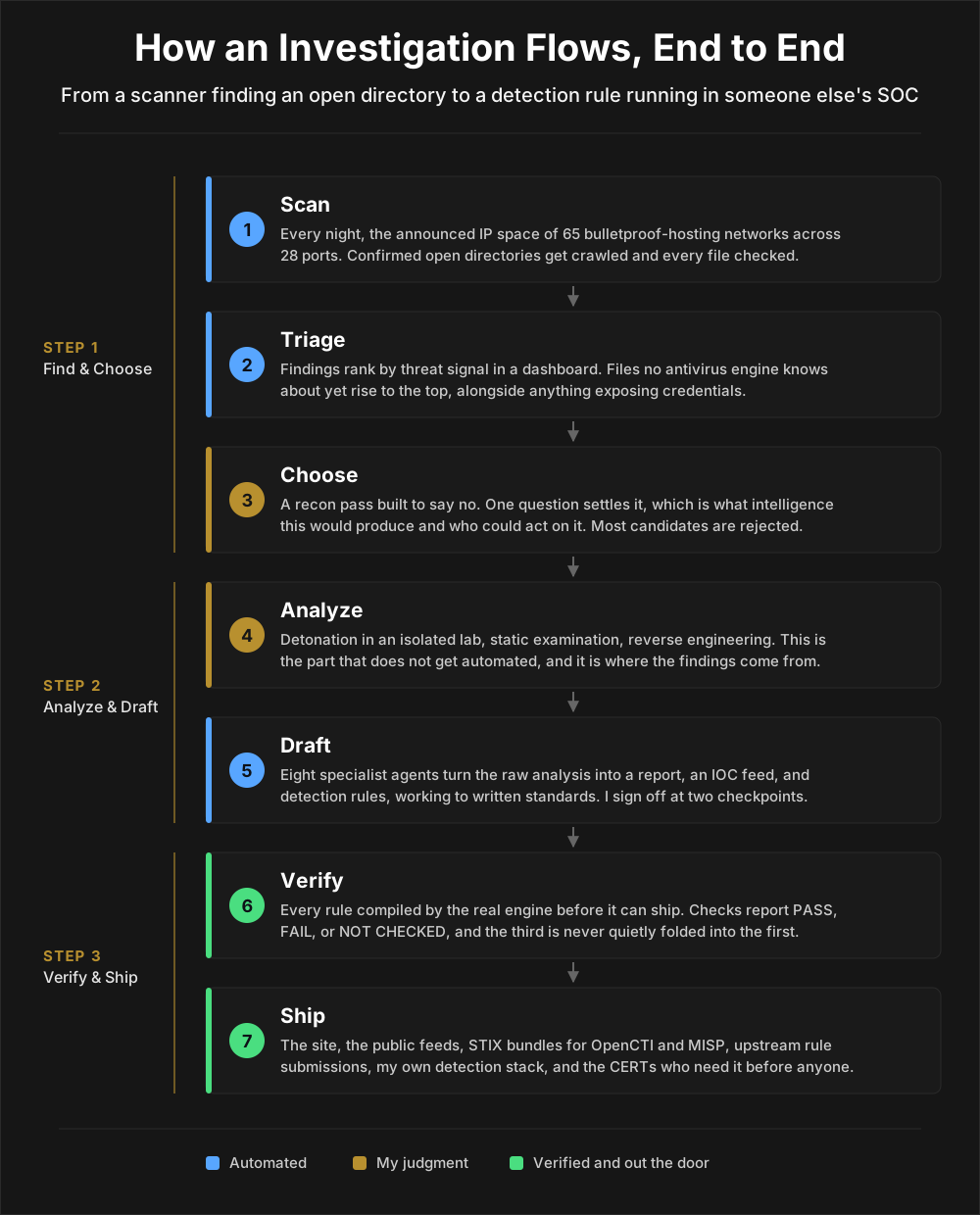
It starts with a scan. A self-hosted collection platform called Vantage runs every night against the announced IP space of 65 bulletproof-hosting networks, the corner of the market where malware actually gets staged and served, across 28 ports. Anything that answers gets probed for an open directory, and a confirmed one gets crawled in full.
Then everything gets triaged. Every file is classified and checked for reputation, and the results rank by threat signal in a dashboard. What rises to the top is the material worth a human look: payloads no antivirus engine has catalogued yet, files evading nearly every engine, and exposed credentials.
Then I choose, and this is the first decision that is genuinely mine. It is also the most consequential one in the whole operation, because the platform surfaces far more than I could ever investigate. A recon pass sorts the candidates with a single question, which is what intelligence this would produce and who could actually act on it. Most candidates get rejected, and the rejections are written down so I do not chase the same dead end twice.
A chosen candidate stops being a platform problem and becomes an investigation. I pull the files into an isolated lab and take them apart by hand: detonation, static examination, reverse engineering, watching what the sample does to a machine and to the network. Nothing here is automated, and this is where the actual findings come from.
What that produces is scattered and hard to read, so it goes into a multi-agent workflow. Eight specialist agents each own one part of the job, working against written standards rather than improvising, and between them they produce the report, the machine-readable indicator feed, and the detection rules.
I stay in the loop at two points. I read the draft at the first checkpoint and can redirect it, and I sign off the finished files at the second. Approving them means the work is good, not that it goes live.
Nothing publishes because an agent said it went well. Every YARA rule is compiled by the real compiler, every Sigma rule runs through SigmaHQ’s own validator, and every Suricata signature is parsed by a live Suricata engine. Those checks report one of three outcomes rather than two, and the third, NOT CHECKED, is never quietly folded into a pass.
What survives goes out in every form somebody might want it. The report and its companion files publish to the site, indicators join the public feeds, the campaign becomes a STIX bundle for OpenCTI and MISP, durable rules are submitted upstream to the public rule repositories, and everything lands in my own detection stack so I find out when one of my rules is wrong.
Where a finding is somebody’s live incident rather than a publication, it goes to them first. That is why publishing defaults to an unlisted preview: the report has to be readable and shareable before it is public, because the people who most need it are usually not the audience the front page is for.