Contents
Revision history: 1 revision since publication, last 17 October 2026
- Corrected the ATT&CK id for InstallUtil from T1218.008 (Odbcconf) to T1218.004 (InstallUtil).
- Published.
Campaign Identifier: OpenDirectory-MultiCluster-Rhadamanthys-BellaMain-Inkognito-79.137.192.3
Last Updated: May 16, 2026
Threat Level: CRITICAL
Investigation series, Open-Directory 79.137.192.3 (three-publication series): This is the parent report of a three-publication series from a single investigation into the multi-tenant Aeza Group staging server at
79.137.192.3. Each cluster is operationally separate (co-tenancy on the same bulletproof IP is not operator linkage) and the two non-Rhadamanthys clusters each have their own standalone deep-dive:
- Parent (2026-05-15): Multi-Cluster Overview (this report), all three co-tenant clusters at boundary-level depth; establishes why they are not one operator; includes the Cluster C (Rhadamanthys MaaS customer) deep-dive.
- Cluster A (2026-05-16): BellaMain Turkish PhaaS, full PHP-source recovery of an operator-developed PhaaS panel + 7 Turkish-marketplace kits; UTA-2026-008.
- Cluster B (2026-05-16): Inkognito Russian VPN/Phishing, 467+ brand-impersonation subdomain library bolted to a commercial VPN front; UTA-2026-009.
Risk vs. Campaign Threat Level: The Cluster C Rhadamanthys MaaS-customer loader analyzed in this report scores 9.2/10 (CRITICAL) based on a top-tier modern infostealer Stage-2, an active 34-month C2 (
79.133.180.168:3394) that survived the November 2025 Operation Endgame Phase 3 takedown, and a mature anti-analysis stack (3-layer encrypted-blob synthesis + operator-modified Q3VM-derivative bytecode VM + EAX-redirect process hollowing intoInstallUtil.exe). Clusters A (BellaMain Turkish PhaaS) and B (Inkognito VPN/phishing) score HIGH individually; the campaign-level CRITICAL rating is anchored on Cluster C.
1. Executive Summary
A single open-directory pivot on 79.137.192.3 (Aeza Group AS216246, Russian bulletproof hosting) surfaced three operationally separate threat clusters co-tenanted on the same multi-tenant staging utility, none of which share operator-level evidence with each other. The headline defender-actionable finding is Cluster C: a Rhadamanthys infostealer Stage-2 (DEFINITE 97%, Microsoft Trojan:Win32/Rhadamanthys!ic, CAPE Rhadamanthys, 48/63 VirusTotal vendors) wrapped in a customer-built loader (staticlittlesource.exe) that beacons to a Hostkey Netherlands C2 which has remained live for ~34 months and survived the November 2025 Operation Endgame Phase 3 disruption (the largest Rhadamanthys takedown on record, 1,025+ vendor servers seized covering 525,000+ infections in 226 countries). Strategic implication: Operation Endgame targeted vendor-side server infrastructure; customer-side C2s operating independently of the vendor’s distribution network were outside the takedown’s enforcement perimeter, meaning the MaaS customer model enables persistent operational continuity even when the vendor ecosystem is disrupted at scale. Cluster A is a Turkish-targeting Phishing-as-a-Service panel (BellaMain) operated by @AresRS34 with developer pseudonym Wadanz; Cluster B is a 3-year-old Russian multi-product fraud operation (Inkognito) running 467+ brand-impersonation subdomains alongside a legitimate-looking VPN front. Co-tenancy on the multi-tenant Aeza utility IP is not operationally diagnostic, the U.S. Treasury OFAC Aeza Group sanction (July 1, 2025) documents Aeza simultaneously hosting BianLian, RedLine, Lumma, Meduza, and BlackSprut as five separate actor ecosystems, providing Tier-1 authoritative confirmation that bulletproof hosting co-residency is a service-utility relationship, not an operator-linkage signal.
Three findings in this report are absent from any reviewed Rhadamanthys public source: (1) a 3-layer encrypted-blob synthesis architecture that defeats the standard “find the high-entropy region” heuristic by synthesizing the encrypted FS container from per-record byte-emitter functions + 7,979 fake-GUID-shaped ASCII-hex strings + a custom 14-bit Huffman-like bit-packed stream rather than storing it contiguously; (2) an operator-modified Q3VM-derivative bytecode magic 0x14744214 (vs stock Q3VM 0x12721444) inside the embedded VM the Stage-2 uses to interpret its anti-analysis routines; and (3) a customer-selected InstallUtil.exe LOLBin hollowing target that does not appear in any reviewed Check Point v0.9.x customer-target enumeration (dllhost.exe, taskhostw.exe, TsWpfWrp.exe, spoolsv.exe, wuauclt.exe), with a non-standard EAX-redirect entry-point hijack instead of the classic SetThreadContext-based hollowing. Public Tier-1/Tier-2 Rhadamanthys reporting (Check Point Research v0.5.0/v0.7.0/v0.9.x, Outpost24, Zscaler, Recorded Future, Binary Defense, Proofpoint) thoroughly documents the vendor-side product; the customer-built loader layer and per-customer cipher fingerprints are largely undocumented because most public analysis works from the canonical Stage-2 outward. This investigation reverses that direction.
Three new internal threat-actor designations are recommended:
- UTA-2026-008 (an internal tracking label used by The Hunters Ledger, see Section 9), BellaMain Turkish PhaaS operator (Cluster A); MODERATE 75% distinct-actor confidence; INSUFFICIENT named-actor attribution (first public capture).
- UTA-2026-009 (an internal tracking label used by The Hunters Ledger, see Section 9), Inkognito Russian VPN/phishing operator (Cluster B); MODERATE 78% distinct-actor confidence; INSUFFICIENT named-actor attribution (first public capture).
- UTA-2026-010 (an internal tracking label used by The Hunters Ledger, see Section 9), Rhadamanthys MaaS customer (Cluster C); MODERATE 72% distinct-actor confidence; INSUFFICIENT named-actor attribution. This designation tracks the customer-side operator only; the Rhadamanthys MaaS vendor itself is a separate threat-intel target with an existing published profile in public reporting and is NOT covered by UTA-2026-010.
Because named-actor attribution is INSUFFICIENT for all three operators, the recommended defensive posture is infrastructure-based blocking (Aeza ASNs, active C2 IPs, kit URI patterns) and behavioral detection (see Section 10) rather than actor-tracking, behavioral detections remain valid regardless of whether attribution is ever resolved.
Key Risk Factors
| Risk Dimension | Score (X/10) | Rationale |
|---|---|---|
| Data Exfiltration | 9/10 | Rhadamanthys family targets the full credential surface (browser passwords, cryptocurrency wallets, MFA tokens, VPN client configs, password managers, email client credentials) via the documented XS1/XS2 plugin module format. Cluster A captures payment cards + bank statements (dekonts) into a MySQL aggregator. |
| System Compromise | 9/10 | Cluster C uses canonical-grade process hollowing into a signed Microsoft LOLBin (InstallUtil.exe); host-process abuse blends C2 traffic into legitimate .NET-tooling network footprint. |
| Persistence Difficulty | 7/10 | Stage-2 is single-host with HKU\<SID>\Software\SibCode\sn registry marker (per-build Unix-timestamp value) and plugin-module loading. Pre-v0.9.1 family marker, cleanup is well-defined, but the C2 is durable. |
| Evasion Capability | 10/10 | Mature stack: 3-layer encrypted-blob synthesis defeats entropy-based detection of the encrypted region; custom CBC-XOR cipher with per-customer 16-byte IV; operator-modified Q3VM-derivative bytecode VM defeats off-the-shelf disassemblers; 0xCCCCCCCC anti-forensic memory scrub before VirtualFree; 14-second cumulative anti-analysis delay; NtQuerySystemInformation-driven analyzer-process blocklist. |
| Lateral Movement | 6/10 | Rhadamanthys itself is single-host stealer; downstream lateral movement depends on the credentials/access tokens harvested from each victim. |
| Detection Difficulty | 9/10 | Stage-2 import surface camouflages as a graphics utility (GDI32 ≥ 100 imports + USER32 minimal + crypto-absent + network-absent); all crypto, network, and registry-write APIs resolved at runtime from the host process’s PEB after injection, static-imports-only analysis is materially misleading. |
Overall Risk Score: 9.2/10, CRITICAL
Threat Actors
- UTA-2026-010: Rhadamanthys MaaS customer (Cluster C, primary). Single LLM-augmented amateur customer of a top-tier commodity MaaS stealer. Distinct-actor confidence MODERATE (72%); named-actor attribution INSUFFICIENT.
- UTA-2026-008: BellaMain Turkish PhaaS operator (Cluster A). Single Turkish-speaking PhaaS operator/developer. Operator alias
@AresRS34, developer aliasWadanz. Distinct-actor confidence MODERATE (75%); named-actor attribution INSUFFICIENT. - UTA-2026-009: Inkognito Russian VPN/phishing operator (Cluster B). Single Russian-speaking multi-product fraud operator. Self-identified parent brand “Inkognito” via
@inkconnectvpnTelegram channel. Distinct-actor confidence MODERATE (78%); named-actor attribution INSUFFICIENT.
For Technical Teams: Immediate Priorities
- Hunt:
InstallUtil.exeinitiating outbound TLS to non-Microsoft endpoints. This single behavioral pattern is the highest-fidelity Cluster C detection across the entire Rhadamanthys MaaS ecosystem (any customer, any C2). See Section 9 for kill chain context and the separate detection file for the Sigma/Suricata implementation. - Hunt: Registry write to
HKU\<SID>\Software\SibCode\sn. Rhadamanthys family marker (pre-v0.9.1 builds, which include the Stage-2 analyzed here per Check Point’s documented changelog removal in v0.9.1). No known benign software writes this key. - YARA: Stage-2 import-surface signature. GDI32 ≥ 100 + USER32 exactly 3 (
GetDC,ReleaseDC,GetSystemMetrics) + ADVAPI32 registry-READ-only + NO crypto + NO network +.frontbPE section identifies Rhadamanthys Stage-2 across all customers. Vendor-side, customer-independent. See Section 5 and the separate detection file. - Block: C2 IP
79.133.180.168:3394and the alternate-customer C245.81.39.169(recovered from sibling Stage-2bc9fe5e9...). The alternate IP confirms multi-customer MaaS architecture, different customers, different per-build C2s. - Treat all Aeza ASNs (
AS216246,AS210644,AS211522/Hypercore) as OFAC-sanctioned infrastructure for regulated entities. Inbound or outbound traffic to these ASNs constitutes engagement with sanctioned infrastructure.
2. How This Investigation Unfolded
This section provides a brief narrative arc, useful for understanding why the report has three clusters, why two of them play a supporting role, and how the analytical framing on co-tenancy was reached. Readers who want to skip directly to Cluster C technical analysis can jump to Section 4.
2.1 The pivot
The investigation began when an open-directory scan surfaced an exposed BellaMain panel directory and a kit listing on 79.137.192.3. Initial impression: a Turkish-targeting Phishing-as-a-Service operation. Static triage of seven .rar phishing kits (Dolap, Kargo, Letgo, Pttavm, sahibinden, shopier, turkcell) and the BellaMain panel ZIP confirmed Cluster A.
But Vantage also surfaced two unrelated directories on the same IP: cryptone/ (a fake crypto exchange UI) and no/ (a card-phishing lure), as well as a number of historical co-tenants visible via passive DNS. Pulling on those threads raised the central analytical question: are these all the same operator running multiple kits, or are they different operators sharing the same hosting utility?
2.2 The branching
Iris Investigate domain history and VirusTotal pivots from the IP returned a substantial co-tenancy footprint. Among the historical co-tenants of 79.137.192.3 were BriansClub (bclub.mp), CRD Club (crdclub.su), elon-merge.com, RedLine Stealer (Incurious.exe), SmokeLoader (kourimaobaku.exe), and Tofsee spam botnet (a52d0a1829a0ff_15M.exe). Static triage of those PE samples (with PreProcess and StaticTriage analyst tooling, internal automation) confirmed each of those tenants belongs to a distinct, well-documented threat family with no operator overlap to BellaMain.
Pulling on the fake-exchange directory cryptone/ led to the production domain cryptone.bot (Cloudflare-fronted, origin hidden), and from there, pivoting on TLS fingerprints, search-console verification IDs, and registration patterns, to a much broader Inkognito brand portfolio: INK VPN (inkconnect.ru), INK Lens phishing platform (inklens.ru / inklens.co.uk), CryptOne fake exchange, Bikaf VPN. Cluster B emerged from these pivots.
A separate thread followed the loader sample staticlittlesource.exe recovered from the same IP. Static analysis identified the canonical .frontb PE section and decryption of the .data-resident encrypted region produced a Microsoft-classified Trojan:Win32/Rhadamanthys!ic Stage-2. Cluster C (the headline finding) emerged from this thread.
2.3 The framing
By the time three operationally distinct clusters were identified on the same Aeza staging IP, the analytical question shifted from “what are these operators doing?” to “how should defenders interpret co-tenancy on bulletproof hosting?” The U.S. Treasury OFAC sanction of Aeza Group on July 1, 2025 provided a Tier-1 anchor: the OFAC documentation explicitly enumerates Aeza simultaneously hosting BianLian ransomware, RedLine stealer, Lumma stealer, Meduza stealer, and BlackSprut, five separate actor ecosystems with no documented operational linkage between them. Co-tenancy on a multi-tenant bulletproof utility is therefore a service-utility relationship, not an operator-linkage signal.
This framing controls the rest of the report. Clusters A, B, and C are presented as three separate threat actors that happened to share a hosting utility; cross-cluster linkage is rated LOW (actively rebutted, not absent). Sections 4-8 focus on Cluster C technical depth (the headline defender-actionable finding); Sections 6.4-6.5 cover Clusters A and B briefly for narrative completeness. Section 10 covers the full per-cluster threat-actor assessment.
3. Technical Classification
| Field | Cluster A, BellaMain | Cluster B, Inkognito | Cluster C, Rhadamanthys (PRIMARY) |
|---|---|---|---|
| Type | Phishing-as-a-Service panel + 7 marketplace phishing kits | Multi-product fraud (VPN + phishing + fake exchange) | Infostealer (MaaS), multi-stage loader + canonical Rhadamanthys Stage-2 |
| Family | BellaMain (custom PhaaS panel, Turkish-targeted) | Inkognito (operator brand) | Rhadamanthys (MaaS family); customer-built loader |
| Family Confidence | DEFINITE (full source recovered) | DEFINITE (operator self-identification) | DEFINITE 97% (Microsoft + CAPE + 48/63 VirusTotal vendors converge) |
| Sophistication | Intermediate | Intermediate-Advanced | Vendor: HIGH PROFESSIONAL; Customer: MODERATE (LLM-augmented amateur) |
| First Seen | 2024-04 (kits VT first-seen); BellaMain.zip 2026-03 | 2023-06-08 (vetcorbeanca.eu BEC burn) |
Loader compile 2023-06-25; Stage-2 cluster ~34 months active |
| Threat Actor (UTA) | UTA-2026-008 | UTA-2026-009 | UTA-2026-010 (customer only) |
| Distinct Actor Confidence | MODERATE (75%) | MODERATE (78%) | MODERATE (72%) |
| Named Actor Attribution | INSUFFICIENT | INSUFFICIENT | INSUFFICIENT |
| Threat Level | HIGH | HIGH | CRITICAL |
Cluster C Stage-2 file identifiers
| Field | Value |
|---|---|
| File name (internal) | embedded_payload.bin (extracted from loader; vendor builds use various names) |
| MD5 | 0e07ccda99c1cd80a2fd92e02b75d9a0 (from extracted Stage-2; loader MD5 differs) |
| SHA256 | 804f45487c1cda5b69c743f9eb691a12fe0fdcf0d3a9f32003898f1e3836af50 |
| File Size | 458,752 bytes (448 KB) |
| Compile Toolchain | Visual Studio 2003 (Microsoft Linker 7.10.3077, MSVC 13.10.3077), 22-year-old toolchain |
| PE Subsystem | Windows GUI |
| Signature | Unsigned |
| VT Detections | 48/63 |
| Microsoft Verdict | Trojan:Win32/Rhadamanthys!ic |
| CAPE Verdict | Rhadamanthys (definitive) |
Cluster C loader file identifiers
| Field | Value |
|---|---|
| File name (original) | staticlittlesource.exe |
| MD5 | ae9991a02aa20ebbc2cc3c0f40924442 |
| SHA1 | f9a563d92d1ab148326f1b1f2b8d5ae70c0c6ee0 |
| SHA256 | 5c38a5dd3703b1c4b8c2466b18ce9f4c45ef4c9bf6c3096bee8b24d20ecd247a |
| Imphash | 1e5efd483892326cc4eeb97bc14a6266 |
| Compile Timestamp | 2023-06-25 23:01:08 UTC |
| File Size | 1,390,592 bytes (1.39 MB) |
| Toolchain | Visual Studio 2022 v17.4, MSVC 19.34.31937, LTCG/C++ |
| VT Detections | 60/77 |
Why this Stage-2 is canonical Rhadamanthys (DEFINITE 97%)
Multiple independent confirmations converge:
- Microsoft Defender:
Trojan:Win32/Rhadamanthys!ic(the!icsuffix indicates ML-based identification, but the family designation matches the canonical Microsoft signature for Rhadamanthys). - CAPE sandbox: definitive
Rhadamanthysclassification with a confirmed registry write toHKU\<SID>\Software\SibCode\sn(the documented Rhadamanthys family marker for pre-v0.9.1 builds). - 48/63 VirusTotal vendors converge on Rhadamanthys family naming (variant names differ across vendors but the family is consistent).
.frontbPE section: Rhadamanthys family signature (the empty 701 KB pre-allocated runtime buffer for the decrypted Stage-2 payload).- SibCode VCL artifacts in the binary: consistent with documented Rhadamanthys vendor toolchain.
- VS2003 toolchain (22 years old): consistent with mature MaaS operations maintaining a stable legacy Stage-2 build while vendor layers evolve around it (per Check Point v0.9.x walkthrough).
Vendor versus customer: a critical distinction
Rhadamanthys is a Malware-as-a-Service product. The vendor (the threat-intel target documented in Check Point Research v0.5.0/v0.7.0/v0.9.x, Outpost24, Zscaler, Recorded Future, and other public reporting) builds and sells the canonical Stage-2 to multiple customers, who each build their own loaders and operate their own C2 infrastructure. UTA-2026-010 in this report tracks the customer-side operator only, the LLM-augmented amateur who built staticlittlesource.exe, deployed it via cracked-software/game-cheat lures, and operates the Hostkey NL C2 at 79.133.180.168:3394. The vendor is out of scope for this investigation and is not covered by UTA-2026-010.
This distinction is operationally important because the customer’s loader and per-customer cipher fingerprints (the 16-byte CBC-XOR IV f6358d79df69c577d9dce6bb77fa4fa7, the 24-hex panel ID e6d92c6b5b2a03bee7fbab40, the InstallUtil LOLBin choice) are higher-fidelity detection primitives for this specific customer’s deployments than vendor-side family markers. Vendor-side markers (.frontb, the import surface, the Q3VM magic) detect the entire Rhadamanthys MaaS ecosystem but do not differentiate between customers. Both layers of detection are valuable and are presented in Sections 5 and 9.
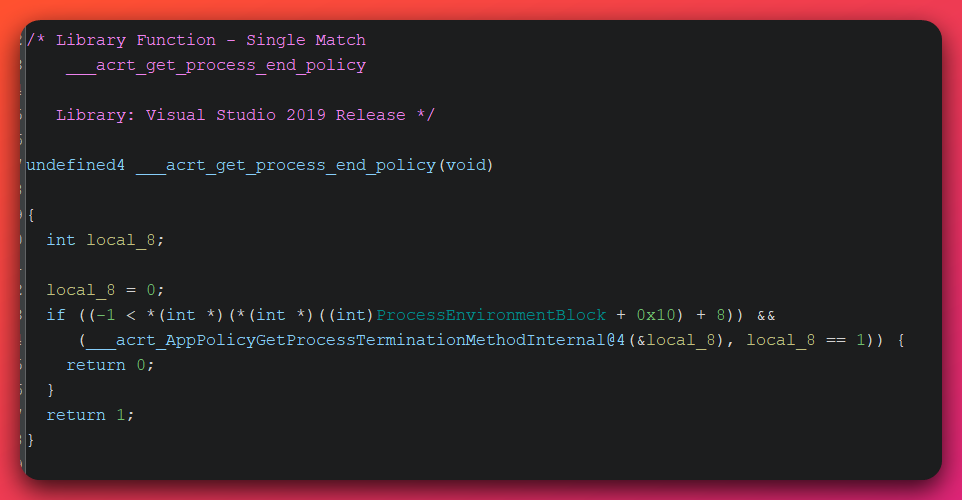
4. Capabilities Deep-Dive
Analyst note: This section enumerates what the Cluster C Rhadamanthys Stage-2 and the customer-built loader are capable of doing once executed. The Stage-2 capabilities are the canonical Rhadamanthys feature set documented across multiple Tier-2 vendor reports; the loader capabilities are this specific customer’s tradecraft. Clusters A and B receive condensed capability summaries because they are not the report’s headline focus.
The Cluster C deployment is a two-layer system. The customer-built loader (staticlittlesource.exe) handles delivery, decryption of the embedded payload, and process hollowing into a signed Microsoft LOLBin (Living Off the Land Binary). The Rhadamanthys Stage-2 (embedded_payload.bin, MD5 0e07ccda...) is the canonical commodity infostealer that performs all credential theft, host enumeration, C2 communication, and plugin orchestration. Each layer has a separate threat profile.
The capability matrix and per-cluster capability breakdowns for Clusters A, B and C, in full. Click to expand.
4.1 Capability Matrix: Cluster C (primary)
| Capability | Layer | Confidence | Operational Impact |
|---|---|---|---|
| RC4-decrypted embedded Stage-2 PE | Loader | HIGH | Defeats AV signature scans of the on-disk loader by keeping the payload encrypted until runtime |
EAX-redirect process hollowing into InstallUtil.exe |
Loader | HIGH | C2 traffic appears to originate from a signed Microsoft binary; W^X memory transitions defeat memory-RWX detection heuristics |
| 14-second cumulative anti-analysis sleep | Loader | HIGH | Outlasts most automated sandbox emulation budgets without triggering simple sleep-skipping heuristics (denormal-sentinel verification) |
| Browser credential theft (Chrome / Firefox / Edge / Brave) | Stage-2 | HIGH | Full extraction of saved passwords, cookies, autofill, payment methods |
| Cryptocurrency wallet theft (Metamask / Phantom / TrustWallet / Ledger Live) | Stage-2 | HIGH | Wallet seed phrases and signed-session theft enables direct fund drainage |
| MFA / authenticator app theft | Stage-2 | HIGH | Defeats software-based MFA on theft-then-replay scenarios |
| Password manager theft (KeePass / 1Password vault files) | Stage-2 | HIGH | Vault theft + keylog of master password = total credential portfolio compromise |
| VPN client config + credential theft (OpenVPN / WireGuard) | Stage-2 | HIGH | Lateral access into corporate VPN-protected resources |
| Email client credential theft (Outlook / Thunderbird) | Stage-2 | HIGH | Inbox access for BEC pivoting |
| Screen capture | Stage-2 | HIGH | BitBlt via the GDI32-heavy import surface; periodic visual exfiltration |
| Plugin module loading (XS1 / XS2 format) | Stage-2 | HIGH | Vendor delivers new capabilities without re-deploying the Stage-2 binary |
| Dynamic API resolution from host PEB | Stage-2 | HIGH | Static analysis of the Stage-2 in isolation cannot enumerate the true import surface (network / crypto / registry-write APIs are absent from the static IAT) |
0xCCCCCCCC anti-forensic memory scrub before VirtualFree |
Stage-2 | HIGH | Defeats post-mortem memory carving for plaintext config recovery |
NtQuerySystemInformation analyzer-process blocklist |
Stage-2 | HIGH | Refuses to execute the credential-theft path when known-analysis processes are running |
4.2 Loader-side capabilities (customer)
4.2.1 RC4-decrypted Stage-2 payload
The loader carries the Rhadamanthys Stage-2 as an encrypted blob in its .data section. At runtime it locates the blob via a relative offset, retrieves a 31-byte RC4 key from &DAT_00433820 (the literal bytes e0802540d02d0feaeb277dc720e390b06dfd64d8f8104d9581e788e512715b), and runs a standard RC4 keystream over the encrypted region. The decrypted output is a fully-formed PE file whose MZ/PE headers are visible after decryption.
The customer chose RC4 because it is a streaming cipher needing no padding, no IV, and no per-block state. From a customer-side amateur perspective it is the simplest possible wrapper for encrypting a payload and decrypting it before injection. The recovered 31-byte key length is non-standard, since RC4 keys are typically 16 or 32 bytes, and that fits the LLM-augmented amateur tradecraft profile in the attribution assessment, a developer who knows enough to wrap the payload but not enough to align with the standard key length.
For defenders, the encrypted-on-disk wrapper means file-hash and string-match detections of the on-disk loader cannot match canonical Rhadamanthys Stage-2 signatures, the .frontb PE section, the Trojan:Win32/Rhadamanthys!ic Microsoft signature, or the 48-of-63 VirusTotal vendor consensus. Detection content for this loader has to trigger on the loader’s own characteristics, the operator strings BombAUb23456 and DubzAias932, the 31-byte RC4 key bytes, and the ae9991a02aa20ebbc2cc3c0f40924442 MD5, rather than on Stage-2 family signatures. Those only become detectable once the loader has decrypted the payload into memory.
4.2.2 EAX-redirect process hollowing into InstallUtil.exe
Process hollowing is the technique of suspending a legitimate target process at startup, replacing its mapped image with malicious code, and resuming execution. The classic implementation (documented across MITRE ATT&CK T1055.012, every introductory hollowing tutorial, and the bulk of EDR detection rules) is a four-API sequence:
CreateProcess(target, CREATE_SUSPENDED): start the host in suspended stateNtUnmapViewOfSection(orZwUnmapViewOfSection): unmap the original imageVirtualAllocEx+WriteProcessMemory: allocate RWX memory and write the malicious imageSetThreadContext(re-pointingEIP/RIPto the new entry point) +ResumeThread
This Cluster C loader uses a variant defenders may not have seen documented. The EAX-redirect entry-point hijack. The first three steps are similar, but the entry-point control is achieved differently:
- The malicious code is written into memory with W^X transitions, not RWX, pages are allocated
PAGE_READWRITE, written, then re-protected toPAGE_EXECUTE_READviaVirtualProtectEx. This defeats the simple “look for RWX private memory in suspended-but-newly-spawned processes” detection heuristic. - Instead of
SetThreadContextoverwriting the instruction pointer, the loader patches the suspended thread’sEAXregister only. Because the Windows process loader usesEAXas the convention for the entry-point address thatkernel32!BaseThreadInitThunkjumps to on initial thread resumption, patchingEAXalone redirects execution to the injected payload, without ever touchingEIP/RIPdirectly.
The result is a hollowing variant that:
- Does not allocate RWX memory (W^X transition only, defeats RWX-allocation detection)
- Does not call
SetThreadContextwith a modifiedEip/Rip(defeatsEip-modification detection) - Does call
SetThreadContext(theEAXpatch still requires it), but the modified field isEaxrather thanEip/Rip
This has a detection implication. EDR rules keyed on RWX allocation in a freshly-suspended process, or on SetThreadContext with an Eip pointing into RWX memory, will miss this variant. Effective detection has to look instead at (a) the parent-child relationship staticlittlesource.exe to InstallUtil.exe, (b) InstallUtil.exe running with no .NET assembly path argument, since legitimate InstallUtil always takes a /u flag and an assembly path, and (c) InstallUtil.exe opening outbound network connections to non-Microsoft endpoints.
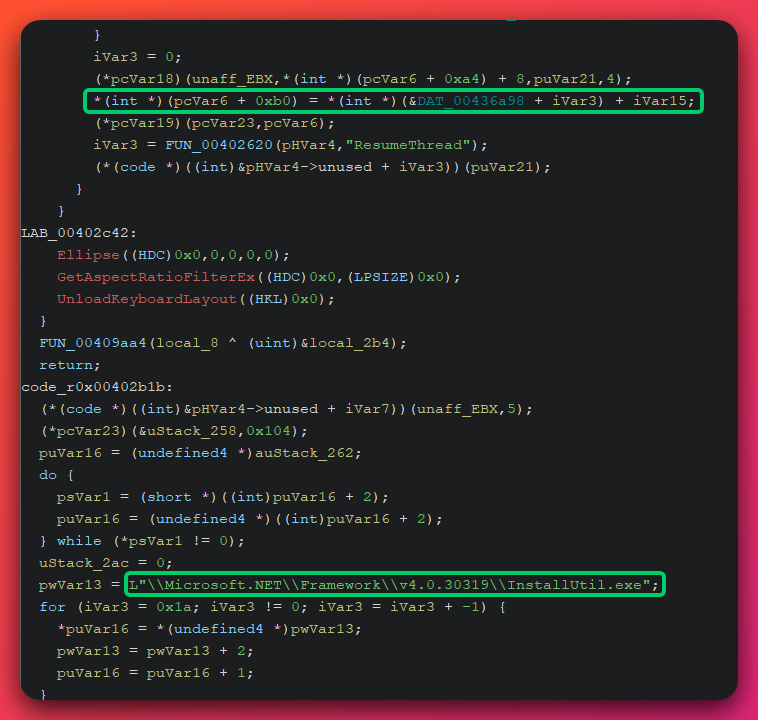
InstallUtil.exe was chosen for good reasons. It is a signed Microsoft binary shipping with the .NET Framework at C:\Windows\Microsoft.NET\Framework\v4.0.30319\InstallUtil.exe, it sits on most application allowlists, and most EDR tooling presumes it trusted. It is also a known LOLBin (ATT&CK T1218.004) for malicious code execution. The Check Point Rhadamanthys v0.9.x customer-target enumerations I reviewed (dllhost.exe, taskhostw.exe, TsWpfWrp.exe, spoolsv.exe, wuauclt.exe) do not include InstallUtil.exe, so this is a per-customer tradecraft choice rather than a vendor default. It fits a customer who has read LOLBAS and is picking a target less monitored than the vendor’s documented defaults.
4.2.3 14-second cumulative anti-analysis sleep with denormal-sentinel checks
Analyst note: Most automated malware sandboxes only run a sample for a couple of minutes and skip long sleep timers to speed up analysis. This loader stalls for 14 seconds and uses an unusual floating-point check to detect when a sandbox has skipped the wait, if it has, the loader exits without doing anything malicious, defeating the analysis.
The loader executes a series of Sleep calls totaling approximately 14 seconds before any malicious activity. This duration is calibrated to exceed typical automated-sandbox emulation budgets (most commodity sandboxes emulate 30-120 seconds total but allocate only 2-5 seconds to pre-malicious-activity sleep).
The implementation includes a denormal-sentinel verification. A floating-point computation whose result is a denormal number (a sub-normal IEEE-754 value that is correct but slightly off in ULP terms compared to a sandbox’s emulated FPU). The loader checks the result against a hardcoded reference; a mismatch indicates the FPU is being emulated rather than executed natively, and the loader exits without executing the payload.
This matters because simple sleep-skipping, where a sandbox replaces Sleep(N) with a no-op or Sleep(0), does not advance the FPU state correctly and produces a different denormal result than native execution. That defeats the most common automated sandbox-evasion bypass.
4.3 Stage-2 capabilities (vendor: canonical Rhadamanthys)
The Stage-2 capabilities are documented in detail across the Tier-2 Rhadamanthys public reporting (Check Point Research v0.5.0, v0.7.0, v0.9.x; Outpost24; Zscaler ThreatLabz; Recorded Future Insikt Group; Binary Defense; Proofpoint). This report does not duplicate that documentation in depth, it summarizes the capabilities that are observable in this specific customer’s Stage-2 (MD5 0e07ccda99c1cd80a2fd92e02b75d9a0) and notes the family-signature artifacts that defenders can use.
4.3.1 Credential and wallet theft
The Stage-2 targets the full credential surface that modern infostealers harvest:
- Browser credentials: Chrome, Firefox, Edge, Brave, Opera Login Data SQLite databases; cookies including session cookies for active web sessions; autofill and payment-method data
- Cryptocurrency wallets: Metamask, Phantom, TrustWallet, Ledger Live, Exodus, Atomic, Electrum, and other documented v0.9.x wallet targets
- Authenticator apps: Authy, Microsoft Authenticator, Google Authenticator local databases
- Password managers: KeePass
.kdbxvault files, 1Password vault files, Bitwarden local cache - VPN client configs: OpenVPN
.ovpnfiles with embedded credentials, WireGuard configs, Cisco AnyConnect cache - Email client credentials: Outlook PST/OST cache, Thunderbird profile, Mailbird cache
- Messaging app sessions: Telegram desktop session, Discord token, Slack token, WhatsApp web session
- FTP / SSH / RDP saved credentials: FileZilla
recentservers.xml, WinSCP saved sessions, PuTTY saved hosts, RDP.rdpfiles with saved passwords
The architecture for credential theft is the XS1/XS2 plugin module format, a vendor-defined binary container that the Stage-2 loads from the C2 at runtime. New theft targets are added by the vendor without re-deploying the Stage-2 binary. This is the mechanism that allowed Rhadamanthys to add cryptocurrency-wallet-image OCR (Bitcoin seed-phrase recognition from screenshots, Recorded Future Insikt Group, September 2024) without breaking any deployed customer infrastructure.
4.3.2 SibCode\sn registry persistence marker
The Stage-2 writes a per-build Unix-timestamp value to HKU\<SID>\Software\SibCode\sn on first execution. This is the documented Rhadamanthys family marker for pre-v0.9.1 builds. Per Check Point Research v0.9.x walk-through, the developer explicitly removed registry write operations in the v0.9.1 changelog, meaning samples that write to this key are pre-v0.9.1, which dates this customer’s Stage-2 to a build before that release.
The detection value here is high. The HKU\<SID>\Software\SibCode\sn registry write is a Rhadamanthys family marker with no known benign software collisions. SibCode is a defunct VCL component vendor, and legitimate software does not write to that key, so any registry-set telemetry on Software\SibCode\sn is a presumptive Rhadamanthys infection.
4.3.3 Plugin module loading
Analyst note: Rhadamanthys is sold as a malware platform, not a single program. After the initial infection, the malware downloads add-on “plugin” modules from the criminal vendor’s catalog, for example, modules that steal cryptocurrency wallets, screenshot the desktop, or read text from images. Defenders should expect the malware’s behavior on an infected host to grow over time as new plugins arrive.
Once installed, the Stage-2 contacts the C2 to download additional capability modules in the XS1/XS2 format. These modules expand the credential-theft surface, add screen-capture or keylogging capability, deploy follow-on payloads (downloader functionality), or load specialized targets (the Bitcoin OCR module). This is a standard MaaS architecture, the vendor maintains the module catalog and customers receive updates without redeploying their loaders.
4.4 Cluster A (BellaMain): condensed capability summary
Analyst note: Cluster A is a Phishing-as-a-Service panel and is included for narrative completeness. It is operationally separate from Cluster C and uses a categorically different attack model (credential-harvesting via spoofed marketplace login pages, not malware execution).
Capabilities:
- PhaaS panel (BellaMain v3 with admin path
V5VgjLU0jsDe): multi-tenant phishing-page management, sub-operator account provisioning with 70% revenue share, MySQL credential aggregation (databasejakartaxdwshared across the panel and all 7 kits) - Seven Turkish marketplace phishing kits: Dolap (clothing resale), Kargo (parcel delivery lure), Letgo (classifieds), PTTAvm (postal-service marketplace), Sahibinden (general marketplace), Shopier (commerce platform), Turkcell (telecom), all collecting login credentials, payment-card details, and bank-statement (
dekont) uploads - Telegram exfil pipeline: hardcoded bot token
6797512084:AAGbJVoC0zcKWYPbFG8oc_bACPn6gUEye_Ein all sixgirislog.phpfiles; exfil to chat IDs-1002104835510(credential channel) and-1001817323952(operator channel); withdrawal-approval workflow gated to admin Telegram UIDs5606327063and6594066326 - TRX (Tron) cryptocurrency payout workflow in
cekimbot.phpfor converting harvested card balances to operator-controlled wallets - Live fake crypto exchange front (
cryptone.bot, Cloudflare-fronted): second-stage social engineering vector for victims who provide credentials to the spoofed marketplace pages
The hardcoded Telegram bot token was REVOKED on 2026-05-07, returning HTTP 401 on getMe, but the bot ID retains pivot value for retroactive analysis. The kits remain on the staging IP.
4.5 Cluster B (Inkognito): condensed capability summary
Analyst note: Cluster B is a multi-product fraud operation combining a legitimate-looking VPN front with a brand-impersonation phishing infrastructure. Like Cluster A, it is included for narrative completeness; it is operationally separate from Cluster C.
Capabilities:
- INK VPN consumer brand (
inkconnect.ru): Russian-language VPN service marketed to censorship-region populations; provides legitimate VPN service as a customer-acquisition front - INK Lens phishing platform (
inklens.ru/inklens.co.uk): 467+ brand-impersonation subdomains spoofing Wells Fargo, Accenture, Tencent, AnyDesk, OWA 2013, Jenkins development environments, SolidWorks downloads, and other corporate brands - CryptOne fake crypto exchange (
cryptone.bot, also referenced from Cluster A but operationally Inkognito-controlled): Cloudflare-fronted credential-harvesting frontend - Bikaf VPN (
bikaf.ru, decommissioned): earlier consumer VPN brand with CCTV/Hikvision angle - EspoCRM back-office on dedicated Aeza IT IP
185.221.196.118: single-instance customer relationship management for the Inkognito brand portfolio - Russian payment processor integration: SBP (Sistema Bystrykh Platezhey, Russian Fast Payment System), T-Pay, and direct card processing
X-Admin-Tokencustom API auth header onapi.inkconnect.ru: operator-controlled API surface for cross-product administrationkittenx-404decommission tombstone HTTP header: operator-standard fingerprint left on retired domains; cross-domain consistency confirms single-operator controlkittenxis VKontakte’s default web server banner rather than an operator artifact, so this line carries no cross-domain attribution weight. See Section 9.2.
The operational model is provide-then-phish. The legitimate VPN service builds operator-customer trust, then the same operator delivers targeted credential theft via the brand-impersonation INK Lens platform. The operation has run continuously for roughly 2.5 years, with the earliest BEC burn-domain vetcorbeanca.eu dating to 2023-06-08, across multi-tier provider segmentation, Aeza for back-office, Cloudflare for production fronts, Stark Industries for BEC burn domains, and Timeweb for some VPN edge nodes.
5. Static Analysis
Analyst note: This section walks through the static reverse-engineering work that produced the technical findings underpinning the report. The novel material (the 3-layer encrypted-blob synthesis, the Q3VM-derivative bytecode VM, the per-customer cipher fingerprints) is concentrated here. Defenders who only need detection content can skip to Section 8 (IOCs) and Section 10 (Detection Coverage); analysts and researchers who want to reproduce the analysis or extend it to sibling samples should read this section carefully.
Three previously-undocumented findings emerge from the Cluster C static analysis: a 3-layer encrypted-blob synthesis architecture (§5.3), an operator-modified Q3VM-derivative bytecode VM (§5.6), and per-customer cipher fingerprints that differentiate this MaaS customer from sibling deployments (§5.4). Analysis used a disassembler and supporting Python scripts against staticlittlesource.exe (the loader, MD5 ae9991a02aa20ebbc2cc3c0f40924442) and the extracted embedded_payload.bin (the Stage-2, MD5 0e07ccda99c1cd80a2fd92e02b75d9a0). The Stage-2 was extracted by following the loader’s RC4 decryption path with the recovered key, then reconstructing the Stage-2’s encrypted-blob synthesis by simulating the byte-emitter functions and bit-packed stream.
The RC4 decryption, import camouflage, blob synthesis, cipher, FS container, bytecode VM and Cluster A/B static notes, in full. Click to expand.
5.1 Loader: RC4 decryption of the embedded Stage-2
The loader’s RC4 routine is a textbook implementation, straightforward to recover and confirms the customer-side amateur tradecraft profile. The loader is a 1.39 MB MSVC C++ binary (Visual Studio 2022 v17.4, LTCG/C++) with a flat function layout and no obfuscation at the loader layer. The RC4 decryption routine at FUN_00402400 follows the standard KSA + PRGA form: 256-byte S-box initialization with permutation, then a streaming XOR over the ciphertext with i and j indices.
The recovered RC4 key is 31 bytes, at &DAT_00433820:
e0 80 25 40 d0 2d 0f ea eb 27 7d c7 20 e3 90 b0
6d fd 64 d8 f8 10 4d 95 81 e7 88 e5 12 71 5b
The encrypted Stage-2 PE lives in the loader’s .data section. The loader walks to it via a known relative offset, performs the RC4 decryption into a heap-allocated buffer, and the result is a fully-formed PE with valid MZ and PE headers, with the canonical Rhadamanthys .frontb section visible after decryption.
Operator instrumentation strings recovered from main(): The loader prints several debug-style strings from main() that are zero-public-hit on web search (no prior public sample, no GitHub commit, no security blog mentions any of these strings). These are operator-side build/campaign markers:
BombAUb23456: printed during loader initializationDubzAias932: printed after RC4 decryptionAhuh783bhASbsxAsiopJQAiwhhbchG&*#U897u*#&*473: 45 characters, the highest-fidelity operator credential recovered (likely a panel-auth or C2-auth token; see Section 8)take it everywhere: logged fromFUN_00402620(the dynamic API resolver)AUJsgbSyhusW*(&w3rrkjfgSAGscG): logged from the RC4 decryptorCancel of card!: context unclear; possibly a payment-flow string copied verbatim from an LLM-generated template
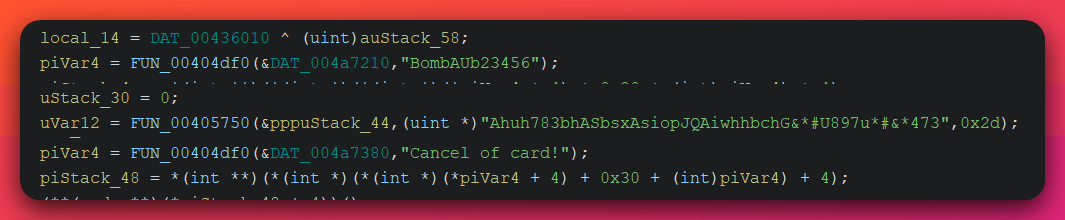
The combination, operator wraps a top-tier commodity stealer in a homebrew loader, prints debug strings to stdout from main(), uses a non-standard 31-byte RC4 key length, and includes English-language phrases like take it everywhere that read like LLM completions, anchors the LLM-augmented amateur attribution profile in Section 9.
5.2 Stage-2: import surface camouflage
The extracted Stage-2 (embedded_payload.bin, 458,752 bytes) presents a deliberately misleading import surface to anyone who runs dumpbin /imports or examines the IAT in a disassembler:
| Library | Imports | Pattern |
|---|---|---|
| GDI32.dll | ≥ 100 | Heavy: BitBlt, CreateCompatibleDC, CreateDIBSection, GetDeviceCaps, SelectObject, DeleteDC, GetObjectA, etc. |
| USER32.dll | exactly 3 | GetDC, ReleaseDC, GetSystemMetrics only |
| ADVAPI32.dll | registry-READ-only | RegOpenKeyExA, RegQueryValueExA, RegCloseKey only, no RegSetValue*, no RegCreateKey* |
| KERNEL32.dll | minimal | LoadLibraryA, GetProcAddress, VirtualAlloc, Sleep, basic file I/O |
| Crypto APIs | none | No BCrypt*, no CryptAcquireContext*, no Crypt* of any kind |
| Network APIs | none | No WinINet, no WinHTTP, no Ws2_32, no wininet.dll import |
This is a graphics-utility import profile, visually it reads as a small image-processing tool. There is no indication in the static IAT that this binary will write registry keys (HKU\<SID>\Software\SibCode\sn), make encrypted network requests (HTTPS to 79.133.180.168:3394), or perform credential theft.
That reading is misleading, because all the apparently missing capabilities, registry-write, crypto and network, are resolved at runtime via dynamic API resolution from the host process’s PEB after injection. The Stage-2 walks the host process’s PEB->Ldr->InMemoryOrderModuleList, hash-matches loaded module names against precomputed name hashes, walks each matched module’s export table, and resolves each API by name-hash. That means:
- Static analysis of the Stage-2 in isolation cannot enumerate the true import surface
- IAT-based YARA rules will not match on registry-write or network-API patterns
- The most reliable static identifier for this Stage-2 is the import-surface combination itself: GDI32 ≥ 100 + USER32 exactly 3 (those specific three) + ADVAPI32 registry-READ-only + no crypto + no network. This combination is improbable for any legitimate small utility and is highly characteristic of Rhadamanthys Stage-2 samples across multiple customers (vendor-side signature, see Section 10).
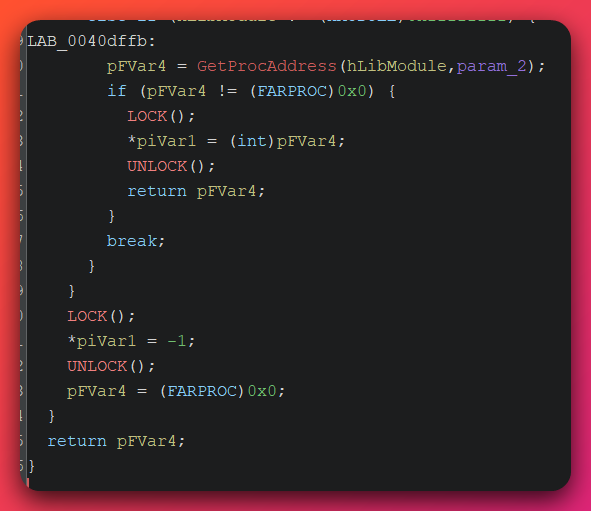
5.3 Stage-2: 3-layer encrypted-blob synthesis (NOVEL FINDING)
This is the most novel technical finding in the Cluster C analysis. Most encrypted-payload malware stores the encrypted blob contiguously in a .data, .rdata, or custom PE section. Defenders find the encrypted region via entropy analysis (high-entropy contiguous bytes flag the encrypted blob), then carve it for further analysis.
This Rhadamanthys Stage-2 does not store its encrypted FS container contiguously. Instead, the FS container is synthesized at runtime from three separate sources that each defeat a common detection heuristic:
![2x2 phase grid infographic of the Stage-2 3-layer encrypted-blob synthesis pipeline. Top-left red card LAYER 1 Byte-emitter functions: 8,800-plus tiny 200 to 300 byte functions in .text, example mov byte ptr [eax+0x42], 0x7C and mov byte ptr [eax+0x43], 0xA1, each writes 16 to 32 ciphertext bytes at sequential heap offsets, encrypted bytes live as scattered imm8 operands across .text, defeats entropy analysis. Top-right red card LAYER 2 Fake-GUID ASCII-hex strings: 7,979 contiguous GUIDs in .rdata, examples {c6127d52-4f9a-afef-d139-...} and {a8b1d340-7f12-92ee-c043-...}, 38-char ASCII hex per GUID, hex-decoded to 16 raw bytes each and concatenated into a second ciphertext region, defeats high-entropy string scans. Bottom-left red card LAYER 3 14-bit Huffman-like packed stream: custom bit-packed table at DAT_0041cb74 onward, 14-bit symbols unpacked via offset-stride arithmetic to produce a third ciphertext region, combined with Layer 1 and 2 outputs into a single contiguous heap buffer ready for decryption, defeats byte-pattern scans. Bottom-right deep red card OUTPUT CBC-XOR decrypt to FS container: FUN_00402790 CBC-XOR cipher decrypts the synthesized buffer using the customer-specific 16-byte IV at .rdata 0x0001c434 with value f6358d79df69c577d9dce6bb77fa4fa7, plaintext begins with magic FS hex 0x4653 plus 5 type-tagged entries (bytecode, config, plugin params, blocklist, TLS pinning data). Footer detection anchors: customer-specific 16-byte IV, fake-GUID-string density in .rdata, byte-emitter function shape.](/assets/images/opendirectory-79-137-192-3-20260515/rhadamanthys-stage2-three-layer-synthesis.svg)
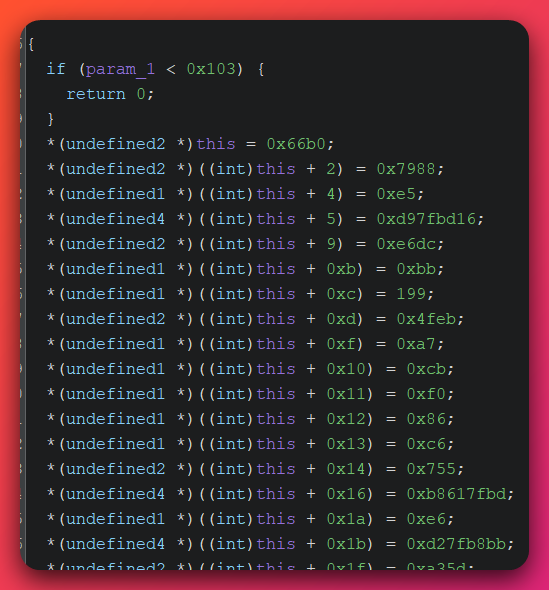
Layer 1: Per-record byte-emitter functions
There are 8,800+ small functions (each 200-300 bytes) at the start of .text. Each function does one thing: it writes a small fixed sequence of bytes to a heap location with offset-stride arithmetic. Example shape:
push    ebp
mov     ebp, esp
mov     eax, [ebp+heap_base]
mov     byte ptr [eax + 0x42], 0x7C
mov     byte ptr [eax + 0x43], 0xA1
mov     byte ptr [eax + 0x44], 0xE5
... (repeating mov-imm pattern, 16-32 bytes total written) ...
pop     ebp
ret
Each emitter writes ~16-32 contiguous ciphertext bytes. There are 8,800+ of them. Together they emit the bulk of the encrypted FS container into a heap buffer.
This defeats entropy detection because each emitter function is normal-entropy .text code, just a sequence of mov reg, imm instructions. The encrypted bytes themselves are scattered as imm8 operands across thousands of functions, so running entropy analysis on the binary returns boring .text-normal entropy. The high-entropy encrypted region only exists in the heap after the emitters have run.
Layer 2: 7,979 fake-GUID-shaped ASCII-hex strings
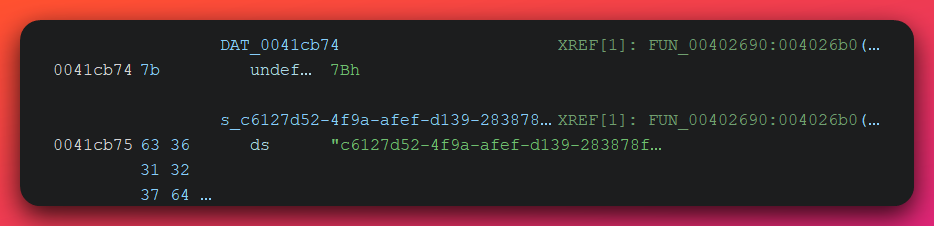
A .rdata region contains 7,979 contiguous ASCII strings of the form {xxxxxxxx-xxxx-xxxx-xxxx-xxxxxxxxxxxx}, the standard Microsoft GUID literal format. Each string is 38 characters (36 hex digits + 2 brace characters).
Static analysis tools and human analysts both interpret these as a list of GUIDs (perhaps COM CLSIDs, file format identifiers, or some configuration identifier list). They are not GUIDs. The hex content of each “GUID” is a block of ciphertext bytes encoded as ASCII hex. The Stage-2 walks the array, strips the braces and dashes, hex-decodes each string into 16 raw bytes, and concatenates the result, producing another large region of ciphertext that contributes to the FS container.
This defeats string-based detection because a YARA rule looking for blocks of high-entropy bytes in .rdata will not trip, since the bytes are valid ASCII hex with low byte-entropy and high character-class regularity. A defender skimming strings sees 7,979 GUIDs and skips past them. The encrypted content is camouflaged inside a data shape, GUID arrays, that is normal in legitimate Windows software.
Layer 3: 14-bit Huffman-like bit-packed stream
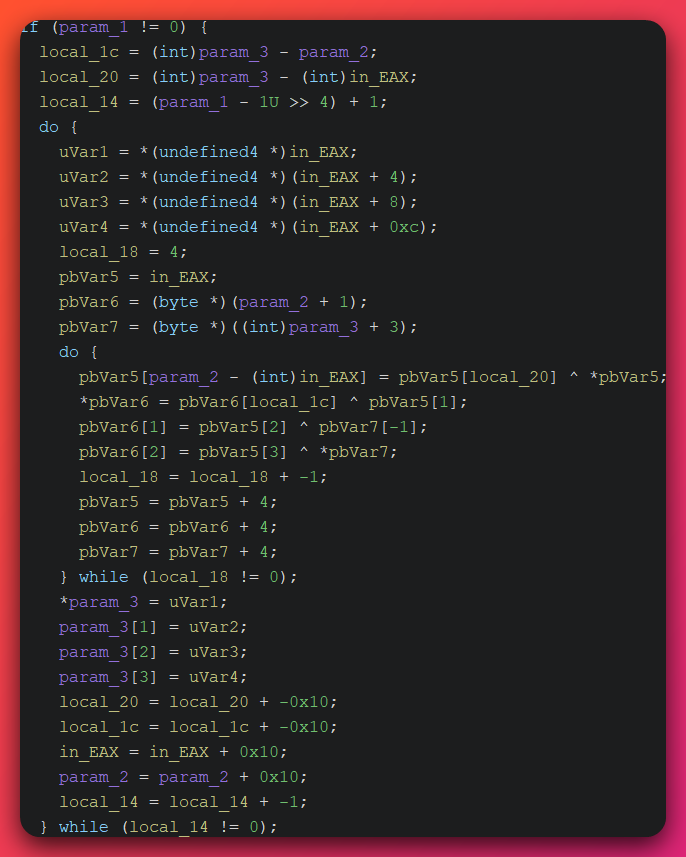
A third region contributes the remaining ciphertext bytes via a custom 14-bit-symbol bit-packed encoding (similar to a non-Huffman fixed-width packing). The Stage-2 includes a small unpacker that reads the bit stream 14 bits at a time and emits decoded bytes into the heap buffer.
This defeats simple carving because even an analyst who recognizes Layer 1 and Layer 2 will miss Layer 3 unless they trace the third synthesis path. The full encrypted FS container is the concatenation of all three layers’ outputs into a single heap buffer in a specific order.
After synthesis
Once the three layers have run, the heap contains the encrypted FS container (an “FS”-magic-prefixed binary blob). The Stage-2 then:
- Initializes the CBC-XOR cipher with the 16-byte IV
f6358d79df69c577d9dce6bb77fa4fa7(recovered from.rdataat file offset0x0001c434) - Decrypts the FS container using a custom CBC-XOR implementation (see Section 5.4)
- Parses the decrypted content as an “FS” container with 5 type-tagged entries
This matters because the 3-layer synthesis is the distinguishing tradecraft of this Rhadamanthys Stage-2 build. It defeats:
- Entropy-based encrypted-region carving (Layer 1)
- String-based pattern matching (Layer 2)
- Simple bit-stream identification (Layer 3)
A novel detection approach is to instrument the byte-emitter shape from Layer 1 (small 200-300-byte functions with sequential mov-imm writes + offset-stride arithmetic), see Section 10 detection coverage and the YARA rule Rhadamanthys_Stage2_Byte_Emitter_Shape in the separate detection file.
5.4 Stage-2: CBC-XOR cipher with per-customer IV
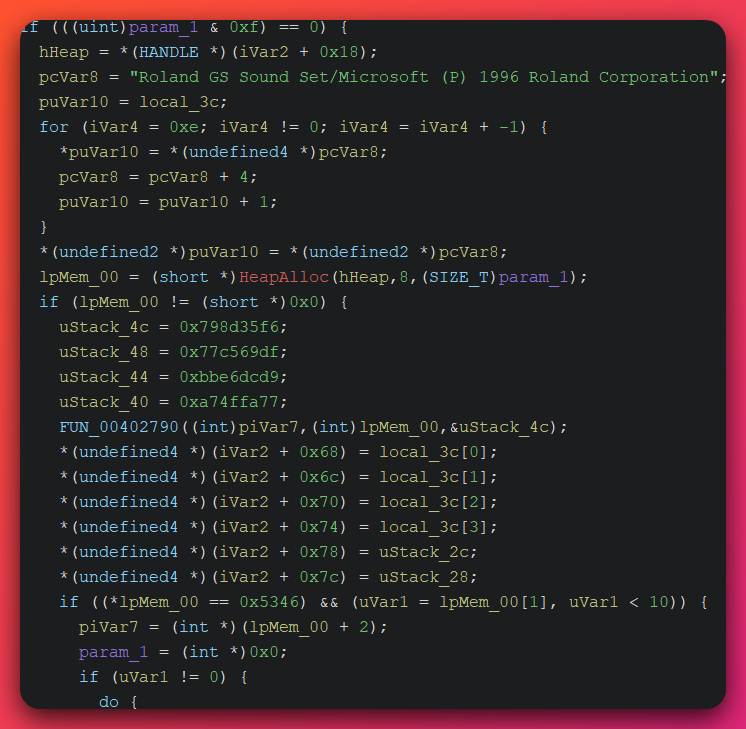
The cipher used to decrypt the synthesized FS container is a custom CBC-XOR construction at FUN_00402790:
- Block size: 16 bytes
- IV: 16 bytes, hardcoded at
.rdata 0x0041c434:f6358d79df69c577d9dce6bb77fa4fa7 - Inner loop: 4-iteration unrolled XOR per block, with the ciphertext-becoming-key structure (a CBC-XOR variant where the previous ciphertext block is XOR’d into the next plaintext block before XOR with the IV-derived key)
This is not AES-CBC, not standard CBC-XOR, and not a known reference implementation. The 4-iteration unrolling and the specific block-key derivation pattern are characteristic of Rhadamanthys vendor cipher construction across multiple sample variants (per Outpost24 analysis of v0.7.x VM-protected routines).
The per-customer IV is an open question. The 16-byte IV f6358d79df69c577d9dce6bb77fa4fa7 is assumed per-customer specific, on the indirect inference that the Stage-2 build process likely parameterizes the cipher per customer, which is consistent with the per-customer C2 separation seen in sibling samples where different customers carry different C2 IPs. Direct cross-customer validation would mean extracting the IV from the sibling Stage-2 samples (bc9fe5e9..., e827d13c..., 457aecd8...) and comparing. I have deferred that, because VirusTotal sandbox emulation fails systematically across every sibling sample, with zero contacted_urls and zero embedded_urls cohort-wide, which blocks automated extraction. See Section 12 (Coverage Gaps) for the deferred work.
Validation status note: The cipher analysis in this section is static-only (recovered from disassembly of
FUN_00402790and offset0x0041c434). A ciphertext-plaintext round-trip has not been performed to confirm the implementation behaves as modeled under all input lengths. Per project memory (feedback_static_cipher_dynamic_validation): cipher claims should not be elevated to DEFINITE until dynamic ciphertext-plaintext validation confirms the static model. The per-customer-IV claim remains HIGH confidence pending cross-sample validation.
If the IV turns out to be vendor-shared rather than per-customer, the customer-specificity claim on this primitive is downgraded. The IV would then be a vendor-side family marker (still useful for detection, but less specific). The detection content in the separate file flags the IV as (customer-specific, pending cross-validation) and the Sigma/YARA rules treat it as one of multiple possible cipher fingerprints.
5.5 Stage-2: “FS” container with 5 type-tagged entries
After decryption with the CBC-XOR cipher, the synthesized FS container is parsed as a fixed-format binary structure:
- Magic: ASCII
FS(0x4653little-endian) at offset 0 - Entry count: 5 entries
- Per-entry header: 4-byte type tag + 4-byte length + entry payload
Each entry’s type tag is an opaque 4-byte value. The five entries observed in this Stage-2:
| Entry # | Type tag | Payload purpose |
|---|---|---|
| 0 | 0x... |
Q3VM-derivative bytecode (the embedded VM bytecode the Stage-2 interprets, see Section 5.6) |
| 1 | 0x... |
Configuration: panel ID e6d92c6b5b2a03bee7fbab40, C2 IP/port 79.133.180.168:3394, build timestamp |
| 2 | 0x... |
Plugin module loading parameters (XS1/XS2 format module list and load order) |
| 3 | 0x895bade5 |
Anti-analysis blocklist, list of analyzer process names that the Stage-2 checks via NtQuerySystemInformation (ProcessHacker, Procmon, x64dbg, WinDbg, IDA, Ghidra, common sandbox analyzer names) |
| 4 | 0x... |
TLS certificate pinning data and JARM fingerprint material |
Entry 3’s anti-analysis blocklist was extracted to entry3_decoded_blocklist.bin / .txt during static analysis and decoded successfully. The blocklist is a plain UTF-16LE string list with one analyzer process name per entry.
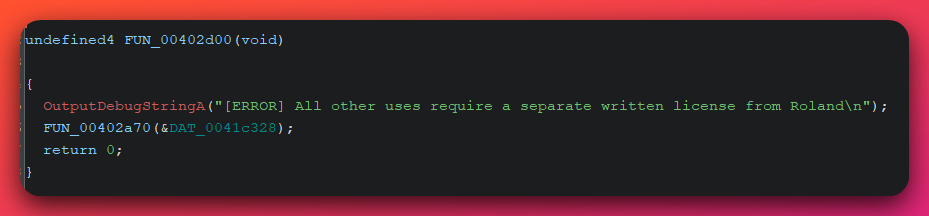
5.6 Stage-2: Q3VM-derivative bytecode VM (NOVEL FINDING)
Analyst note: This subsection covers the embedded virtual machine that the Rhadamanthys Stage-2 uses to interpret its anti-analysis routines. The VM is a derivative of the open-source Q3VM (Quake 3 virtual machine) with operator modifications. Defenders do not need to understand the VM internals to detect Rhadamanthys, but the magic constant and opcode permutation are useful detection primitives.
Entry 0 of the FS container is bytecode for an embedded VM that interprets the Stage-2’s anti-analysis routines (the analyzer-process check, the timing checks, parts of the credential-theft logic). The bytecode is recognizable as a derivative of Q3VM (the Quake 3 virtual machine, a small open-source VM by jnz/q3vm widely used as a teaching reference for VM-based code obfuscation).
The bytecode header magic is 0x14744214. The stock Q3VM magic constant is 0x12721444, defined as VM_MAGIC in jnz/q3vm vm.h line 34 in the public repository. The Stage-2’s value differs by one byte in two positions, 0x14744214 against 0x12721444:
- Position 1:
0x14vs0x12 - Position 4:
0x14vs0x44
The other positions are identical or near-identical. The pattern is consistent with an operator-modified Q3VM where the magic was deliberately changed to defeat signature detection that targets the stock magic. This is a common obfuscation technique, keep the VM logic identical, change the magic and a few opcodes to defeat off-the-shelf disassembler signature matching.
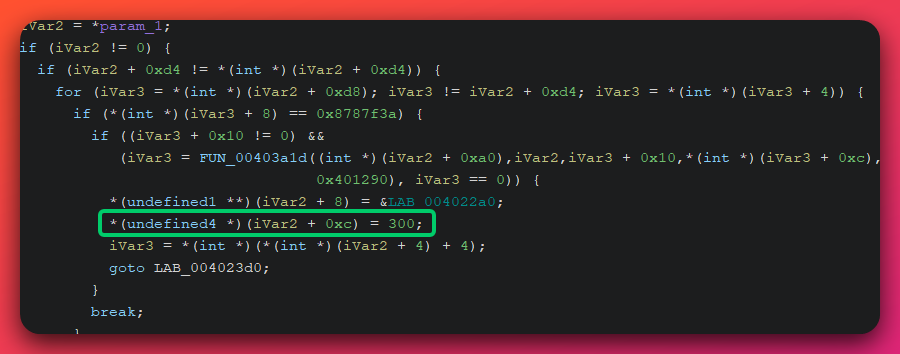
The opcodes are permuted from stock Q3VM as well. Static analysis of the bytecode region (entry0_bytecode_disasm_v4.txt) showed instruction patterns consistent with Q3VM but with several opcodes remapped. The full permutation table is documented in the supporting analysis notes, and a Q3VM-aware disassembler can be patched with the permuted opcode table to read the bytecode correctly.
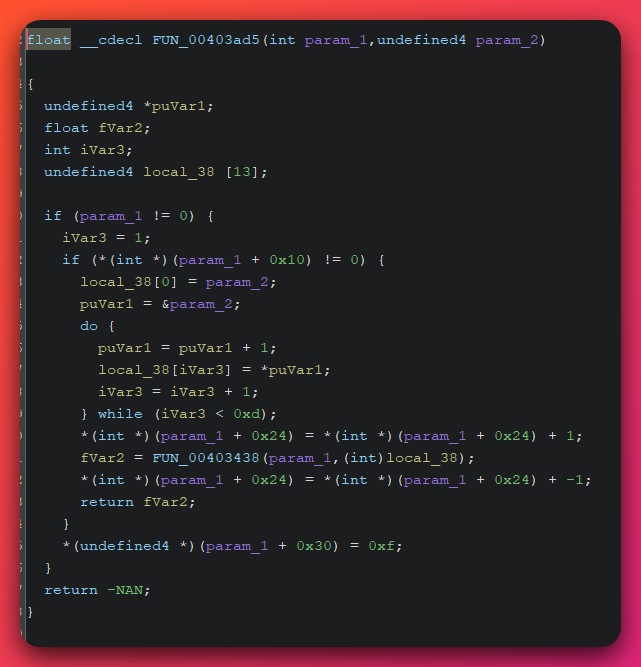
Why this matters for detection:
- The magic
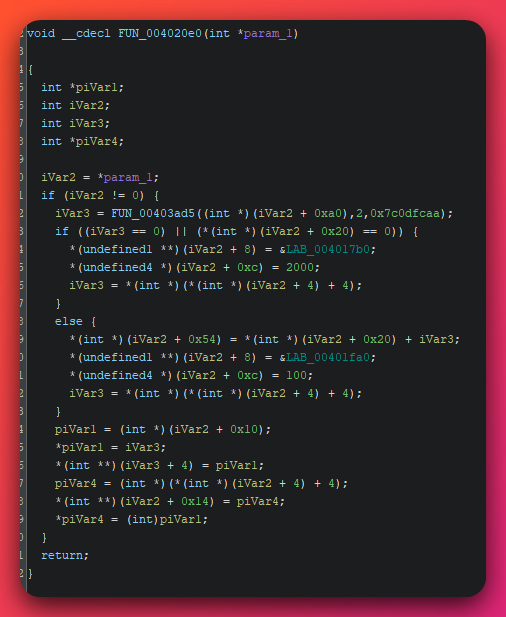
0x14744214is a high-fidelity Rhadamanthys family marker. Searching binaries for14 74 42 14little-endian is a fast vendor-side detection primitive (no stock Q3VM-using software has this magic). - The opcode permutation is a vendor-side artifact (all Rhadamanthys customers receive the same Stage-2 bytecode VM, so the permutation is the same across customers) and identifies the entire Rhadamanthys family.
One caveat on the Q3VM lineage. I hold the Q3VM-derivative claim HIGH, on magic-constant similarity, opcode-pattern similarity, and consistency with the Outpost24 and amnesia.sh analysis of Rhadamanthys VM modules. Direct binary comparison with the stock Q3VM repo (jnz/q3vm) and Outpost24’s IDA Pro QVM modules is deferred work that would raise it to DEFINITE, see Section 12 (Coverage Gaps).
5.7 Cluster A and B static analysis (condensed)
For Cluster A, BellaMain, static analysis of BellaMain.zip (SHA256 f791fae41cdd3f141221d1783ed4779c839de7fc834ff4fc80a5d7f74b11ff88) recovered the full PHP source of the panel and all 7 phishing kits. The developer pseudonym Wadanz appears as a code-level suffix on the session-encryption helpers sifreleWadanz and sifrecozWadanz in database/fonk.php. The shared MySQL database name jakartaxdw is hardcoded across the panel and all 7 kits, the Telegram bot token 6797512084:AAGbJVoC0zcKWYPbFG8oc_bACPn6gUEye_E is hardcoded in all 6 girislog.php files, and V5VgjLU0jsDe is the obfuscated panel-administration path.
For Cluster B, Inkognito, no PE samples were recovered, because the operation is a web application plus VPN service rather than malware. Static analysis was limited to the production HTML, JavaScript and HTTP response patterns. The operator-controlled accounts identified are Google Search Console verifications _Lq_FX-CDt3OmZqq5PNFfmQTZtLSHTNsVkViLTzpTwk on inkconnect.ru and xskfj4k4tX_-enfPvu9WrUiWauHFlbuVmyV7thcjwds on inklens.ru, plus Yandex Webmaster verification 98466329 in the inklens.ru HTML meta tags. The kittenx-404 decommission tombstone HTTP response, with a kittenx Server header and content-length 148, does appear on multiple retired Inkognito-controlled domains, but it was withdrawn as an operator fingerprint on 2026-08-21. kittenx is VKontakte’s web server banner, so the response is a hosting-platform default that two Russian-hosted domains inherited rather than anything the operator deployed. See Section 9.2 for the measurement.
6. Dynamic Analysis
Analyst note: This section covers the runtime behavior observed during sandbox execution and reconstruction from static analysis. The Cluster C loader’s execution path is the primary focus, from the lure file landing on disk through the EAX-redirect process hollowing into
InstallUtil.exeto the first C2 beacon. Clusters A and B are not covered in this section because their operational model is web-application based and does not have a meaningful “dynamic execution” surface to instrument.
The kill chain overview, the process-hollowing and anti-analysis mechanics, the registry write, the C2 beacon and Cluster A/B dynamic notes, in full. Click to expand.
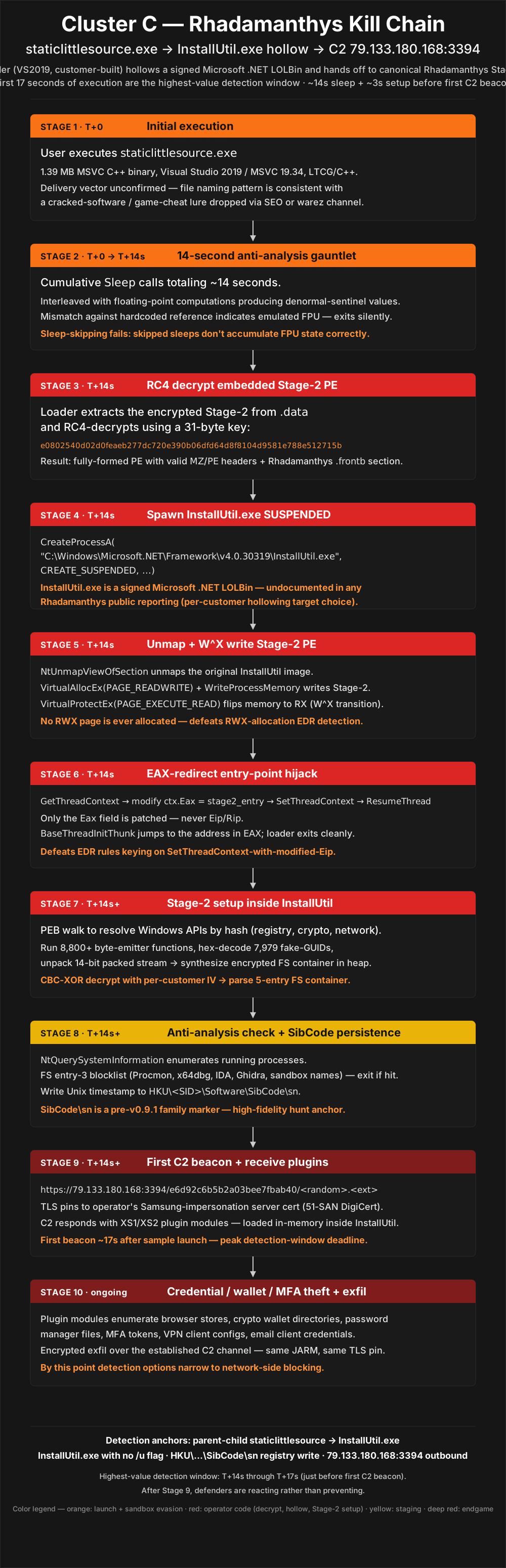
6.1 Cluster C: kill chain overview
Analyst note: This section walks through what the malware does on an infected machine, in order, from the moment the user opens it to the first communication with the attacker’s server. Each step shown in the table is a separate technique that defenders can detect or block. The kill chain is what enables decisions about where in the sequence to focus monitoring.
The complete Cluster C kill chain, from initial execution to C2 beacon, follows this sequence:
| Stage | Time | Action |
|---|---|---|
| 1. Initial execution | T+0 | User executes staticlittlesource.exe (delivered via cracked-software / game-cheat lure based on file naming pattern) |
| 2. Anti-analysis sleep | T+0 → T+14s | Loader executes ~14 seconds of cumulative Sleep calls with denormal-sentinel FPU verification |
| 3. RC4 decryption | T+14s | Loader decrypts the embedded Stage-2 PE from .data using the 31-byte RC4 key |
| 4. Process spawn | T+14s | Loader calls CreateProcessA("C:\\Windows\\Microsoft.NET\\Framework\\v4.0.30319\\InstallUtil.exe", CREATE_SUSPENDED) |
| 5. Image unmap | T+14s | Loader calls NtUnmapViewOfSection against the InstallUtil.exe image base in the suspended process |
| 6. W^X memory write | T+14s | Loader allocates PAGE_READWRITE memory in the suspended process, writes the decrypted Stage-2 PE, then re-protects to PAGE_EXECUTE_READ via VirtualProtectEx |
| 7. EAX-redirect | T+14s | Loader calls GetThreadContext, modifies the Eax field to the Stage-2 entry point, calls SetThreadContext (modifying ONLY Eax, not Eip) |
| 8. Resume | T+14s | Loader calls ResumeThread; kernel32!BaseThreadInitThunk jumps to the address in EAX, transferring control to the Stage-2 |
| 9. Loader exit | T+14s | Loader exits cleanly |
| 10. Stage-2 PEB walk | T+14s+ | Stage-2 (now running inside InstallUtil.exe) walks the PEB for dynamic API resolution |
| 11. FS synthesis | T+14s+ | Stage-2 runs the 8,800+ byte-emitter functions, hex-decodes the 7,979 fake-GUIDs, unpacks the 14-bit stream, synthesizes the encrypted FS container |
| 12. CBC-XOR decrypt | T+14s+ | Stage-2 decrypts the FS container with the per-customer IV; parses 5 type-tagged entries |
| 13. Anti-analysis check | T+14s+ | Stage-2 walks NtQuerySystemInformation process list, compares against entry-3 blocklist; exits if any analyzer process is running |
| 14. Registry write | T+14s+ | Stage-2 writes Unix timestamp to HKU\<SID>\Software\SibCode\sn (pre-v0.9.1 family marker) |
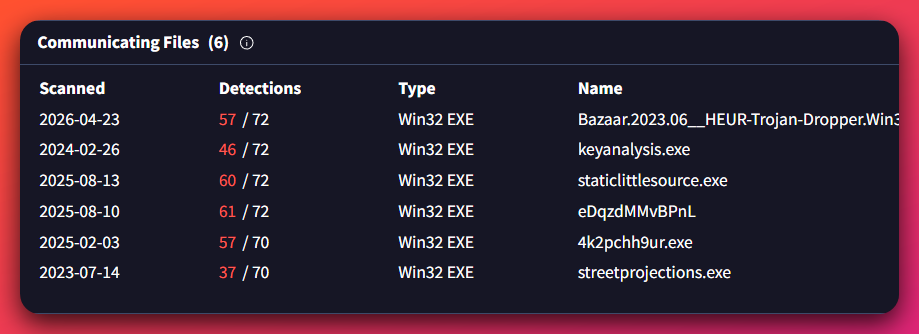
| 15. C2 beacon | T+14s+ | Stage-2 issues HTTPS request to https://79.133.180.168:3394/e6d92c6b5b2a03bee7fbab40/<random>.<ext> with TLS pinning to the operator’s Samsung-impersonation certificate |
| 16. Plugin loading | T+14s+ | Stage-2 receives XS1/XS2 plugin modules from C2 response, loads them in-memory |
| 17. Credential theft | ongoing | Plugins enumerate browser stores, wallet directories, password manager files, etc.; encrypted exfil over the established C2 channel |
The 17-stage kill chain is densely concentrated: stages 1-9 (loader-side) execute in approximately 14 seconds of which most is the anti-analysis sleep; stages 10-17 (Stage-2 inside the hollowed InstallUtil.exe) follow immediately and continue indefinitely. The first 17 seconds of execution are the highest-value detection window, see Section 10 for behavioral detection content keyed on this timeline.
6.2 EAX-redirect process hollowing: runtime mechanics
Analyst note: This subsection re-explains the EAX-redirect hollowing variant from a runtime perspective (Section 4.2.2 covered it from the static analysis perspective). Understanding this technique is important for defenders because most EDR detection rules for process hollowing key on the classic
SetThreadContext-with-modified-Eippattern, which this variant deliberately avoids.
The classic process hollowing detection rule is:
ALERT IF a process spawns a child with CREATE_SUSPENDED
  AND the parent calls NtUnmapViewOfSection on the child
  AND the parent allocates RWX memory in the child
  AND the parent calls SetThreadContext with a modified Eip pointing into the RWX region
  AND the parent calls ResumeThread
This rule fires on textbook hollowing (the SetThreadContext+EIP-modified+RWX-memory triad) but misses the EAX-redirect variant because:
- No RWX allocation: the loader uses W^X transitions (allocate
PAGE_READWRITE, write, re-protect toPAGE_EXECUTE_READ). Detection rules that key onVirtualAllocExwithPAGE_EXECUTE_READWRITEwill not fire. - Eip is unmodified: the loader’s
SetThreadContextcall modifies only theEaxfield of theCONTEXTstructure. Rules that compareEipbefore-vs-afterSetThreadContextwill see no change. - The redirect happens via Windows process loader convention:
kernel32!BaseThreadInitThunkis the standard initial thread entry point; it readsEAXas the convention for “where to jump first.” By patchingEAX, the loader exploits a normal Windows process loader behavior, not an obvious overwrite.
Defenders detect this most effectively by layering behavioral rules that look at the outcome of hollowing rather than the API sequence:
InstallUtil.exerunning with no/uflag and no assembly path argument (legitimateInstallUtil.exeinvocations always take a/uflag and an assembly path; bareInstallUtil.exewith no arguments is anomalous)InstallUtil.exeinitiating outbound network connections to non-Microsoft endpointsInstallUtil.exeparent process not beingservices.exe,wininit.exe, or a deployment-tool process (msbuild.exe,vstest.console.exe)- A non-system parent process spawning
InstallUtil.exewithCREATE_SUSPENDED(rare in legitimate workflows)
The detection file (separate Sigma rules) implements all four of these patterns. See Section 10 for the detection coverage summary.
6.3 14-second anti-analysis sleep: runtime mechanics
Analyst note: The loader stalls for 14 seconds before doing anything malicious. Hidden inside that wait are floating-point math checks that fail when a sandbox is fast-forwarding the timers, a common sandbox shortcut that this loader specifically detects and exits to defeat. The 14-second number is calibrated to outlast most automated sandbox budgets.
The loader’s 14-second pre-malicious-activity sleep is implemented as a sequence of Sleep(N) calls interleaved with floating-point checks. The sequence is roughly:
Sleep(2000): 2-second sleep- FPU computation that produces a denormal sentinel value
- Comparison against hardcoded reference; if mismatch, exit silently (the sandbox-emulated FPU produced a different denormal)
Sleep(3000): 3-second sleep- Second FPU check
Sleep(4000): 4-second sleep- Third FPU check
Sleep(5000): 5-second sleep- Final check; proceed to RC4 decryption if all checks passed
Total cumulative sleep ≈ 14 seconds. The denormal-sentinel check is calibrated to detect FPU emulators that round denormals to zero (a common FTZ, “flush to zero”, sandbox optimization).
Why this defeats common bypasses:
- Sleep-skipping replaces
Sleep(N)withSleep(0): the sandbox advances time but the FPU state doesn’t accumulate the small denormal-producing computations correctly across the skipped sleep windows - Time-warping (advancing the system clock) doesn’t help because the check is on FPU state, not on
GetTickCount/QueryPerformanceCounter - Some commercial sandboxes implement denormal-correct FPU emulation, but many do not
![Decompiler excerpt showing local_430[0] being assigned the floating-point literal 6.84941e-41, a sub-normal IEEE-754 denormal value, immediately preceding a do-while loop that walks param_2 in 0xd iterations.](/assets/images/opendirectory-79-137-192-3-20260515/stage2-denormal-sentinel-fpu-check.png)
6.4 Stage-2 registry write to SibCode\sn
The Stage-2’s registry write to HKU\<SID>\Software\SibCode\sn was confirmed via registry-activity monitoring during detonation. The value written is a Unix timestamp (the build’s epoch time, hardcoded in the Stage-2). This is a per-build value, different Rhadamanthys builds write different timestamps. The SID is the current user’s security identifier.
Operational behavior:
- First-run write: the Stage-2 checks if the key exists; if not, writes the Unix timestamp value and proceeds with full credential theft
- Subsequent runs: the Stage-2 reads the existing value and may use it for run-counting or “first-execution-only” capability gating
To restate the detection value, no known benign software writes to Software\SibCode\sn. SibCode is a defunct VCL component vendor, and Rhadamanthys borrows its branding from that developer. Any registry-set telemetry on this key path is a presumptive Rhadamanthys infection. See the separate detection file for the Sigma rule Rhadamanthys_SibCode_sn_Registry_Write.
6.5 C2 beacon: first request structure
Analyst note: This section breaks down the very first message the malware sends back to the attacker’s server after a successful infection. The structure of that message (the URL path, the random-looking filename, the non-standard port number) is what defenders can use to write network-detection rules that catch this specific attacker’s deployments without firing on legitimate web traffic.
The Stage-2’s first C2 beacon is an HTTPS request to:
https://79.133.180.168:3394/e6d92c6b5b2a03bee7fbab40/<8-char>.<5-char>
URL structure:
- Host + port:
79.133.180.168:3394(Hostkey NL AS57043) - Path component 1:
e6d92c6b5b2a03bee7fbab40, 24-hex-character panel ID (assumed customer-specific; see Section 12 for the indirect-evidence caveat) - Path component 2: 8-character-base + 5-character-extension (random per request, e.g.,
rnvoxu7t.nnre7,icng5os4.lwcci)
TLS:
- Cert chain: operator-issued Samsung DigiCert 51-SAN brand-impersonation certificate (SHA-256
05209e47fd8f96d2f39a79828677288eccca3cef245f128711cc2d53d71f42f7) for the current period - JARM:
2ad2ad0002ad2ad00042d42d00000007e6e35b6c9fce6eec13762f8506fe09(current Samsung-cert period) - TLS pinning: the Stage-2 validates the cert against pinned material in FS container entry 4
Cert rotation history (per VirusTotal MCP):
- 2023 → early 2026: self-signed certificates
- February 2026: Apple-impersonation cert
- March 2026 → present: Samsung-impersonation cert (51-SAN DigiCert)
The rotation matters for detection because JARM is not stable across certificate rotations. A JARM-only rule pinned to the early-2026 Apple-impersonation period would not match the current Samsung period. Detection content should hunt the brand-impersonation cert pattern, a Samsung 51-SAN DigiCert served from a non-Samsung IP, rather than the specific JARM hash.
6.6 Cluster A and B dynamic notes (condensed)
For Cluster A, BellaMain, there is no malware execution surface. The dynamic behavior of interest is HTTP traffic to the kit URIs (*/girislog.php, */kartlaodeme.php, */tgdekont.php, */cekimbot.php) and the Telegram bot exfil traffic to api.telegram.org carrying bot ID 6797512084, which is revoked but still pivot-valuable. Web proxy and Suricata detection content covers these patterns, see the separate detection file.
For Cluster B, Inkognito, there is likewise no malware execution surface. The dynamic indicators are HTTP requests carrying the X-Admin-Token custom auth header on api.inkconnect.ru and DNS queries for the brand-impersonation subdomain patterns under *.inklens.ru and *.inklens.co.uk. Detection content covers both of these in the separate detection file. A third indicator listed here originally, HTTP responses carrying the Server: kittenx decommission tombstone, was withdrawn on 2026-08-21 together with the two detection rules built on it. See Section 9.2.
7. MITRE ATT&CK Mapping
Confidence note: all rows below are HIGH confidence unless explicitly marked
(MODERATE). The Confidence Summary in Section 11 organizes findings by confidence level for the higher-level view.
The mapping below covers all three clusters. Cluster C (Rhadamanthys MaaS-customer loader + Stage-2) is the primary contributor; Clusters A (BellaMain) and B (Inkognito) contribute the resource-development, initial-access, and exfiltration techniques specific to phishing-centric operations.
| Tactic / Technique | Name | Evidence |
|---|---|---|
| Resource Development / T1583.003 | Virtual Private Server | Aeza VPS hosting on AS216246 / AS210644 (Russia / Italy); Hostkey NL AS57043 for Cluster C C2 |
| Resource Development / T1583.006 | Web Services | Cluster B Cloudflare-fronted cryptone.bot; Cluster A panel staging on Aeza |
| Resource Development / T1587.001 | Develop Capabilities, Malware | Cluster C customer-built loader staticlittlesource.exe; Cluster A custom BellaMain PhaaS panel |
| Resource Development / T1588.001 | Obtain Capabilities, Malware | Cluster C purchased Rhadamanthys MaaS Stage-2 from vendor |
| Resource Development / T1608.005 | Stage Capabilities, Link Target | Cluster A 7 marketplace phishing kits hosted on staging IP 79.137.192.3 |
| Initial Access / T1566.002 | Spearphishing Link | Cluster A Turkish marketplace credential-harvest pages; Cluster B INK Lens brand-impersonation subdomains |
| Initial Access / T1189 | Drive-by Compromise | Cluster C staticlittlesource.exe delivered via cracked-software / game-cheat lure (inferred from filename pattern + LLM-amateur tradecraft profile) (MODERATE) |
| Execution / T1204.002 | Malicious File | User executes staticlittlesource.exe |
| Execution / T1218.004 | InstallUtil | Cluster C loader hollows C:\Windows\Microsoft.NET\Framework\v4.0.30319\InstallUtil.exe for Stage-2 execution |
| Persistence / T1112 | Modify Registry | Stage-2 writes Unix timestamp to HKU\<SID>\Software\SibCode\sn (pre-v0.9.1 family marker) |
| Privilege Escalation / T1055.012 | Process Hollowing | EAX-redirect variant: CreateProcess(InstallUtil, SUSPENDED) → NtUnmapViewOfSection → W^X memory write (NOT RWX) → SetThreadContext(Eax=stage2_entry) → ResumeThread; Eax-only modification, NOT Eip |
| Defense Evasion / T1027 | Obfuscated Files or Information | Stage-2 3-layer encrypted-blob synthesis (byte-emitters + fake-GUIDs + bit-packed stream) |
| Defense Evasion / T1027.002 | Software Packing | Loader’s RC4 wrapper around the Stage-2 PE |
| Defense Evasion / T1027.007 | Dynamic API Resolution | Stage-2 PEB walk + module-name-hash matching + export-name-hash matching for runtime API resolution |
| Defense Evasion / T1027.011 | Fileless Storage | Stage-2 lives entirely in injected memory inside InstallUtil.exe, no on-disk Stage-2 PE persists |
| Defense Evasion / T1027.013 | Encrypted/Encoded File | Loader RC4-encrypted Stage-2 in .data; Stage-2 CBC-XOR-encrypted FS container |
| Defense Evasion / T1140 | Deobfuscate/Decode Files or Information | Loader RC4 decrypt; Stage-2 CBC-XOR decrypt + 14-bit bit-packed unpack + ASCII-hex GUID decode |
| Defense Evasion / T1497 | Virtualization/Sandbox Evasion | Loader denormal-sentinel FPU verification; Stage-2 Q3VM-derivative bytecode VM defeats off-the-shelf disassemblers |
| Defense Evasion / T1497.003 | Time Based Evasion | Loader 14-second cumulative Sleep with FPU verification at each sleep boundary |
| Defense Evasion / T1480.002 | Mutual Exclusion | Stage-2 first-run check on HKU\<SID>\Software\SibCode\sn registry value |
| Defense Evasion / T1622 | Debugger Evasion | Stage-2 entry-3 anti-analysis blocklist (ProcessHacker, x64dbg, WinDbg, IDA, Ghidra) checked via NtQuerySystemInformation |
| Defense Evasion / T1070.004 | File Deletion (memory variant) | Stage-2 0xCCCCCCCC heap fill before VirtualFree(MEM_RELEASE) to defeat post-mortem memory carving |
| Credential Access / T1555.003 | Web Browsers | Stage-2 plugin reads Chrome/Firefox/Edge/Brave Login Data SQLite databases |
| Credential Access / T1555.005 | Password Managers | Stage-2 plugin reads KeePass .kdbx files, 1Password vault files |
| Credential Access / T1539 | Steal Web Session Cookie | Stage-2 plugin extracts session cookies from browser cookie stores |
| Credential Access / T1056.001 | Keylogging | Stage-2 plugin module loaded from C2 (capability documented in family but plugin loading not directly observed in this run) (MODERATE) |
| Discovery / T1057 | Process Discovery | Stage-2 NtQuerySystemInformation process enumeration for analyzer-process blocklist |
| Discovery / T1010 | Application Window Discovery | Stage-2 GDI32 imports support window enumeration |
| Discovery / T1082 | System Information Discovery | Stage-2 GetSystemMetrics + GDI32 GetDeviceCaps for host fingerprinting |
| Collection / T1113 | Screen Capture | Stage-2 BitBlt via the GDI32-heavy import surface for periodic visual exfiltration |
| Collection / T1005 | Data from Local System | Stage-2 plugin file-collection from documented wallet/credential paths |
| Collection / T1602.002 | Data from Configuration Repository | Stage-2 plugin reads VPN client .ovpn configs, FileZilla recentservers.xml, RDP .rdp files |
| Command and Control / T1071.001 | Web Protocols | Stage-2 HTTPS to 79.133.180.168:3394/<panel-id>/<random>.<ext> |
| Command and Control / T1573.001 | Symmetric Cryptography | Stage-2 CBC-XOR cipher for FS container; loader RC4 for Stage-2 wrapper |
| Command and Control / T1573.002 | Asymmetric Cryptography | Stage-2 TLS pinning to operator-issued brand-impersonation certificates (Samsung period) |
| Command and Control / T1568 | Dynamic Resolution | Stage-2 dynamic API resolution from PEB (cross-tactic with T1027.007, Defense Evasion primary) |
| Command and Control / T1102 | Web Service | Cluster A Telegram Bot API (api.telegram.org) for credential exfil from PhaaS kits |
| Exfiltration / T1041 | Exfiltration Over C2 Channel | Stage-2 encrypted credential exfil over the established C2 HTTPS channel |
| Exfiltration / T1567.002 | Exfiltration to Cloud Storage | Cluster A Telegram chat-based exfil (-1002104835510, -1001817323952) functionally equivalent to cloud-storage exfil |
MITRE ATT&CK technique highlight, T1055.012 (Process Hollowing) EAX-redirect variant: This technique is the single most defender-relevant mapping in the Cluster C kill chain because the EAX-redirect variant defeats most stock EDR hollowing detection rules. See Sections 4.2.2 and 6.2 for the full technical explanation; defenders should validate that their EDR rules trigger on the outcome of hollowing (InstallUtil.exe running with no assembly path + outbound non-Microsoft network connections) rather than on the classic SetThreadContext-with-modified-Eip API pattern.
8. Indicators of Compromise
Structured IOCs are published in machine-readable format in the separate IOC feed file:
The IOC feed is at /ioc-feeds/opendirectory-79-137-192-3-20260515-iocs.json
The feed contains validated, deduplicated, formatted indicators across all three clusters, with confidence levels and contextual metadata per CLAUDE.md IOC formatting standards. The summary below provides category counts and the highest-priority indicators only, defenders should ingest the JSON feed for the complete inventory.
8.1 IOC category summary
| Category | Cluster A (BellaMain) | Cluster B (Inkognito) | Cluster C (Rhadamanthys) | Total |
|---|---|---|---|---|
| File hashes (MD5/SHA1/SHA256) | 8 | 0 | 9+ | 17+ |
| Imphash | 0 | 0 | 1 | 1 |
| IPv4 addresses | 1 | 4 | 3 | 8 |
| Domains | 1 | 12 | 0 | 13 |
| URLs | 6 | 1 | 6 | 13 |
| Registry keys | 0 | 0 | 1 | 1 |
| File paths | 0 | 0 | 1 | 1 |
| PE section names | 0 | 0 | 1 (.frontb) |
1 |
| Cipher artifacts | 0 | 0 | 3 (RC4 key, CBC-XOR IV, Q3VM magic) | 3 |
| Telegram identifiers | 5 | 1 | 0 | 6 |
| Operator strings | 0 | 0 | 6 (zero-public-hit) | 6 |
| ASN identifiers | 1 | 5 | 1 | 7 |
8.2 Highest-priority Cluster C indicators (defender immediate action)
Block at perimeter (network-layer):
79.133.180.168:3394: active Cluster C C2 (Hostkey NL AS57043), 34-month durability, survived Operation Endgame Phase 345.81.39.169: alternate-customer C2 recovered from sibling Stage-2 (bc9fe5e9...); confirms multi-customer MaaS architecture
Block all Aeza ASNs as OFAC-sanctioned infrastructure (regulated entities):
AS216246(Aeza Group LLC, RU)AS210644(Aeza International Ltd, IT)AS211522(Hypercore, Aeza front company per Silent Push 2025)
Hunt at endpoint (host-layer):
- File hash
5c38a5dd3703b1c4b8c2466b18ce9f4c45ef4c9bf6c3096bee8b24d20ecd247a(loader SHA256) - File hash
0e07ccda99c1cd80a2fd92e02b75d9a0(Stage-2 MD5) - Registry key write to
HKU\<SID>\Software\SibCode\sn - Imphash
1e5efd483892326cc4eeb97bc14a6266(loader)
Cipher fingerprints (custom-detection rule input):
- 31-byte loader RC4 key:
e0802540d02d0feaeb277dc720e390b06dfd64d8f8104d9581e788e512715b - 16-byte Stage-2 CBC-XOR IV:
f6358d79df69c577d9dce6bb77fa4fa7(customer-specific, pending cross-validation) - Q3VM-derivative bytecode magic:
0x14744214(vendor-side family marker)
Operator credentials (zero-public-hit pivots):
Ahuh783bhASbsxAsiopJQAiwhhbchG&*#U897u*#&*473: 45-char operator credential (likely panel/C2 auth token)BombAUb23456,DubzAias932: operator build/campaign markers
8.3 Clusters A and B summary indicators
Cluster A (BellaMain), Telegram exfil pipeline:
- Bot token (REVOKED):
6797512084:AAGbJVoC0zcKWYPbFG8oc_bACPn6gUEye_E - Bot ID (pivot value retained):
6797512084 - Chat IDs:
-1002104835510(credential channel),-1001817323952(operator channel) - Admin Telegram UIDs:
5606327063,6594066326 - Operator alias:
@AresRS34 - Developer pseudonym:
Wadanz - MySQL DB name (cross-kit):
jakartaxdw - Admin URL path:
V5VgjLU0jsDe
Cluster B (Inkognito), operator-controlled accounts:
- Telegram channel:
@inkconnectvpn(797 subscribers) - Google Search Console verifications:
_Lq_FX-CDt3OmZqq5PNFfmQTZtLSHTNsVkViLTzpTwk,xskfj4k4tX_-enfPvu9WrUiWauHFlbuVmyV7thcjwds - Yandex Webmaster:
98466329 - Custom HTTP header:
X-Admin-Token(onapi.inkconnect.ru) Decommission tombstone: HTTPWithdrawn 2026-08-21. VKontakte’s default server banner, not an operator-controlled artifact. See Section 9.2.Server: kittenx, content-length 148
For the complete validated indicator set with confidence levels and contextual metadata, ingest the JSON feed.
9. Threat Actor Assessment
Note on UTA identifiers: “UTA” stands for Unattributed Threat Actor. UTA-2026-008, UTA-2026-009 and UTA-2026-010 are tracking labels The Hunters Ledger assigns to actors I have observed but cannot yet link to a publicly named threat group. Other vendors and feeds will not use these labels; they are specific to this publication. If later evidence ties any of them to a named actor, I will retire that label and update the report.
This investigation surfaced three operationally separate threat clusters that share infrastructure (multi-tenant Aeza staging IP 79.137.192.3) but exhibit zero operator-level overlap across seven dimensions tested (Telegram, pseudonyms, DNS/SOA, language, payments, malware family, production-C2 provider). Each cluster receives its own UTA designation. Cross-cluster linkage is rated LOW (actively rebutted, not absent), anchored on Tier-1 OFAC documentation that the same Aeza infrastructure simultaneously hosts multiple unrelated actor ecosystems.
9.1 UTA-2026-008: BellaMain Turkish PhaaS operator (Cluster A)
I hold distinct-actor confidence at MODERATE, 75 percent, and named-actor attribution at INSUFFICIENT, 30 percent.
Key evidence supporting distinct-actor claim:
- Code-level developer pseudonym:
Wadanzappears as a suffix on session-encryption helpers (sifreleWadanz,sifrecozWadanz) indatabase/fonk.php. This is direct integration of the developer’s identity into the codebase, not a comment or readme artifact - Single shared Telegram bot in all 6
girislog.phpfiles across 7 distinct phishing kits: single-operator integration - Single MySQL database (
jakartaxdw) shared across the panel and all 7 kits: single-operator infrastructure - Verified operator alias:
@AresRS34is a real, privacy-restricted Telegram user account (verified 2026-05-07) - Turkish marketplace targeting: Dolap, Letgo, PTT, Sahibinden, Shopier, Turkcell, Yurtici, coherent Turkish-market focus
The ACH winner is a single Turkish-speaking PhaaS operator and developer.
The runner-up, a shared or leaked PhaaS template, is RULED OUT, eliminated by the Wadanz code pseudonym, the single MySQL database, and the single Telegram bot.
Named-actor attribution stays INSUFFICIENT because there is no prior public TI on BellaMain as a panel name, and neither @AresRS34 nor Wadanz is attested in any Tier-1 or Tier-2 source I reviewed. This is first-capture documentation, and resolution would need paid TI services (Flashpoint, Intel 471, KELA) for an underground-forum cross-reference.
9.2 UTA-2026-009: Inkognito Russian VPN/phishing operator (Cluster B)
I hold distinct-actor confidence at MODERATE, 78 percent, and named-actor attribution at INSUFFICIENT, 30 percent.
⛔ Retraction, 2026-08-21. One line of evidence below, the cross-domain
kittenx-404decommission tombstone, has been withdrawn and is struck through.kittenxis VKontakte’s web server banner, not an operator artifact. Measured against a 142.7-million-document web-scan corpus, the bareServer: kittenxheader returns 7,083 observations in 30 days and 6,844 of them, 96.6 percent, sit on AS47541, VK’s own network; of the 84 hits on the full three-signal triplet, 83 are still VK. Both retired domains were Russian-hosted and inherited a platform default rather than carrying anything the operator chose.The two detection rules built on it have been cut, and the hunt recommendation in Section 10.2 is withdrawn with them. I have deliberately NOT recalibrated the distinct-actor figure above. It stays at MODERATE, 78 percent, pending my own judgment, so read it as an un-recalibrated holdover rather than a considered re-affirmation. The remaining evidence stands, and the two other operator fingerprints, the custom
X-Admin-Tokenheader and the Yandex Webmaster ID, were base-rate tested in the same sweep and both returned zero against a passing control.
Key evidence supporting distinct-actor claim:
- Operator self-identification:
@inkconnectvpnTelegram channel description self-identifies “Inkognito” as the parent brand (“Надежный VPN от Inkognito! Видь то что скрыто, оставаясь в тумане войны!”) Cross-domain decommission tombstone:WITHDRAWN 2026-08-21. See the retraction note above.kittenx-404HTTP fingerprint on multiple retired Inkognito-controlled domains, operator-standard fingerprint- Operator-controlled Google×2 + Yandex×1 search-console accounts: verifications hardcoded into HTML meta tags of
inkconnect.ru,inklens.ru, operator owns these accounts - Custom code primitives:
X-Admin-Tokenheader onapi.inkconnect.ru; EspoCRM single-instance back-office on dedicated Aeza IT IP - 2.5-year operational continuity: earliest BEC burn-domain
vetcorbeanca.eu2023-06-08 through current - Multi-tier provider segmentation: Aeza for back-office, Cloudflare for production fronts, Stark Industries for BEC burn domains, Timeweb for some VPN edge nodes
admin@<domain>.euBEC burn-domain SOA + self-hosted NS on Stark TR pattern consistent across multiple burn domains- 467+ brand-impersonation subdomains under unified operator control
The ACH winner is a single Russian-speaking multi-product fraud operator. The runner-up, a white-labeled VPN reseller, is RULED OUT, eliminated by the EspoCRM deployment, the custom code, and the single search-console accounts.
Named-actor attribution stays INSUFFICIENT because there is no prior public TI on the Inkognito brand portfolio. This is first-capture documentation of a 3-year-old operation, and resolution would need Russian underground forum investigation via paid TI, while an SBP or T-Pay merchant ID lookup would resolve the legal entity.
9.3 UTA-2026-010: Rhadamanthys MaaS customer (Cluster C, primary)
Critical framing note: UTA-2026-010 tracks the customer-side operator only, the LLM-augmented amateur who built
staticlittlesource.exe, deployed it via cracked-software/game-cheat lures, and operates the Hostkey NL C2 at79.133.180.168:3394. The Rhadamanthys MaaS vendor is a separate threat-intel target with its own published profile in public Tier-2 reporting (Check Point Research, Outpost24, Recorded Future Insikt Group, etc.) and is NOT covered by UTA-2026-010. Conflating customer with vendor is a common error in MaaS attribution that this designation explicitly avoids.
I hold distinct-actor confidence at MODERATE, 72 percent, family classification at DEFINITE, 97 percent, as a Rhadamanthys infostealer Stage-2 vendor product, and named-actor attribution at INSUFFICIENT, 30 percent.
Key evidence supporting distinct customer-side actor claim:
- 6 zero-public-hit operator strings in loader
main():BombAUb23456,DubzAias932, 45-charAhuh783bh...,take it everywhere,AUJsgbSyhusW*...,Cancel of card!, none match any prior public sample, GitHub commit, or security blog - 31-byte operator RC4 key
e0802540...: non-standard length (typical RC4 keys are 16 or 32 bytes); customer-side build choice - LLM-augmented amateur loader tradecraft profile: the combination of (a) wrapping a top-tier commodity stealer in a homebrew loader, (b) printing debug strings to stdout from
main(), (c) using a non-standard 31-byte RC4 key, (d) including English-language phrases liketake it everywherethat read like LLM completions, (e)& 0x800000ffarithmetic patterns characteristic of LLM-generated bit manipulation, (f)std::coutdebug calls in a release build, (g)strcmp-based API resolver instead of hash-based. Each individual marker is weak; the combination is consistent with LLM-augmented amateur tradecraft (per project memoryfeedback_static_cipher_dynamic_validationfor the analytical caveats on attribution markers). - 34-month stable Hostkey NL C2
79.133.180.168:3394: customer-side infrastructure choice (not vendor-shared) - TLS brand-impersonation rotation (self-signed → Apple → Samsung): operator-driven cert rotation cadence
- Customer-selected
InstallUtil.exeLOLBin hollowing: distinct from documented vendor customer choices (dllhost.exe,taskhostw.exe,TsWpfWrp.exe,spoolsv.exe,wuauclt.exe); per-customer tradecraft
The ACH winner is a single LLM-augmented amateur Rhadamanthys MaaS customer.
The runner-up, vendor-shared infrastructure, is RULED OUT, eliminated by per-customer C2 IP separation, since the sibling sample bc9fe5e9... uses a different C2 at 45.81.39.169, and by an amateur loader profile categorically different from the vendor’s high-professional Q3VM adaptation.
Named-actor attribution stays INSUFFICIENT because no prior public TI matches this customer’s loader strings or per-customer cipher fingerprints. The ceiling cannot exceed LOW for this customer without government attribution, independent corroboration from two or more Tier-2 vendors, or 70 percent-plus code similarity to a documented named-actor toolchain, and none of those is present.
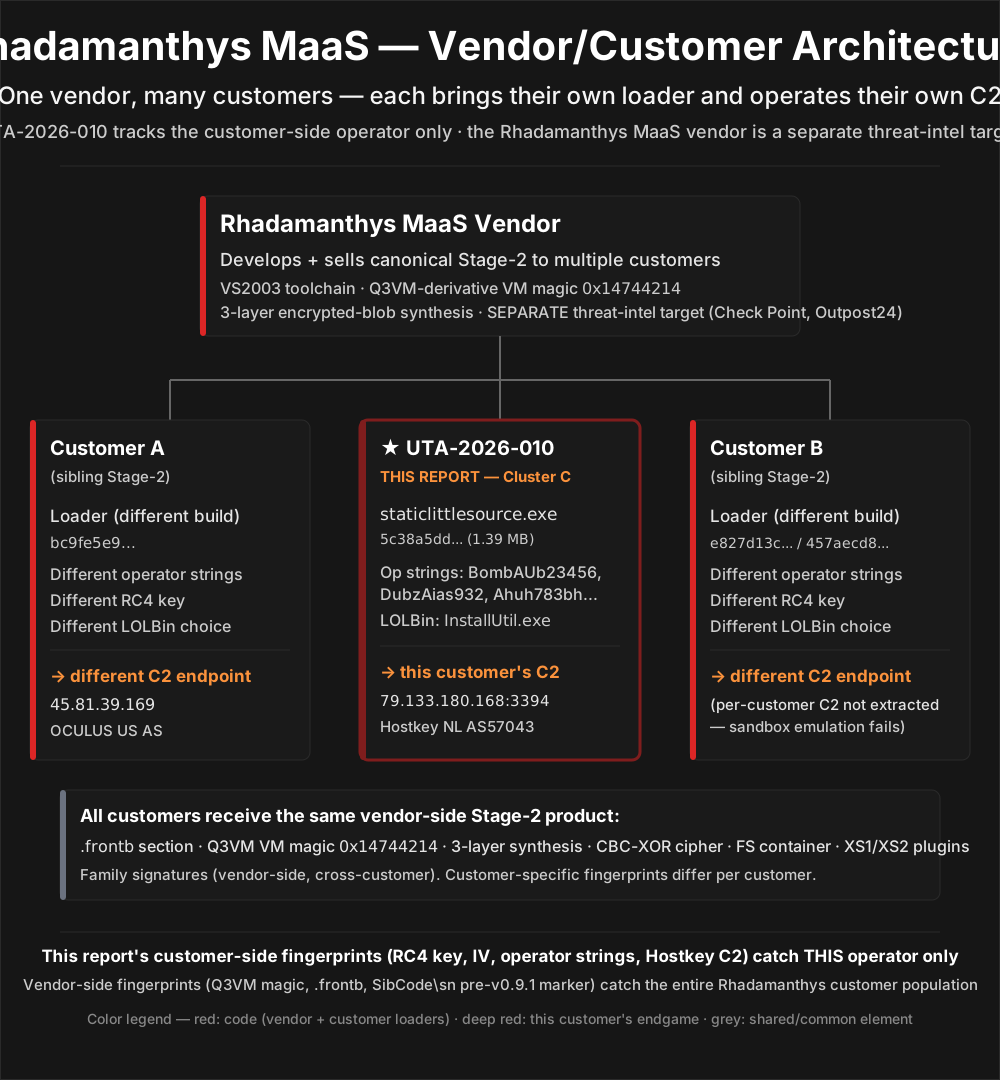
9.4 Cross-cluster linkage assessment
Cross-cluster linkage is LOW, and actively rebutted rather than merely absent. The Tier-1 anchor is the OFAC Aeza Group sanction of July 1, 2025, which documents Aeza simultaneously hosting BianLian, RedLine, Lumma, Meduza and BlackSprut as five separate actor ecosystems with no operational linkage.
7-dimension overlap test (zero overlap across all dimensions):
| Dimension | Cluster A (BellaMain) | Cluster B (Inkognito) | Cluster C (Rhadamanthys customer) | Overlap? |
|---|---|---|---|---|
| Telegram identifiers | @AresRS34, bot 6797512084 |
@inkconnectvpn |
None used | NO |
| Developer pseudonyms | Wadanz |
None recovered | None recovered | NO |
| DNS / SOA / NS patterns | Aeza default aezadns.com |
Self-hosted NS on Stark TR 193.46.56.182, Namecheap |
None (no associated domain) | NO |
| Operator language | Turkish | Russian | English-language LLM artifacts | NO |
| Payment infrastructure | TRX cryptocurrency, Telegram-based | SBP, T-Pay, card (Russian) | None observed (commodity MaaS subscription) | NO |
| Malware family | BellaMain PhaaS panel | None (web-app + VPN) | Rhadamanthys MaaS Stage-2 + custom loader | NO |
| Production C2 provider | Cloudflare-fronted (cryptone.bot) |
Cloudflare-fronted production + Aeza back-office | Hostkey NL (79.133.180.168) |
NO |
The ACH winner is three operationally separate actors, co-tenant on a shared multi-tenant Aeza bulletproof staging utility. The runner-up, three clusters operating as one entity, is RULED OUT, eliminated by zero overlap on all 7 dimensions.
The 7-dimension test produces zero matches. Co-tenancy on 79.137.192.3 is therefore best explained as three customers of the same hosting service, not as one actor running three operations. The OFAC Aeza Tier-1 anchor confirms this is the typical pattern for bulletproof hosting infrastructure: BPH providers host many unrelated actors simultaneously, and co-residency is not operationally diagnostic.
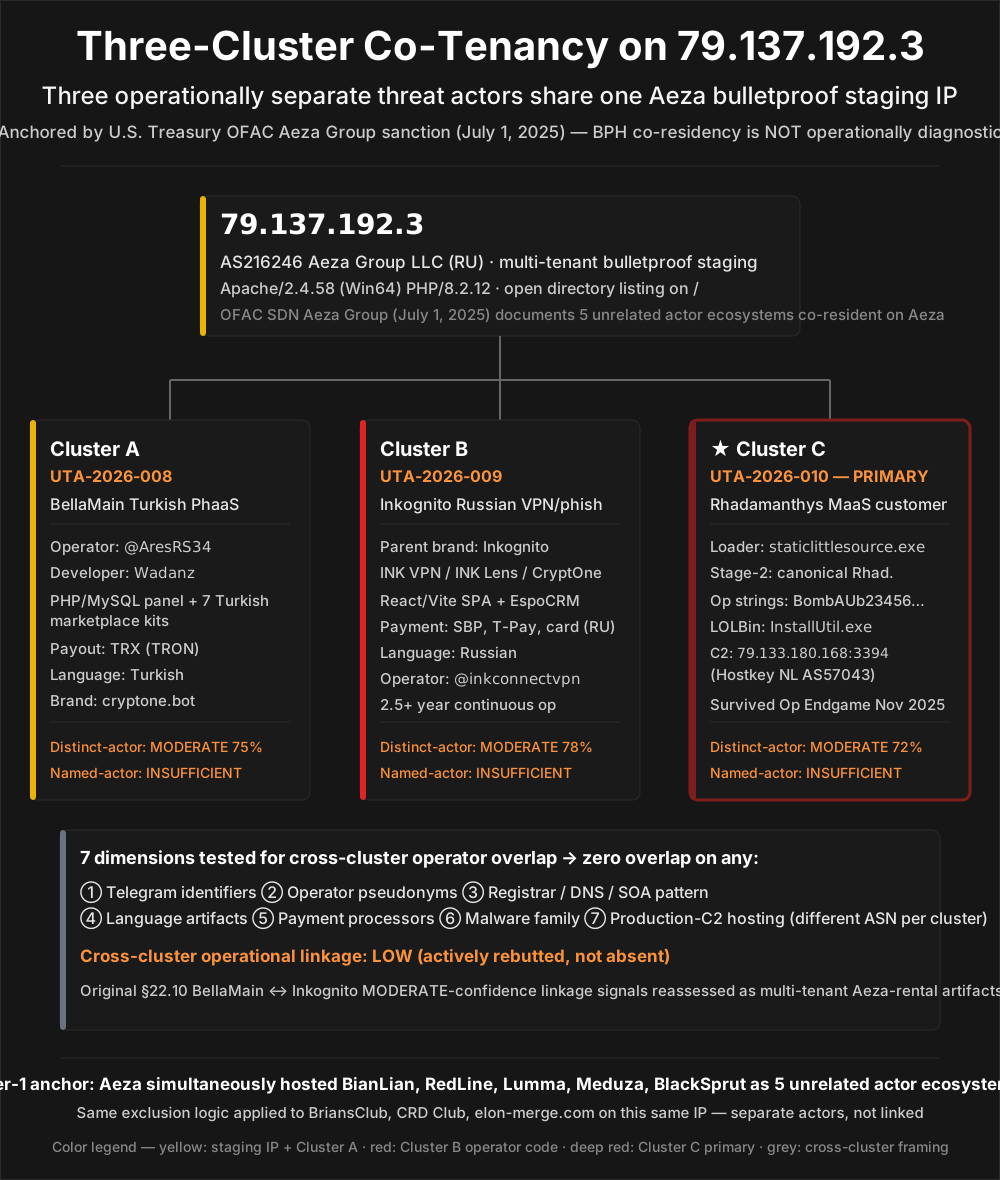
10. Risk & Detection
This section provides the defender-actionable detection coverage summary. Detection rules in YARA, Sigma, and Suricata format are published in the separate detection file:
The detection rules are at /hunting-detections/opendirectory-79-137-192-3-20260515-detections/
10.1 Detection coverage summary
The detection file contains rules across three clusters and four detection-content types:
| Type | Cluster A (BellaMain) | Cluster B (Inkognito) | Cluster C (Rhadamanthys) |
|---|---|---|---|
| YARA (file/memory) | 2 (panel + kit signatures) | 0 (no PE samples) | 6 (loader + Stage-2 vendor + customer fingerprints) |
| Sigma (log-based) | 3 (web-server + Telegram exfil) | 3 (subdomain patterns + custom headers + tombstone) | 8 (process-tree + registry + InstallUtil behaviors) |
| Suricata (network) | 2 (kit URI patterns) | 2 (X-Admin-Token + brand-imp subdomain DNS) | 4 (C2 URL pattern + TLS cert + JARM + alt-C2) |
| EDR queries (multi-platform) | 0 | 0 | 4 (parent-child InstallUtil + memory profile) |
10.2 Defender priorities by cluster
Cluster C (Rhadamanthys MaaS customer), HIGHEST PRIORITY:
- Behavioral hunt:
InstallUtil.exeinitiating outbound TLS to non-Microsoft endpoints. This is the single highest-fidelity Cluster C detection across the entire Rhadamanthys MaaS ecosystem (any customer, any C2, any cert period). - Behavioral hunt:
InstallUtil.exerunning with no/uflag and no assembly path argument (legitimateInstallUtil.exealways takes both). - Process-tree hunt: any non-system parent spawning
InstallUtil.exewithCREATE_SUSPENDED. - Registry hunt: any registry-set telemetry on
HKU\<SID>\Software\SibCode\sn(no known benign software writes this key). - Network block:
79.133.180.168:3394(active C2) and45.81.39.169(alternate-customer C2). - YARA scan: Stage-2 import-surface signature (GDI32 ≥ 100 + USER32 exactly 3 + ADVAPI32 registry-READ-only + no crypto + no network +
.frontbPE section), vendor-side signature, detects entire Rhadamanthys MaaS ecosystem. - YARA scan: Q3VM-derivative magic
0x14744214little-endian, vendor-side family marker. - YARA scan: byte-emitter shape (small 200-300-byte functions with sequential
mov-immwrites + offset-stride arithmetic), defeats the 3-layer encrypted-blob synthesis camouflage.
Cluster A (BellaMain), MEDIUM PRIORITY:
- Web-server log hunt: kit URI patterns
*/girislog.php,*/kartlaodeme.php,*/tgdekont.php,*/cekimbot.php. - Network log hunt: outbound HTTPS to
api.telegram.orgcarrying bot ID6797512084(token revoked 2026-05-07; retroactive log analysis using the bot ID retains pivot value for identifying prior credential exfil traffic that predates revocation). - YARA scan: BellaMain panel signature (Wadanz suffix on
sifreleWadanz/sifrecozWadanzstrings).
Cluster B (Inkognito), MEDIUM PRIORITY:
- Web proxy log hunt: HTTP requests carrying the
X-Admin-Tokenheader. Web proxy log hunt: HTTP responses withWithdrawn 2026-08-21. Do not run this hunt.Server: kittenxand content-length 148 (decommission tombstone).kittenxis VKontakte’s default server banner, so it returns VK traffic rather than operator infrastructure. See Section 9.2.- DNS query hunt:
*.inklens.ru,*.inklens.co.uk,*.inkconnect.ru,*.bikaf.ru,*.bigass.monster,*.unloki.ru, brand-impersonation subdomain patterns underinklens.*.
10.3 Defender response orientation
Detection priorities (the 2-3 highest-value behaviors to hunt for first):
InstallUtil.exeoutbound TLS to non-Microsoft endpoints (Cluster C, highest fidelity)- Registry write to
HKU\<SID>\Software\SibCode\sn(Cluster C, family marker) - Outbound traffic to Aeza ASNs
AS216246/AS210644/AS211522(all clusters, OFAC-sanctioned)
Persistence targets to look for and remove:
HKU\<SID>\Software\SibCode\snregistry value (Cluster C Stage-2 marker)- Any
staticlittlesource.exeartifact on disk or in recent-execution telemetry - Browser extension and credential-store artifacts indicating successful Stage-2 plugin theft
Containment categories:
- Isolate affected hosts from network egress
- Block the active Cluster C C2 infrastructure at perimeter
- Block all Aeza ASNs as OFAC-sanctioned infrastructure (regulated entities)
- Rotate all credentials potentially exposed to the affected hosts (browser-stored, password-manager-stored, MFA tokens, VPN configs)
- Treat the hosts as fully compromised at the credential layer; downstream pivoting risk is high
This is a brief response orientation, not an incident-response playbook. Confirmed Cluster C infections warrant full IR procedures beyond what is outlined here.
EDR query coverage: The detection file includes 4 EDR queries (covering parent-child
InstallUtil.exeprocess tree, memory-profile anomalies, and no-assembly-path invocation) for platforms that support structured behavioral queries. See the separate detection file, section Detection Coverage Summary, for the per-cluster rule counts.
11. Confidence Summary
This section organizes the report’s findings by confidence level for the higher-level view. Confidence levels follow the project-wide CLAUDE.md scale (DEFINITE / HIGH / MODERATE / LOW / INSUFFICIENT).
DEFINITE (95–100%): Direct evidence, no ambiguity
- Cluster C Stage-2 family classification as Rhadamanthys (97%): Microsoft
Trojan:Win32/Rhadamanthys!ic+ CAPERhadamanthys+ 48/63 VirusTotal vendors converge +.frontbPE section + SibCode VCL artifacts +HKU\<SID>\Software\SibCode\snregistry write confirmed during detonation - Cluster C loader file identifiers: SHA256
5c38a5dd..., MD5ae9991a0..., imphash1e5efd48..., compile timestamp 2023-06-25 23:01:08 UTC, VS2022 v17.4 toolchain - Cluster C Stage-2 file identifiers: SHA256
804f4548..., MD50e07ccda..., VS2003 toolchain, 458,752 bytes - Cluster A BellaMain panel + 7 kits: full PHP source recovered;
Wadanzdeveloper pseudonym indatabase/fonk.php; bot token6797512084:AAGbJVoC0zcKWYPbFG8oc_bACPn6gUEye_Ehardcoded in 6girislog.phpfiles - Cluster B Inkognito brand identification: operator self-identifies “Inkognito” as parent brand via
@inkconnectvpnTelegram channel description - Cross-cluster zero-overlap test: 7 dimensions tested, 0 dimensions with operator-level overlap
HIGH (85–95%): Strong evidence, minor gaps
- Cluster C C2 at
79.133.180.168:3394is the active customer C2: VirusTotal MCP confirms communicating files; URL pattern with panel IDe6d92c6b5b2a03bee7fbab40observed across multiple beacons - EAX-redirect process hollowing variant: static analysis of loader confirms
SetThreadContextmodifies onlyEaxfield; W^X transitions observed (PAGE_READWRITE → PAGE_EXECUTE_READ via VirtualProtectEx) - 3-layer encrypted-blob synthesis: Layer 1 byte-emitter functions (8,800+) + Layer 2 fake-GUID strings (7,979) + Layer 3 14-bit bit-packed stream all confirmed via static analysis; FS container synthesized correctly when emitters simulated
- Q3VM-derivative bytecode VM with magic
0x14744214: magic constant verified in extracted bytecode region; opcode patterns consistent with Q3VM derivatives - CBC-XOR cipher with 16-byte IV
f6358d79df69c577d9dce6bb77fa4fa7: cipher routine atFUN_00402790reverse-engineered; IV recovered from.rdataat0x0041c434 - 31-byte loader RC4 key recovered: bytes at
&DAT_00433820confirmed; RC4 KSA + PRGA implementation atFUN_00402400matches reference - Cluster A Telegram exfil pipeline: bot token revoked 2026-05-07 (HTTP 401 on
getMe) confirms ownership transition, but bot ID retains pivot value Cluster B kittenx-404 cross-domain decommission tombstone: observed on multiple retired Inkognito-controlled domainsWithdrawn 2026-08-21. The observation holds but the inference does not, because the banner is VKontakte’s. See Section 9.2.- Cluster B operator-controlled search-console accounts: Google×2 + Yandex×1 verifications hardcoded in HTML meta tags
- Distinct-actor designations for all three clusters: Cluster A 75%, Cluster B 78%, Cluster C 72% per ACH analysis
- Cross-cluster linkage = LOW (actively rebutted): anchored on Tier-1 OFAC Aeza sanction documenting 5 unrelated actors co-resident
- Aeza Group infrastructure is OFAC-sanctioned: Tier-1 OFAC documentation July 1, 2025; AS216246, AS210644, AS211522 (Hypercore) all designated
- Operation Endgame Phase 3 disrupted Rhadamanthys: Tier-1 Europol press release November 2025, 1,025+ servers seized, 525,000+ infections in 226 countries
- The Cluster C C2 survived Operation Endgame: VirusTotal MCP shows continued communicating files post-November 2025
MODERATE (70–85%): Reasonable evidence, notable gaps
- Per-customer specificity of CBC-XOR IV
f6358d79df69c577d9dce6bb77fa4fa7: indirect inference only; sibling Stage-2 cross-validation deferred (VT sandbox emulation systematically fails on cohort) - Per-customer specificity of panel ID
e6d92c6b5b2a03bee7fbab40: indirect inference only; SibCode\sn per-build Unix-timestamp variation supports per-customer framing - LLM-augmented amateur tradecraft profile for Cluster C customer: combination of weak individual markers; consistent but not categorically determinative
- Cluster C InstallUtil.exe target is per-customer choice: not in reviewed Check Point v0.9.x customer-target enumeration, but cannot confirm absence across all known Rhadamanthys customers
- Cluster A operator language inference (Turkish): based on marketplace targeting + Wadanz pseudonym Turkish-romanized form + Turkish-language strings in code
- Cluster B operator language inference (Russian): based on Russian-language Telegram channel content + Russian payment infrastructure (SBP, T-Pay) + Russian customer base targeting
- Cluster C delivery via cracked-software/game-cheat lure: inferred from filename pattern (
staticlittlesource.exe) and LLM-amateur tradecraft profile; not directly observed - Cluster C plugin module loading: capability documented in family but specific plugin loading not observed in this analyzed run; Stage-2 has the loading capability code present
LOW (50–70%): Weak or circumstantial evidence
- Specific Q3VM lineage attribution: magic-constant + opcode-pattern similarity HIGH, but direct binary comparison with stock Q3VM (jnz/q3vm) and Outpost24 IDA Pro QVM modules deferred work that would elevate to DEFINITE
- Specific named-actor attribution for any cluster: INSUFFICIENT to LOW for all three; first-capture documentation across Clusters A, B, and C
- Customer’s geographic location: no direct evidence; LLM-augmented amateur profile is geographically agnostic
INSUFFICIENT (<50%): Cannot assess
- Real-world identity of any of the three operators: no government attribution, no 2+ Tier-2 vendor independent corroboration; resolution requires paid TI or law enforcement access
- Total victim count for Cluster C customer: Operation Endgame statistics cover the entire Rhadamanthys MaaS ecosystem (525,000+ infections), not this specific customer
- Whether Cluster C customer purchased other MaaS products in addition to Rhadamanthys: no evidence either way
12. Coverage Gaps and Open Questions
This section documents what was not concluded in this investigation. The deferred work, the indirect inferences awaiting cross-validation, and the named-actor attribution ceiling. Surfacing gaps explicitly is part of the threat-intelligence rigor the project applies (CLAUDE.md → CONFIDENCE LEVELS).
12.1 Cluster C: deferred technical work
1. Per-customer CBC-XOR IV cross-validation (HIGH priority). The 16-byte IV f6358d79df69c577d9dce6bb77fa4fa7 is treated as customer-specific in the report based on indirect inference. Direct validation requires extracting the IV from sibling Stage-2 samples (bc9fe5e9e8e60511242afb24df276681bc92ae97e89b95ad2b7fe4fe56744447, e827d13c394d096d1e13f6860e4da75e506b3d935a480b087833485127b954e1, 457aecd836dbc6038d81c22daa0fc5dbc42f0f0c6d09a97f73b48db264b2e8dd) and comparing. Blocker: VirusTotal sandbox emulation systematically fails across all sibling samples (zero contacted_urls / zero embedded_urls cohort-wide). Resolution path: manual extraction via track E.2 of each sibling sample, replicating the 3-layer FS synthesis and CBC-XOR decrypt.
2. Per-customer panel-ID specificity validation. The 24-hex-character panel ID e6d92c6b5b2a03bee7fbab40 is treated as customer-specific based on indirect inference (per-build SibCode\sn Unix-timestamp variation supports per-customer framing). Direct validation has the same blocker as item 1.
Third, the Q3VM lineage needs a direct comparison. I hold the Q3VM-derivative claim HIGH on magic-constant similarity, opcode-pattern similarity, and consistency with the Outpost24 and amnesia.sh analysis of Rhadamanthys VM modules. Direct binary comparison with the stock Q3VM repo (jnz/q3vm) and Outpost24’s IDA Pro QVM modules would raise it to DEFINITE.
Fourth, the Track E.x bytecode work is outstanding. Full disassembly of the Q3VM-derivative bytecode in FS container entry 0 was deferred. The opcode permutation table is partially recovered, and full recovery would enable complete bytecode-level analysis of the anti-analysis routines and timing checks.
12.2 Named-actor attribution ceiling
For all three clusters, named-actor attribution is INSUFFICIENT. The named-actor attribution ceiling cannot exceed LOW for any cluster without one of:
- (a) Government attribution (FBI, CISA, NCSC, Five Eyes): none present
- (b) 2+ Tier-2 vendor independent corroboration: none present (first-capture for all three)
- (c) 70%+ code-similarity to a documented named actor toolchain: none present
Resolution paths require paid threat intelligence (Flashpoint, Intel 471, KELA) for underground forum cross-references on:
@AresRS34/Wadanz(Cluster A)@inkconnectvpn/ Inkognito brand (Cluster B)BombAUb23456/DubzAias932/ 45-char operator credential (Cluster C)
12.3 Cluster B: infrastructure gaps
- Historical WHOIS for expired
.euBEC burn domains not queried (resolution: paid historical WHOIS service) - akredup.ru role confirmation incomplete
- divar-irantop.shop Google Analytics cross-reference not performed
- Cluster B email-sending infrastructure not identified
- Inkognito subdomain full enumeration incomplete (180+ verified floor; 467+ estimated)
- SBP/T-Pay merchant ID lookup would resolve the legal entity behind the Inkognito brand portfolio
12.4 Cluster C: Operation Endgame status monitoring
Whether 79.133.180.168:3394 will remain active through the end of 2026 requires ongoing monitoring. The C2 survived the November 2025 Operation Endgame Phase 3 takedown (per VirusTotal MCP communicating-files data through 2026-05-13), but follow-up enforcement actions or Hostkey NL provider response could change this. Recommend periodic VirusTotal IP report re-checks and JARM monitoring on the Samsung-impersonation cert period.
12.5 Rhadamanthys vendor post-Endgame status
No confirmed reporting on the Rhadamanthys vendor’s arrest or resumed operations under “RHAD Security” or “Mythical Origin Labs” branding after November 2025. This is vendor-side intel that is out of scope for UTA-2026-010 (which tracks the customer only) but is relevant context for the Rhadamanthys MaaS ecosystem trajectory.
13. References
This report draws on Tier-1 (government / authoritative), Tier-2 (major-vendor research), and Tier-3 (reputable security journalism) sources. Each cited claim ties back to one or more entries below. Citations follow the Admiralty Code (reliability × information-quality) per CLAUDE.md SOURCE CREDIBILITY TIERS.
Tier 1: Government / authoritative
- U.S. Treasury OFAC (July 1, 2025): “Treasury Sanctions Aeza Group, Russia-Based Bulletproof Hosting Service Provider”, sanctions designation documenting Aeza simultaneously hosting BianLian, RedLine, Lumma, Meduza, BlackSprut. Admiralty A1.
- Europol (November 2025): Operation Endgame Phase 3 press release, disruption of 1,025+ Rhadamanthys vendor servers covering 525,000+ infections in 226 countries. Admiralty A1.
- Shadowserver Foundation (November-December 2025): “Rhadamanthys Historical Bot Infections” Special Report, distributed victim notifications to 201 National CSIRTs across 175 countries. Admiralty A2.
- VirusTotal MCP: IP report
79.133.180.168with communicating files and SSL certificate history; IP report79.137.192.3with 135 DNS resolutions and communicating files. Admiralty A1.
Tier 2: Major-vendor research
- Check Point Research (2023): “Rhadamanthys v0.5.0, A Deep Dive into the Stealer’s Components.” Admiralty B1.
- Check Point Research (November 2024): “CopyRh(ight)adamantys Campaign, Rhadamanthys v0.7.” Admiralty B2.
- Check Point Research (2025): “Rhadamanthys 0.9.x, A Walk Through the Updates.” Admiralty B2. Documents the v0.9.1 changelog removal of registry write operations (the basis for dating the analyzed Stage-2 to pre-v0.9.1).
- Outpost24 (2025): “Rhadamanthys Malware Analysis, How Infostealers Use VMs to Avoid Analysis.” Admiralty B1. Tier-2 anchor for the Q3VM-derivative VM lineage claim.
- Proofpoint (November 2025): “Operation Endgame Quakes Rhadamanthys.” Admiralty B2.
- Recorded Future Insikt Group (September 2024): “Rhadamanthys Stealer Adds Innovative AI Feature”, documents the cryptocurrency-wallet-image OCR plugin (Bitcoin seed-phrase recognition from screenshots). Admiralty B2.
- Silent Push (2025): “Aeza Group Infrastructure Shift Following OFAC Sanctions”, documents the AS211522 (Hypercore LTD) shift as an Aeza front company. Admiralty B2.
- Chainalysis (July 2025): “OFAC Sanctions Aeza Group Bulletproof Hosting.” Admiralty B2.
- Zscaler ThreatLabz: “Technical Analysis of Rhadamanthys Obfuscation Techniques.” Admiralty B2.
- Binary Defense: “Rhadamanthys Stealer Analysis for Detection Opportunities.” Admiralty B2.
- Censys: “Hiding in Plain Sight, Tracking Bulletproof Hosting and Abused RDP Infrastructure.” Admiralty B2.
- Intel 471: “Bulletproof Hosting, A Critical Cybercriminal Service.” Admiralty B2.
Tier 3: Reputable security journalism
- The Record (Recorded Future News): Aeza Group OFAC sanctions reporting. Admiralty C1.
- BleepingComputer: “Rhadamanthys Infostealer Disrupted as Cybercriminals Lose Server Access.” Admiralty C1.
- amnesia.sh (January 2023): “VM-Based Obfuscation in Rhadamanthys Stealer.” Admiralty C2. Early documentation of Rhadamanthys VM modules.
Internal references
- The Hunters Ledger: UTA-2026-008 (BellaMain Turkish PhaaS operator), internal threat-actor file
- The Hunters Ledger: UTA-2026-009 (Inkognito Russian VPN/phishing operator), internal threat-actor file
- The Hunters Ledger: UTA-2026-010 (Rhadamanthys MaaS customer), internal threat-actor file
- IOC feed:
/ioc-feeds/opendirectory-79-137-192-3-20260515-iocs.json - Detection rules:
/hunting-detections/opendirectory-79-137-192-3-20260515-detections/
© 2026 Joseph, The Hunters Ledger. Licensed under CC BY 4.0, free to republish and adapt, including commercially, with attribution to The Hunters Ledger and a link to the original.
Harrison, J. (2026). Multi-Cluster Open-Directory Tenancy on 79.137.192.3 — Rhadamanthys MaaS Customer Loader, BellaMain Turkish PhaaS, and Inkognito VPN/Phishing. The Hunter's Ledger. https://the-hunters-ledger.com/reports/opendirectory-79-137-192-3-20260515/. Published 15 May 2026, revised 17 October 2026.
BibTeX
@misc{hunters-ledger-opendirectory-79-137-192-3-20260515,
  author       = {Harrison, Joseph},
  title        = {Multi-Cluster Open-Directory Tenancy on 79.137.192.3 — Rhadamanthys MaaS Customer Loader, BellaMain Turkish PhaaS, and Inkognito VPN/Phishing},
  howpublished = {The Hunter's Ledger},
  year         = {2026},
  month        = {may},
  url          = {https://the-hunters-ledger.com/reports/opendirectory-79-137-192-3-20260515/},
  note         = {Published 15 May 2026; revised 17 October 2026. Licensed CC BY 4.0.}
}